15 White Oak Kitchen Cabinet Ideas That Prove Natural Wood Is the Most Beautiful Thing You Can Put in a Kitchen
If you’ve been watching the white kitchen slowly lose its decade-long dominance of renovation culture and wondering what’s replacing it — what the material that captures the current moment in kitchen design the way crisp white shaker cabinetry captured the 2010s — the answer is white oak, and it’s been building toward that position for several years now with a consistency and momentum that suggests it’s not a trend cycle but a genuine shift in how people understand what a beautiful kitchen should feel like. White oak cabinetry creates a kitchen that’s simultaneously warm and contemporary, natural and precise, materially rich and visually calm — and it does all of those things together in a way that painted cabinetry, however beautiful in its own right, fundamentally cannot, because painted cabinetry is always a surface applied to a substrate while white oak cabinetry is the material itself, with all the grain variation and organic warmth and specific character that comes from a real tree grown over real decades.
I’ve spent more time than I care to admit standing in kitchen showrooms and new builds and renovated homes trying to understand why some white oak kitchens feel extraordinary and others feel merely nice, and what I’ve concluded is that the difference is almost never about the oak itself — white oak is a forgiving and consistently beautiful material — but about the decisions made around the oak: the countertop that meets it, the hardware that punctuates it, the wall treatment that surrounds it, the floor that grounds it, the degree to which the kitchen commits to the oak as its primary material story versus treating it as one element among many competing for attention. The kitchens that feel extraordinary are the ones that understand white oak as a complete design language rather than a cabinet material choice, that make the other decisions in service of the oak rather than alongside it, that allow the natural warmth and grain character of the wood to be the kitchen’s primary sensory experience rather than one texture among many.
What makes white oak specifically different from other wood species for kitchen cabinetry is the grain pattern — the distinctive ray fleck that appears in quarter-sawn white oak, those beautiful silver-grey rays that run across the grain in longer cuts, creating a surface pattern that’s more graphic and more complex than red oak’s straight grain but more organic and more natural than the cathedral grain of flat-sawn boards. White oak also takes finishing beautifully, accepting everything from raw and natural through wire-brushed to lightly fumed to deeply darkened, which means the same species can produce cabinetry ranging from pale honey warmth through medium warm tan to deep charcoal while always retaining the visual quality of real wood grain. And its specific grey-brown warm tone — neither the orange warmth of pine nor the chocolatey depth of walnut but something more neutral and more contemporary — works with more countertop materials, more hardware finishes, and more overall kitchen palettes than any other wood species.
1. Natural White Oak With Honed Black Soapstone Countertops
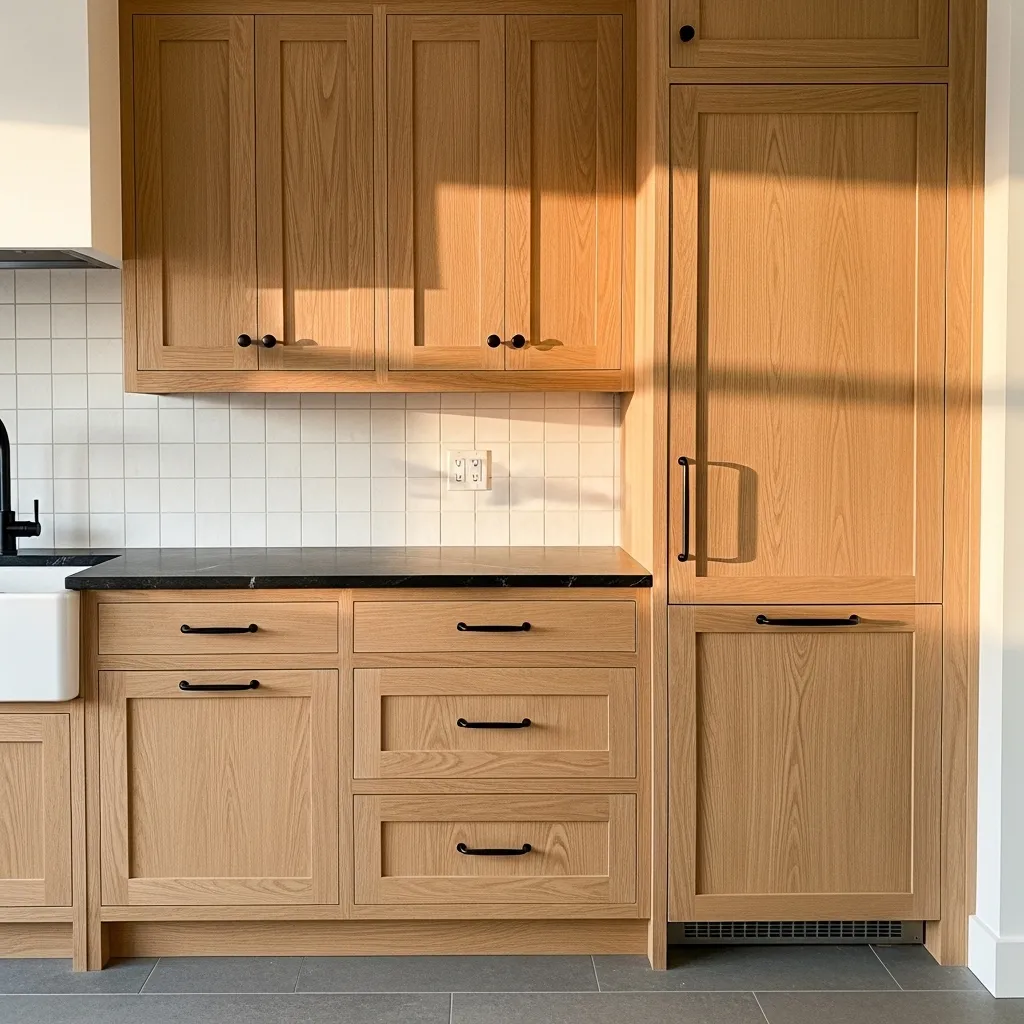
Natural white oak with honed black soapstone countertops is the material pairing that creates the most immediate and most visually dramatic rustic modern kitchen moment available in wood cabinetry — the warm, honey-pale grain of the oak against the deep, matte black-grey of the soapstone creates a contrast so clean and so resolved that it requires almost nothing else. The countertop does the dramatic work; the oak provides the warmth; everything else — the handmade tile backsplash, the matte black hardware, the concrete floor — is simply in support of that primary material conversation rather than competing with it.
Honed soapstone specifically is the countertop material that pairs most beautifully with natural white oak because its specific quality of warmth differentiates it from the cooler, harder darkness of black granite or black quartz — soapstone has a softness and a warmth in its matte surface that granite’s crystalline hardness lacks, and that warmth connects it to the oak’s organic warmth rather than creating a cold-versus-warm material tension. Soapstone also develops patina and character with oil treatment over time, deepening and warming as it ages, which means a soapstone countertop on white oak cabinetry is a material combination that becomes more beautiful and more characterful with use rather than simply maintaining its initial quality.
2. Wire-Brushed White Oak for Maximum Texture
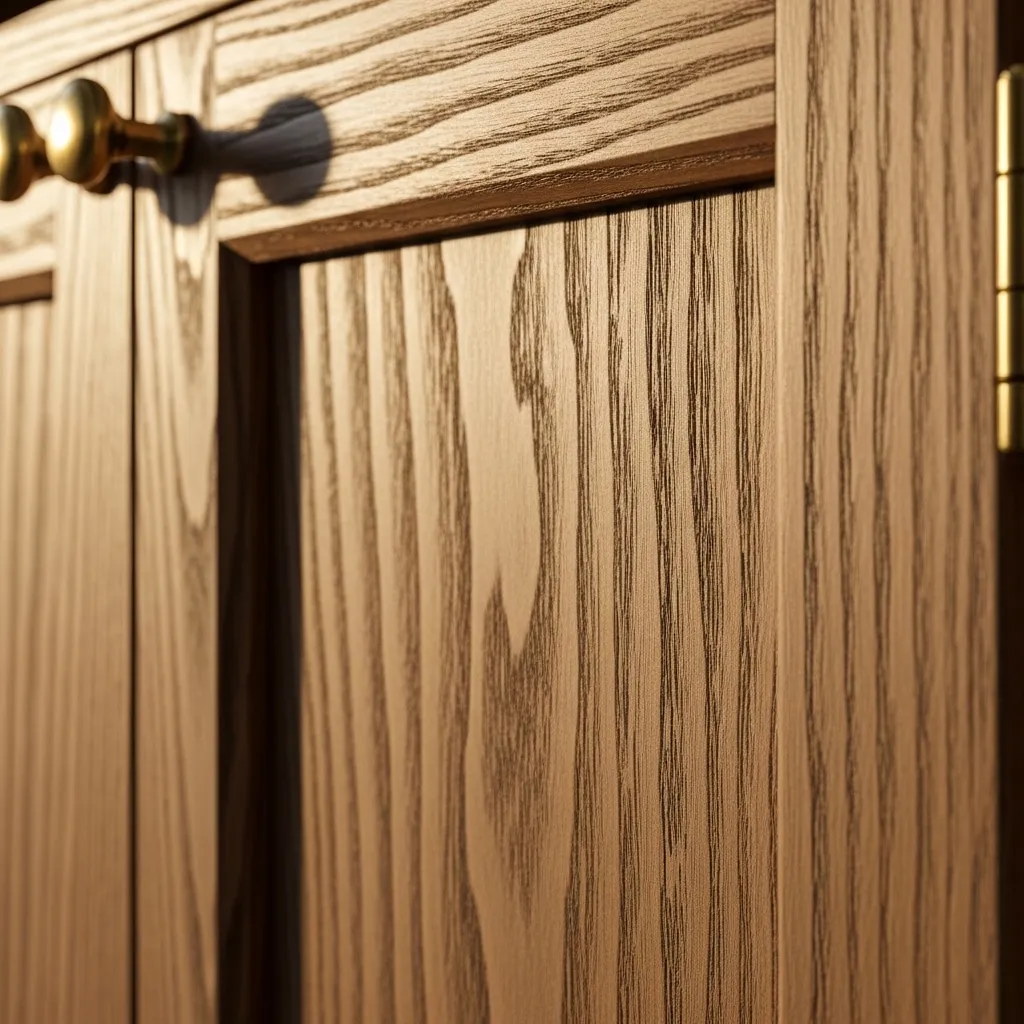
Wire-brushed white oak cabinetry — where the softer early wood between grain lines has been mechanically removed to create a physically textured surface — takes the visual interest of natural white oak and adds a tactile dimension that flat-sanded cabinetry lacks, creating cabinet faces that reward touch as much as sight and that change character dramatically depending on the direction and quality of the light falling on them. In raking afternoon light, the wire-brushed surface creates deep shadow in the grain valleys and bright highlights on the grain ridges, making the wood appear almost three-dimensional. In flat overhead light, the same surface appears quieter and more uniform. This light-responsive quality is the specific characteristic that makes wire-brushed white oak the most atmospherically alive of all cabinet finishes.
The wire-brushing process also enhances the visual depth of white oak’s characteristic ray fleck — the silver-grey rays that run across the grain appear more dimensional in a wire-brushed surface because the brushing creates slightly different textures across the ray versus the surrounding grain, and that textural differentiation makes the ray pattern more visible and more beautiful. A wire-brushed white oak cabinet front in direct afternoon light is one of the most genuinely beautiful surfaces in contemporary kitchen design.
3. White Oak With Warm White Plaster Walls
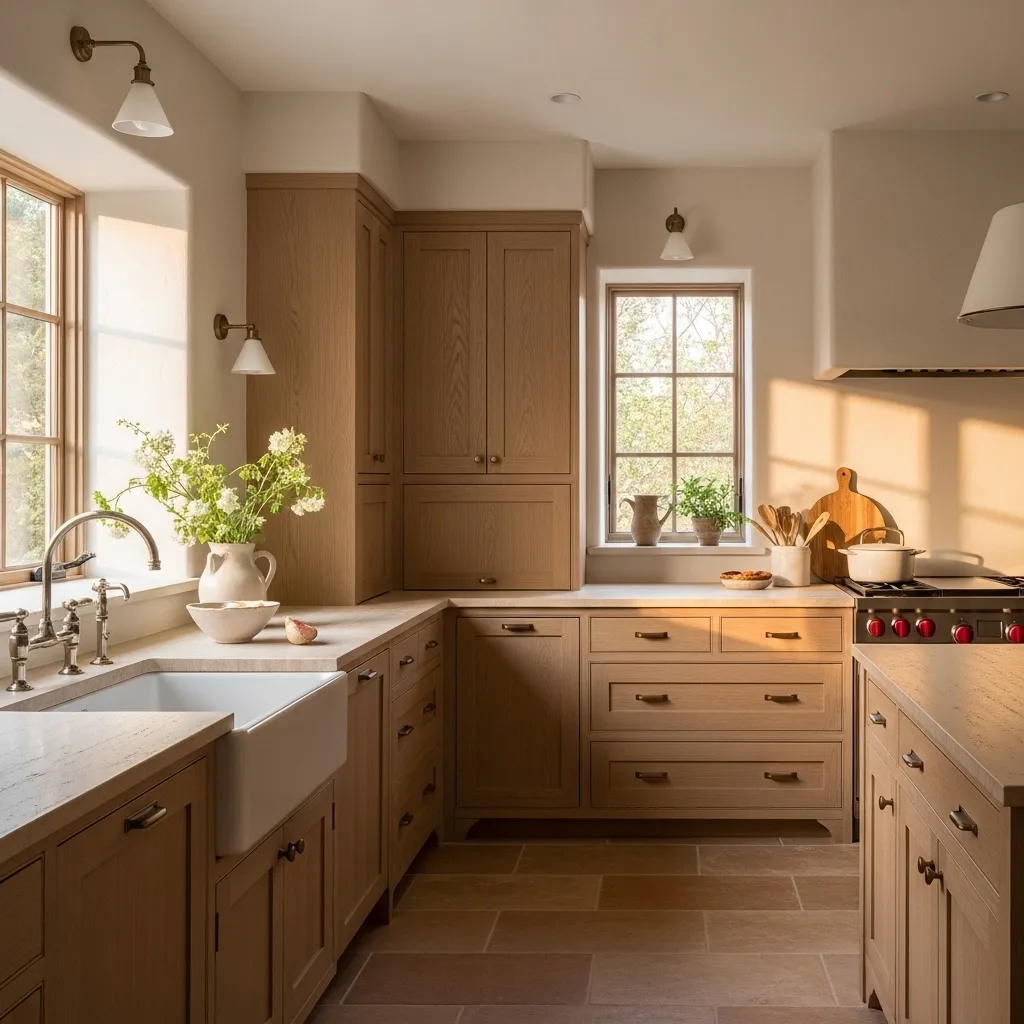
White oak cabinetry against warm Italian plaster walls creates the most completely warm and most completely natural kitchen environment available in contemporary design — both materials are warm, both are organic in origin, both are applied or finished by hand and carry the evidence of that handwork in their surface quality, and together they create a kitchen that feels genuinely ancient in the best possible way, as though it has been in continuous comfortable use for generations rather than recently renovated.
The specific quality of warm Italian plaster that makes it such a successful partner for white oak is its slight tonal variation — unlike painted walls, which are perfectly uniform in tone and create a flat backdrop that the cabinetry sits against without engagement, plaster walls have areas of slightly warmer and slightly lighter tone across their surface that create a living backdrop that responds to the same light that illuminates the oak cabinetry. The oak and the plaster both change in apparent tone as the light changes through the day, and this shared light-responsiveness creates a material relationship between them that feels connected and organic rather than simply coordinated.
4. Full-Height White Oak Cabinetry to the Ceiling
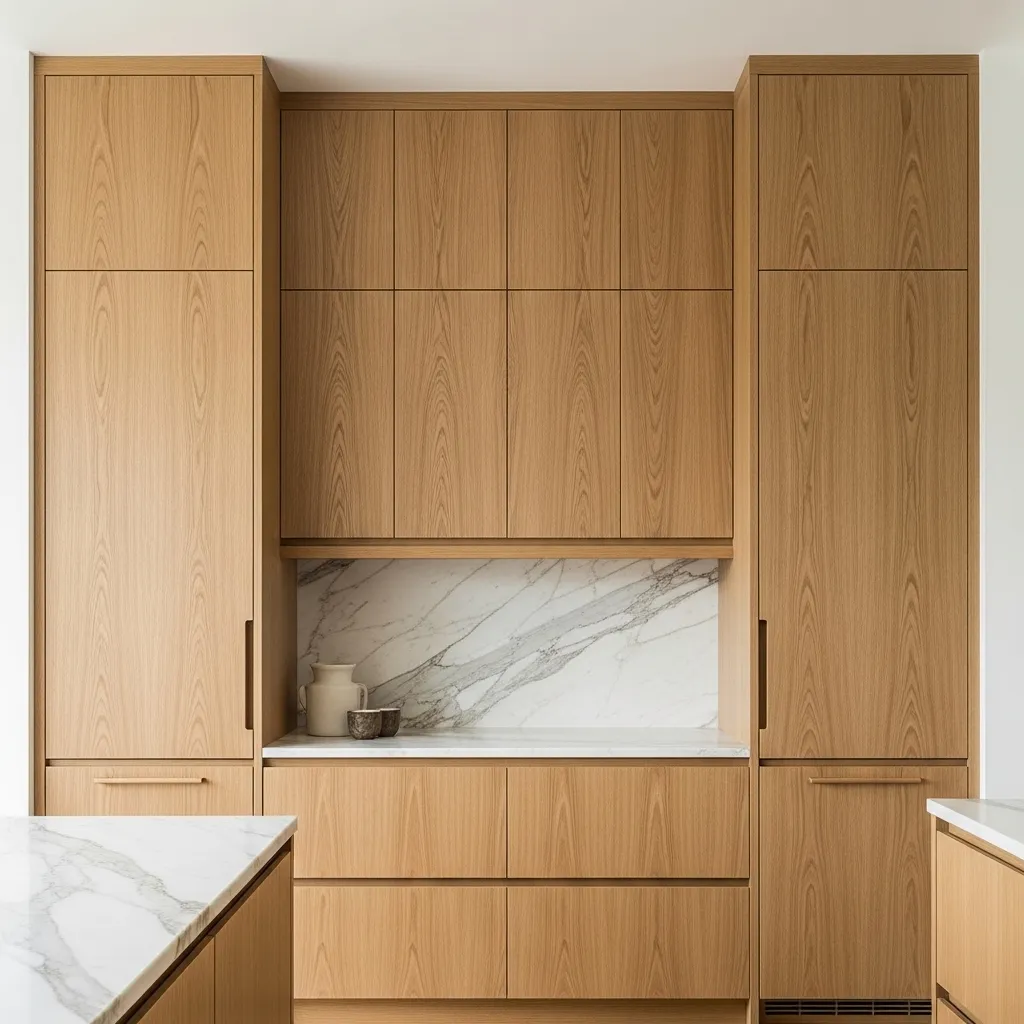
Floor-to-ceiling white oak cabinetry — filling the complete vertical dimension of the kitchen wall without a gap between the upper cabinet tops and the ceiling — creates the most architecturally ambitious and most spatially transformative kitchen cabinet installation available, because it converts the cabinetry wall from furniture to architecture, from something installed in the room to something that defines the room. A wall of wood grain from floor to ceiling is a different category of presence from standard upper-and-lower cabinetry with a soffit gap above — it has the quality of a built-in library, a paneled room, a space that has been specifically designed rather than equipped.
The integrated finger pull — a routed channel along the cabinet edge rather than separate hardware — is the specific detail that makes floor-to-ceiling oak cabinetry read as architecture rather than furniture, because hardware creates visual interruptions in the wood grain that prevent the full wall from reading as a continuous wood plane. Without hardware, the floor-to-ceiling cabinet wall is a continuous surface of warm oak grain from baseboard to ceiling, and that continuity is what creates the architectural quality. The integrated pull also requires precise routing and precise fitting of the cabinet doors to make the routed channel both functional and beautiful — it’s a detail that demands excellent craftsmanship and rewards it with the most beautiful possible result.
5. White Oak Island Against Painted Perimeter Cabinetry
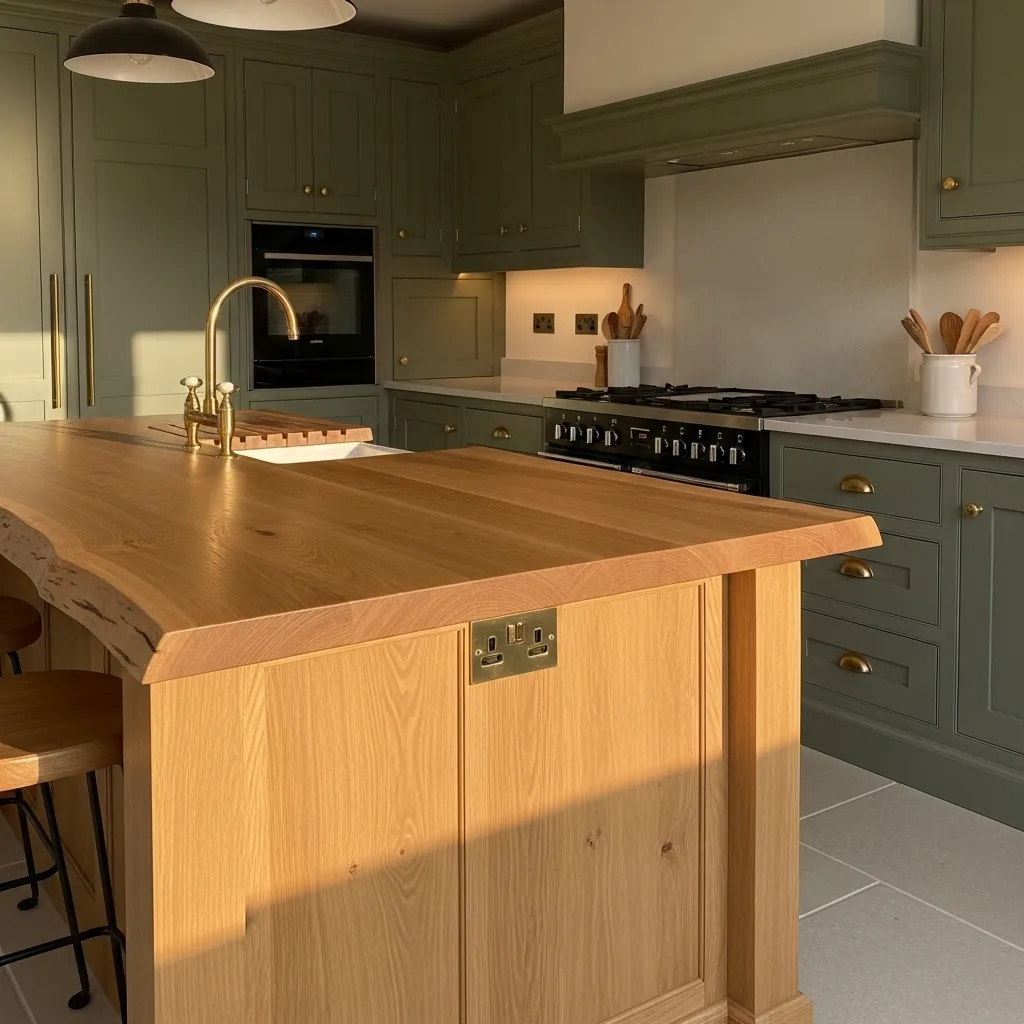
A white oak island against painted perimeter cabinetry creates the most dynamic and most visually interesting kitchen configuration available — it gives the kitchen’s primary social and functional piece the warmth and natural character of real wood grain while allowing the perimeter cabinetry to provide color, sophistication, and visual anchoring without the painted cabinets competing with the wood for primacy. The island is the warm, natural, approachable center; the perimeter is the sophisticated, colored, architectural envelope; and the contrast between them creates a kitchen with genuine visual complexity that a all-oak or all-painted kitchen can’t achieve.
The sage green and white oak combination is the specific pairing that has most completely defined this configuration’s aesthetic in 2026 — the warm grey-green of sage connects to the warm grey-brown of white oak’s undertone in a color relationship that feels specifically natural and specifically botanical, as though both materials came from the same forest and are simply different aspects of it. The sage green reads as neither too cool (avoiding blue-green tones) nor too warm (avoiding yellow-green tones) in relation to the white oak, creating a combination that appears as though it was always the only possible choice rather than one of many options.
6. Fumed White Oak for a Dramatic Darker Character
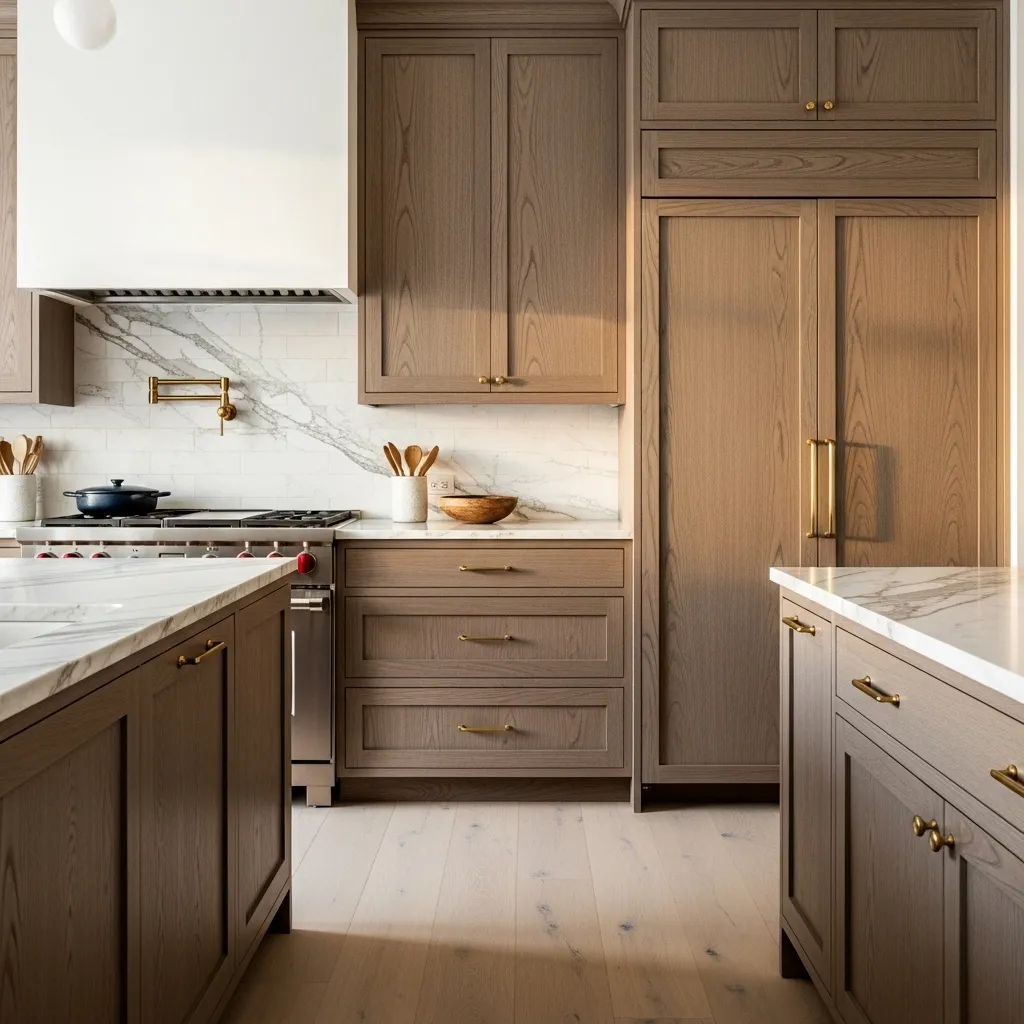
Fumed white oak cabinetry — where the oak has been darkened through exposure to ammonia vapors that react with the wood’s natural tannins to produce a deep warm grey-brown — creates a kitchen with entirely different character from pale natural white oak while retaining the grain pattern and organic quality that makes white oak beautiful. Fuming deepens and enriches the grain pattern rather than obscuring it — the reaction with tannins is uneven in exactly the way that natural wood is uneven, following the grain rather than sitting on top of it, and the result is a surface that appears to have aged and deepened naturally over many years rather than having been stained or colored artificially.
The fumed white oak tone — that specific deep warm grey-brown that’s neither grey nor brown but specifically the color that emerges when white oak’s natural chemistry interacts with ammonia — is a color that has no manufactured equivalent and cannot be replicated by staining. This uniqueness and specificity is part of what makes fumed oak kitchens feel so distinctly different from standard stained or painted cabinetry — the material tells the story of its own making in a way that purchased color can’t, and that story is part of what makes the kitchen feel genuinely natural and genuinely honest rather than designed to appear natural.
7. White Oak Open Shelving Kitchen
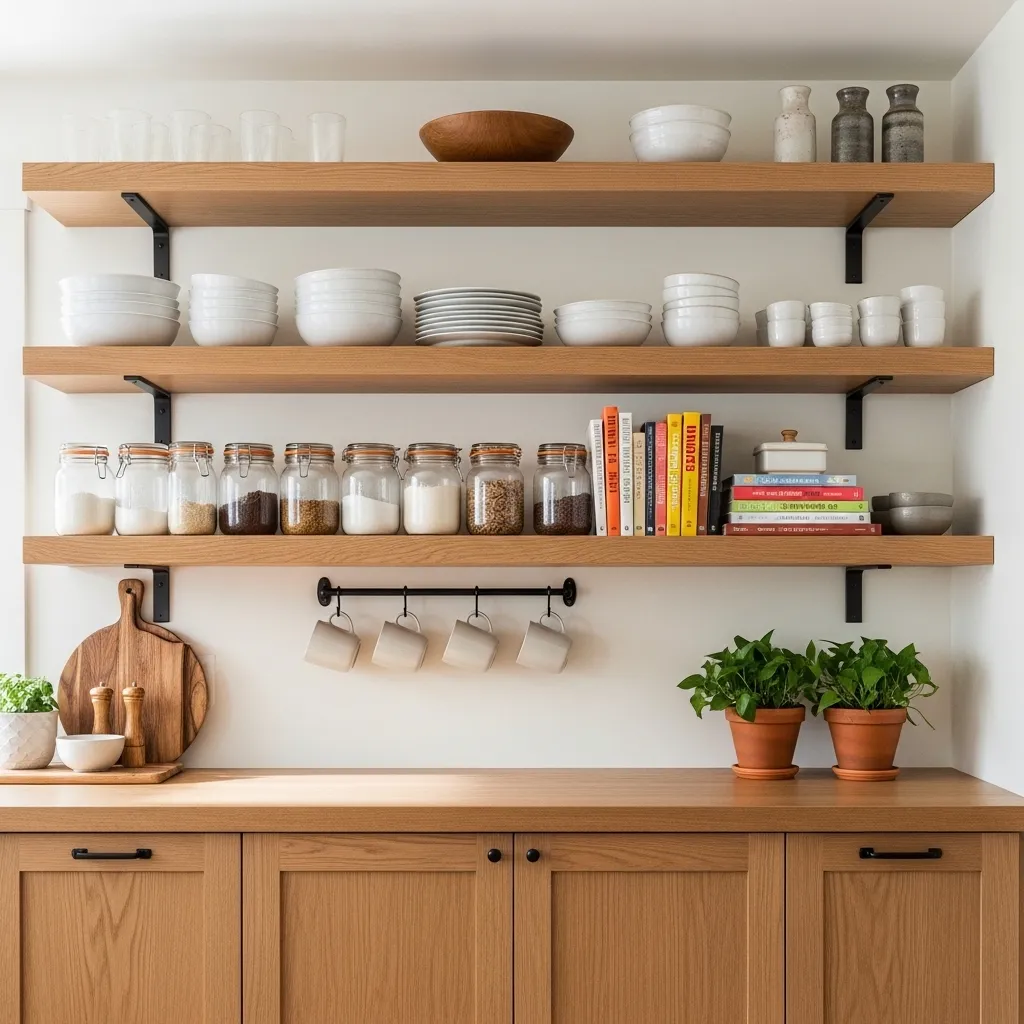
White oak open shelving replacing upper wall cabinets creates the kitchen upper zone that feels most personal, most lived-in, and most warmly domestic — because the displayed objects on open shelves communicate the specific tastes and specific kitchen life of the people who cook there in a way that closed cabinet doors entirely conceal. A kitchen with white oak open shelving above and white oak closed cabinetry below creates a beautifully organized hierarchy between display and storage — the beautiful and frequently used objects displayed at eye level on the warm oak shelves, the less beautiful or less frequently used items stored in the closed cabinetry below.
The specific quality of white oak as an open shelving material is that the shelf itself is always visible as the backdrop against which the displayed objects are seen — unlike painted white shelves that recede into the wall, white oak shelves are warmly present as a surface in their own right, and the objects displayed on them are seen against a warm wood backdrop rather than a neutral white one. This means the kitchen objects — the white ceramic dishes, the clear glass jars, the ceramic mugs — appear warmer and more beautiful on white oak shelves than they do on white painted shelves, because the warm wood backdrop enriches their color and material quality rather than simply providing a neutral surface.
8. White Oak With Zellige Tile Backsplash
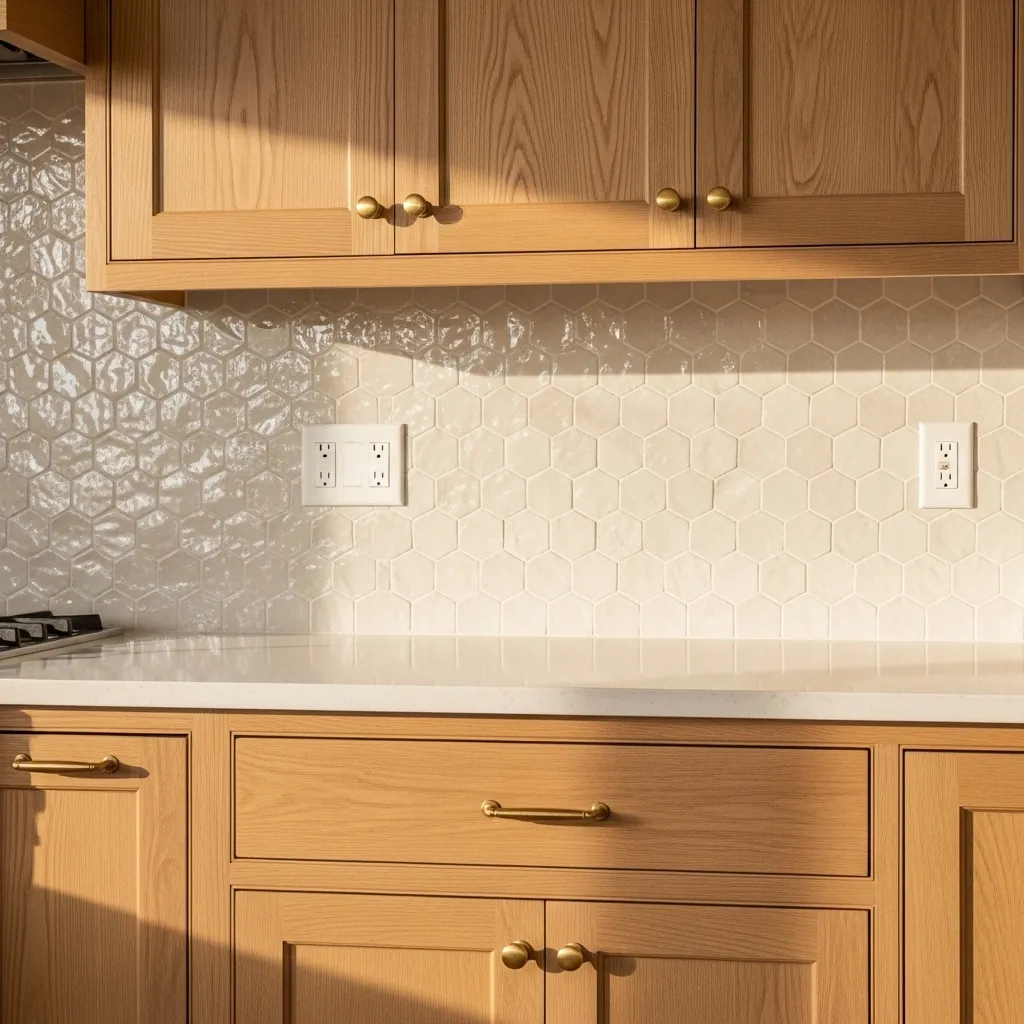
White oak cabinetry with a Moroccan zellige tile backsplash creates the kitchen’s most texturally rich material moment — the smooth, slightly open grain of the white oak below and the highly reflective, irregular handmade surface of the zellige above create a textural conversation between organic warmth and handmade luminosity that makes the backsplash zone the most visually alive section of the kitchen. The zellige tile’s quality of catching and scattering light from its many slightly different-angled surfaces creates a surface that appears to glow from within in a way that no manufactured tile can replicate.
The warm off-white tone of zellige tile is the specific color that creates the most beautiful relationship with white oak — not bright white, which would create a high-contrast separation between the tile and the wood, but the warm, slightly cream-toned off-white that shares the oak’s warmth direction while being clearly a different material. The zellige tile at this tone appears almost as though it has captured the oak’s warmth in a ceramic form, creating a backsplash that feels specifically connected to the cabinetry material rather than independently chosen.
9. White Oak With Integrated Appliances
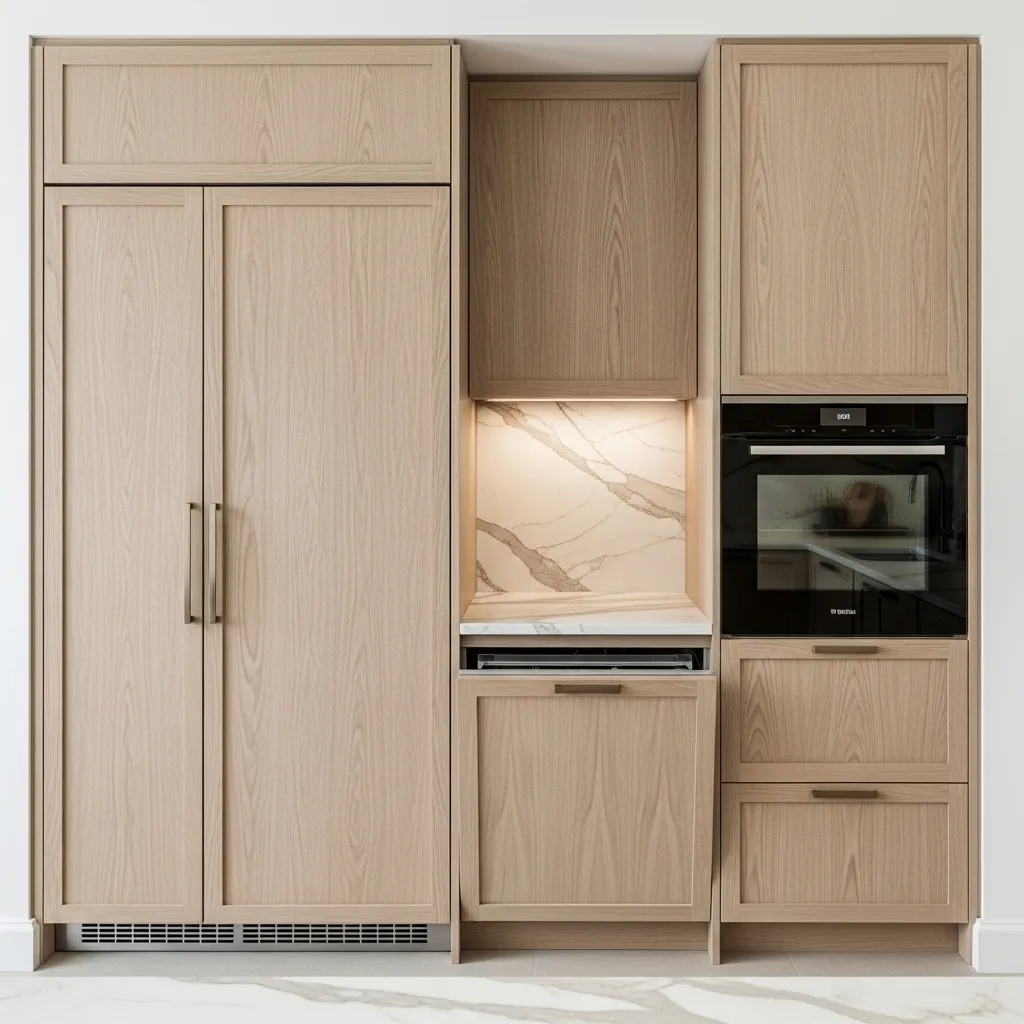
White oak panel-fronted integrated appliances create the most seamless and most architecturally resolved kitchen available — by covering the refrigerator, dishwasher, and any other appliance with white oak panels that match the surrounding cabinetry in grain direction, tone, and profile, the appliances become invisible elements of the wood wall rather than visual interruptions of it. The kitchen transforms from a room equipped with appliances to a room defined by a continuous warm wood surface that happens to contain all the functional equipment of a modern kitchen within it.
The panel-front integration requirement for white oak specifically is that the grain direction and grain match between the appliance panels and the surrounding cabinetry is managed carefully — white oak’s distinctive grain pattern means that panels cut from different boards or in different orientations will read as clearly different even at the same tone, which can make integrated appliances more visible rather than less. The best panel-front integration uses panels cut from the same batch of wood as the surrounding cabinetry and oriented in the same grain direction, so that the continuity of grain across the appliance panel and adjacent cabinet door is as close to seamless as the material allows.
10. White Oak and Warm Brass — The Defining Combination
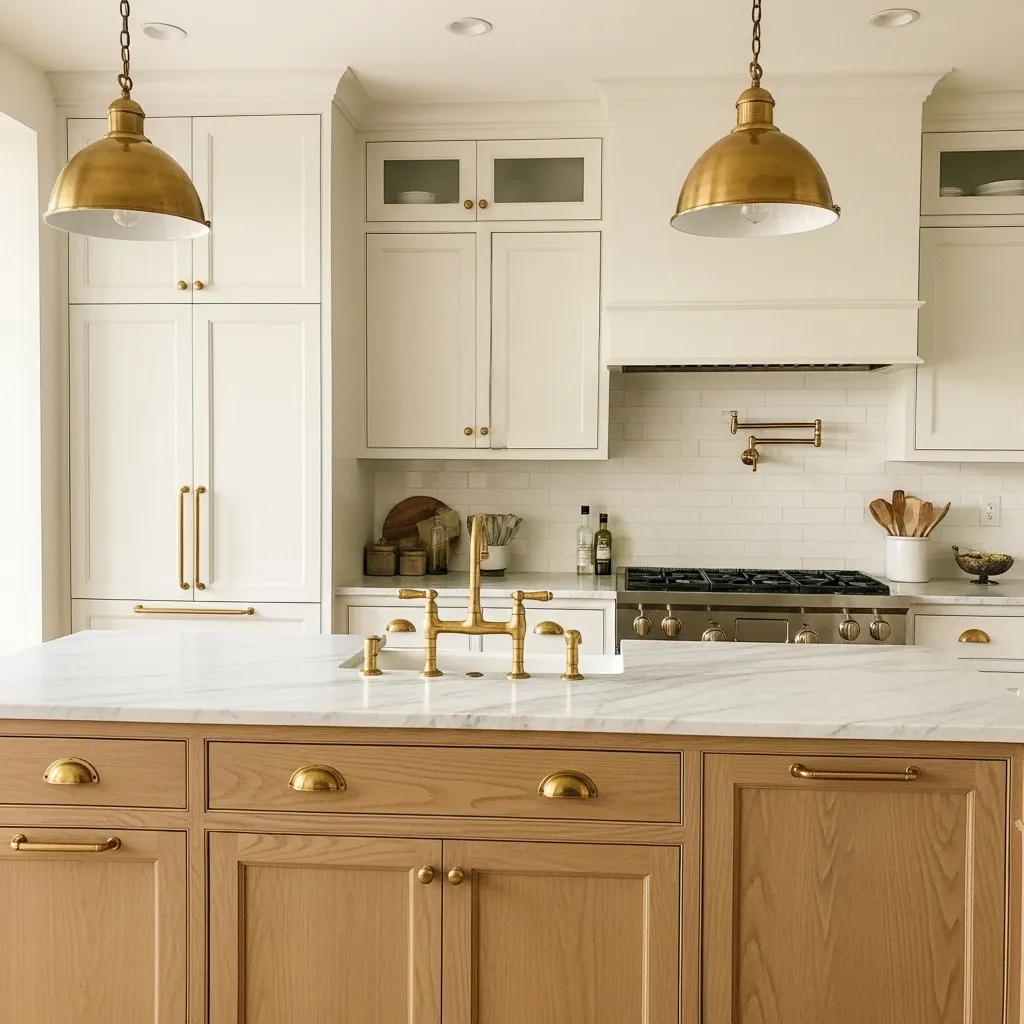
White oak and unlacquered brass is the material combination that most completely and most consistently defines the contemporary natural kitchen aesthetic of 2026 — the warm grain of the oak and the warm amber of the brass speak the same language of organic warmth, with the brass providing the metallic precision and reflective quality that makes the matte wood grain appear richer by contrast. No other hardware finish creates the same quality of warmth and complementarity with white oak — polished chrome is too cool and too hard, brushed nickel is too cool and too restrained, matte black creates beautiful contrast but a different aesthetic character, and satin brass is close but lacks the specific depth and aging quality of unlacquered.
Unlacquered brass specifically — brass that has not been coated with a protective lacquer and therefore ages naturally through exposure to air, moisture, and touch — is the hardware material that creates the most beautiful relationship with white oak over time, because both materials age in the same direction. White oak deepens and warms slightly as it ages and oils build up in the grain; unlacquered brass develops a deeper, more complex patina as the oxidation enriches and darkens the surface. A kitchen installed with white oak and unlacquered brass in year one looks different and more beautiful in year five, and more beautiful again in year ten — both materials doing what natural materials do, which is improving with the evidence of time and use.
11. Two-Tone White Oak — Natural Upper, Darker Lower
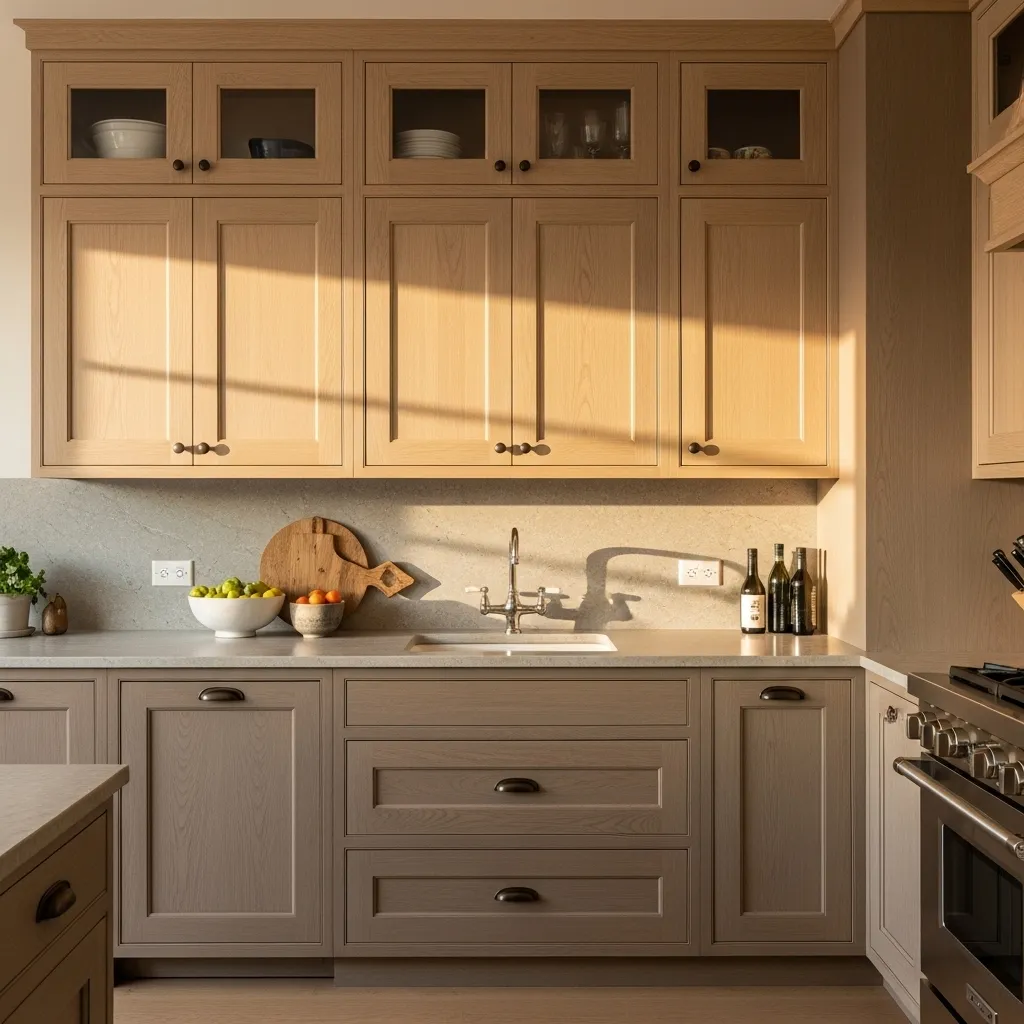
A two-tone white oak kitchen using natural upper cabinets and slightly darker fumed or stained lower cabinets creates the most materially cohesive version of the two-tone kitchen configuration — because both tones are the same species of wood with the same grain character, the tonal difference reads as a deliberate finish variation rather than a material change, and the kitchen maintains a quality of material unity that natural-upper-and-painted-lower configurations lose. The viewer understands that both cabinet zones are white oak; what changes is the finish, and that change is read as a design decision rather than a material inconsistency.
The tonal relationship between the natural upper and the darker lower cabinet is the proportion decision that most determines how the two-tone reads — the lower cabinet should be clearly darker than the upper without being so dark that the grain pattern becomes obscured. A natural oak upper at tone level three and a fumed lower at tone level six creates a relationship that’s clearly different while remaining clearly the same species; a natural oak upper at tone level three and a near-black lower at tone level ten creates a relationship where the species similarity is much harder to read and the kitchen reads as mixed material rather than two-tone wood.
12. White Oak With Concrete Countertops and Industrial Accents
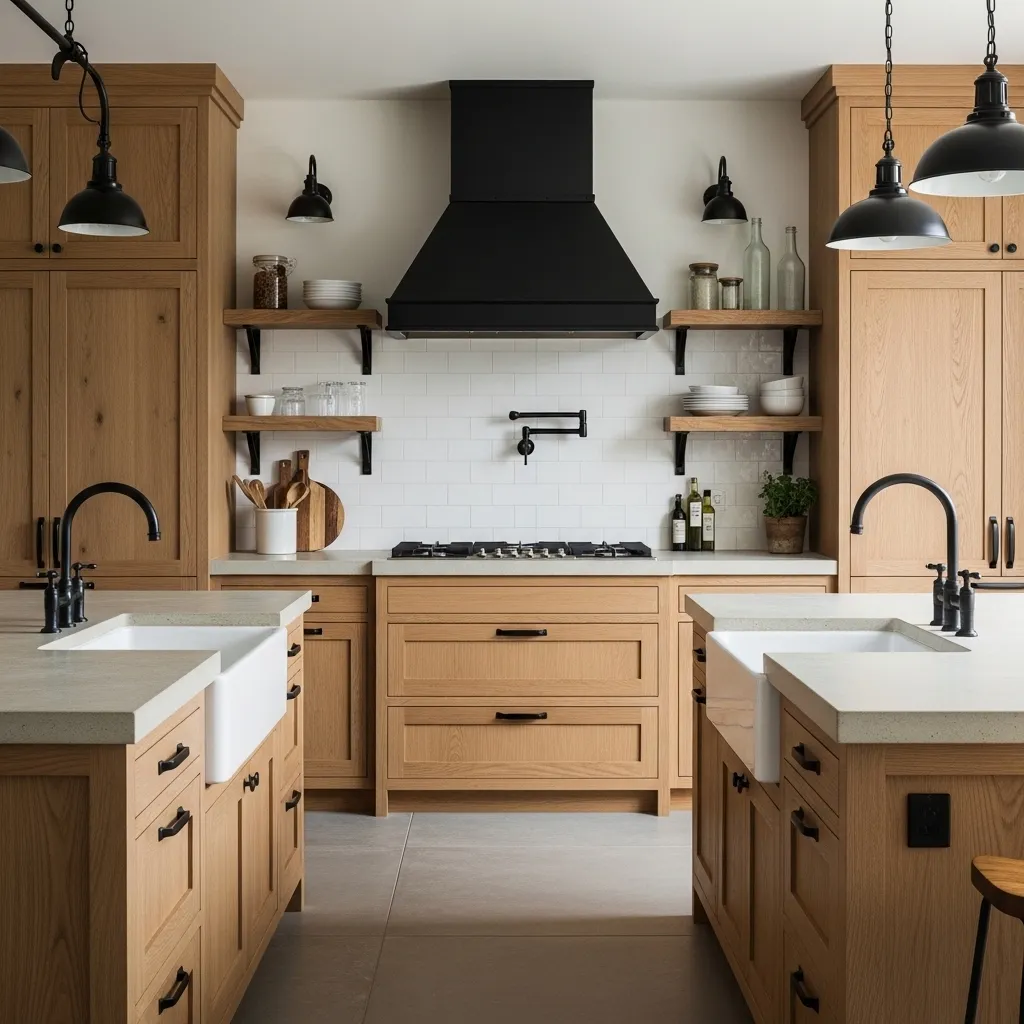
White oak cabinetry with warm concrete countertops and matte black industrial accents creates the kitchen aesthetic that most successfully bridges the rustic warmth of natural wood with the industrial precision of contemporary material choices — the oak provides the organic warmth and natural character, the concrete provides the modern material honesty and weight, and the matte black industrial accents provide the contemporary graphic precision that prevents the oak-and-concrete combination from reading as purely rustic.
The warm concrete in a sand-and-cream tone is the specific concrete specification that works best with white oak because it shares the oak’s warm undertone rather than creating a cool-versus-warm material tension. Cool grey concrete against white oak creates a slightly uncomfortable temperature conflict where the concrete reads as modern-cool and the oak reads as natural-warm and the two pull in different atmospheric directions. Warm concrete at the same warm-tan tone family as the oak creates a material relationship where both surfaces are warm and natural and the difference between them is one of material character — wood versus stone — rather than color temperature.
13. White Oak With Fluted or Reeded Details
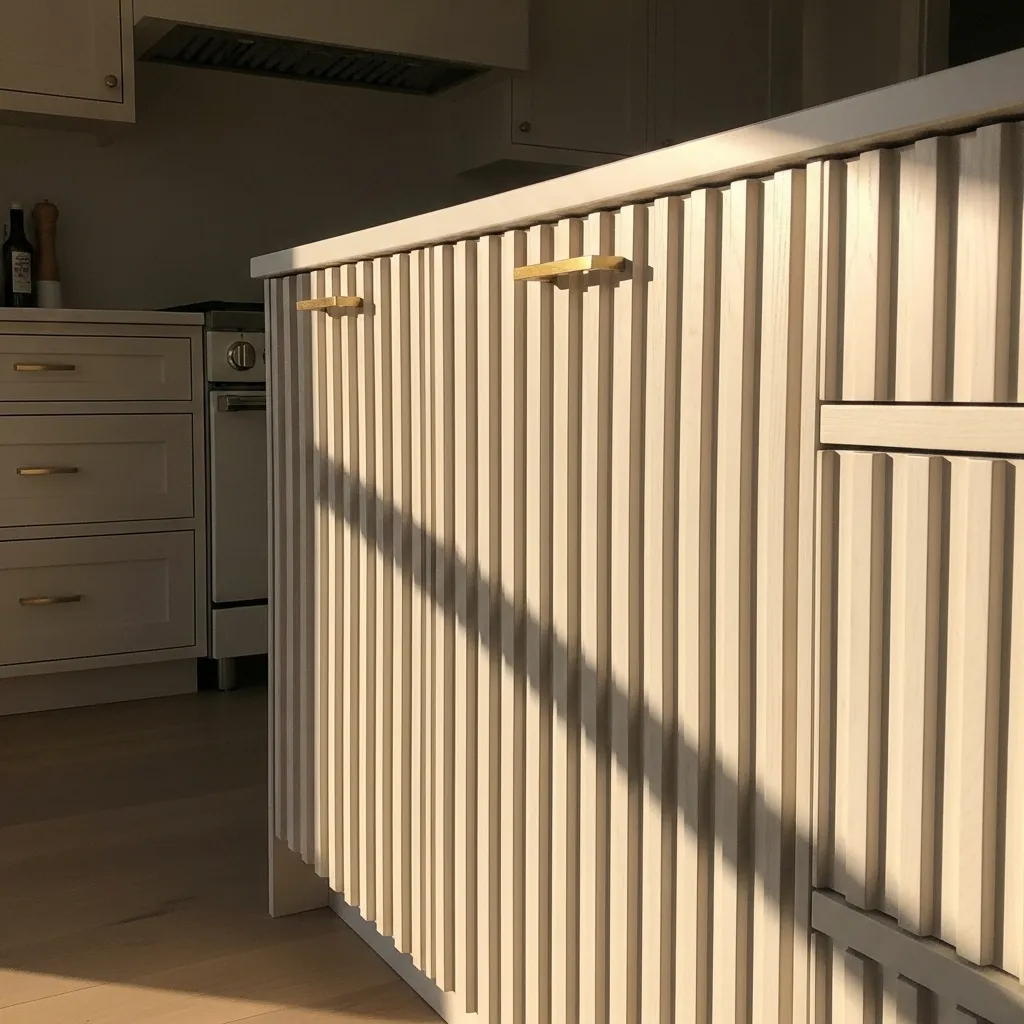
Fluted or reeded white oak cabinet fronts — where vertical channels have been routed into the wood surface to create a dimensional, ribbed texture — take the natural visual interest of white oak grain and add an architectural dimension that flat cabinet faces lack, creating cabinet fronts that are genuinely sculptural in their quality and that change character dramatically with the direction of the light falling on them. Raking afternoon light on fluted white oak creates a surface of strong shadow and highlight that makes the cabinet fronts appear almost three-dimensional, as though the wood has been carved rather than routed; flat overhead light creates a quieter surface where the flute pattern is present but less dramatic.
The strategic application of fluting — on the island alone rather than throughout the kitchen, or on the lower cabinets only, or on a single feature cabinet section — creates a focal point within the kitchen that draws the eye and communicates design intention without making the kitchen feel over-worked. A fully fluted kitchen (every cabinet front fluted) can feel visually busy and can make the kitchen feel like it’s trying too hard; a selectively fluted kitchen where the fluting appears on the most significant piece (the island, the pantry column, the range surround) creates a kitchen where the fluted detail is a designed moment rather than an overall aesthetic.
14. White Oak in a Handleless Contemporary Kitchen
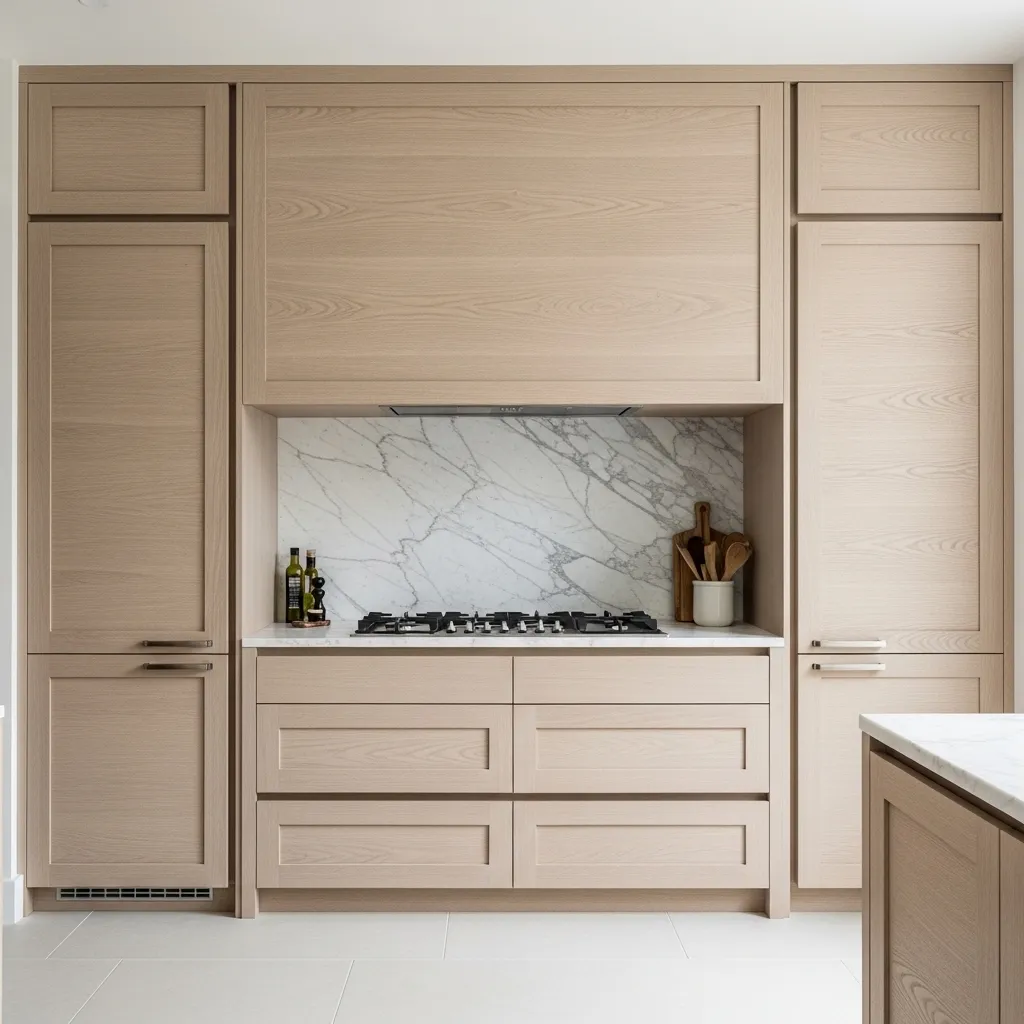
Handleless white oak cabinetry — using push-to-open mechanisms or integrated grip edges that eliminate visible hardware entirely — creates the most contemporary and most architecturally resolved expression of white oak cabinetry available, because it allows the wood grain to be the uninterrupted primary surface of the kitchen without hardware punctuating it at regular intervals. The handleless kitchen creates a surface of continuous warm wood grain from one end of the kitchen wall to the other, and that continuity is what makes it read as architectural rather than just as good cabinetry.
The push-to-open mechanism is the specific hardware that makes truly handleless white oak cabinetry possible — the touch-to-open spring mechanism requires a precise cabinet installation where the door face sits perfectly flat in the cabinet frame, because any misalignment prevents the mechanism from operating smoothly. This precision requirement means that handleless white oak cabinetry is a reliable indicator of excellent cabinet making — the mechanism only works well when everything is exactly right — and that functional precision creates a kitchen where the perfect flatness and perfect alignment of the cabinet faces communicates craftsmanship and quality as clearly as any visible hardware detail could.
15. The Full White Oak Kitchen — Ceiling, Island, Cabinets, and Shelving
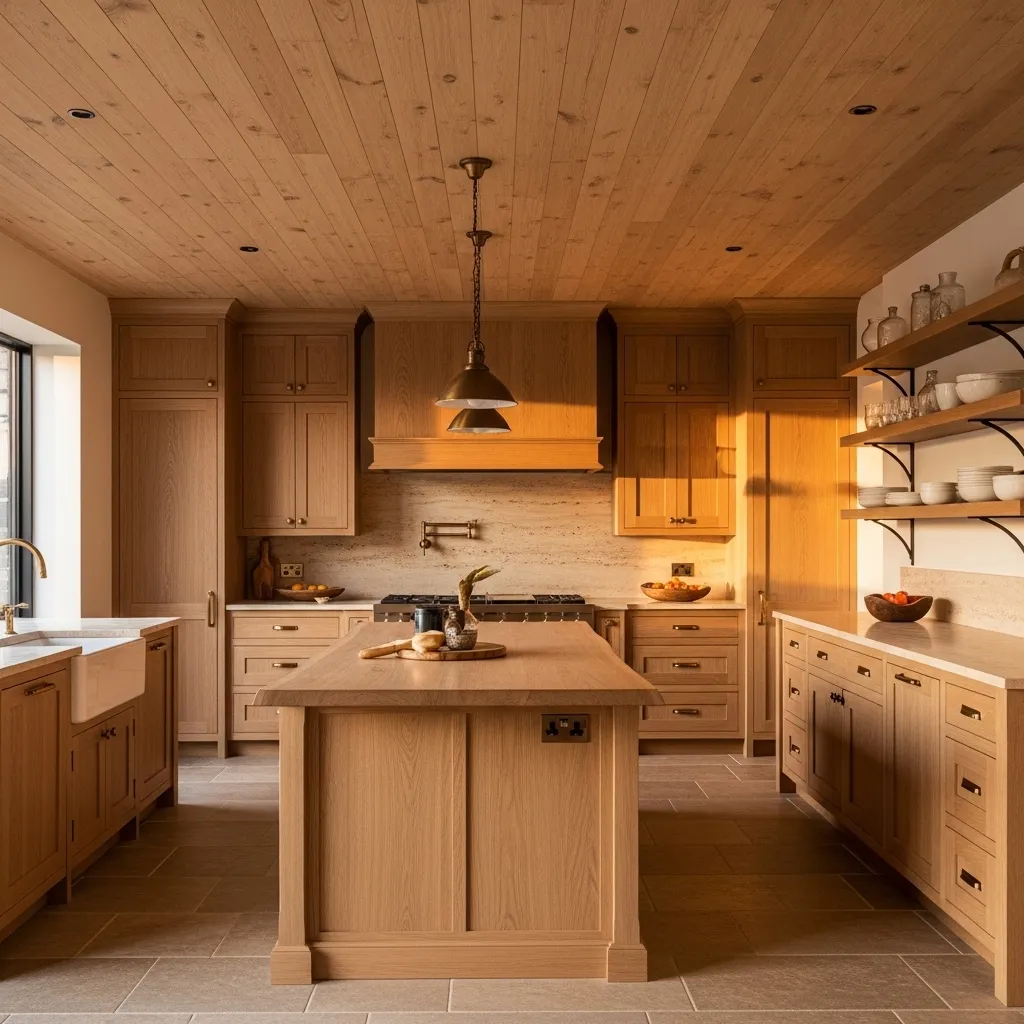
A fully committed white oak kitchen — where oak appears on the ceiling, the cabinetry, the island, and the open shelving simultaneously — creates the most immersive and most extraordinary wood kitchen environment available, a space that feels like being inside a beautiful handmade wooden object rather than a room equipped with wooden furniture. The quality of being surrounded by warm wood grain on every surface that can be wood is a specific sensory and atmospheric experience that partial wood treatments approach but never fully achieve, because it’s the completeness of the wood envelope — above, beside, and all around — that creates the specific quality of warmth and enclosure that makes a fully committed wood kitchen so genuinely extraordinary.
The design challenge of an all-oak kitchen is preventing the uniformity of a single material from reading as monotonous — which requires ensuring that the stone countertops, the floor material, and the wall surfaces not covered by cabinetry provide genuine material contrast that makes the oak appear richer and more vivid than it would in an all-oak room with no contrasting materials. The warm travertine countertop, the stone tile floor, and the painted or plastered wall surfaces between and beside the cabinetry all serve this function — they’re not interruptions of the oak aesthetic but the contrasting materials that allow the oak to be fully appreciated, the other instruments in the orchestra that allow the primary voice to be most clearly heard.