14 Winter Mantle Ideas That Make Your Fireplace the Most Beautiful Spot in the House
If your mantle has been sitting there looking like it hasn’t been thought about since the holiday decorations came down, you’re genuinely missing one of the best decorating opportunities in your entire home — because a winter mantle that isn’t specifically Christmas still has so much potential, from layered candle arrangements in varying heights and warm amber vessels, to dried botanical displays, cozy plaid and tartan textile draping, dramatic oversized mirror moments, branch and twig installations that bring the outside in, moody dark and moody greenery arrangements, copper and bronze metallic tablescapes, vintage collected object displays, eucalyptus and dried flower compositions, gallery wall mantles with a rotating winter print collection, and hygge-inspired setups with so many candles they look like a scene from a Nordic fairytale. The ideas here span every aesthetic from modern minimalist to maximalist traditional, from rustic farmhouse to sophisticated urban — because winter is long and your mantle should feel like it belongs to the season in a way that’s personal and considered rather than just a placeholder between Christmas and spring.
There’s a particular kind of magic that happens around a decorated fireplace mantle in winter that doesn’t exist at any other time of year — something about the combination of real or imagined heat, the flickering of candles, the gathered objects at eye level in a room where everyone naturally faces that wall, all of it creates a focal point that carries enormous emotional weight in a home. I’ve had years where the mantle was an afterthought and years where I genuinely invested time and thought into it, and the difference in how the living room felt throughout January, February, and March was significant enough that I’ve never gone back to treating it casually. A winter mantle done with intention sets the whole tone of a room for months.
What separates a winter mantle that looks genuinely beautiful from one that looks like a collection of random objects placed near a fireplace is editing, height variation, and a point of view. You need a tall element, a medium element, and a low element to create visual rhythm. You need a cohesive color story — even a loose one — that ties the objects together. And you need to make a decision about the aesthetic you’re going for and commit to it rather than mixing too many directions. These fifteen ideas all have those qualities — they’re specific, they’re considered, and every single one of them is achievable without a design degree or an unlimited budget.
1. Layered Candle Collection in Amber and Bronze
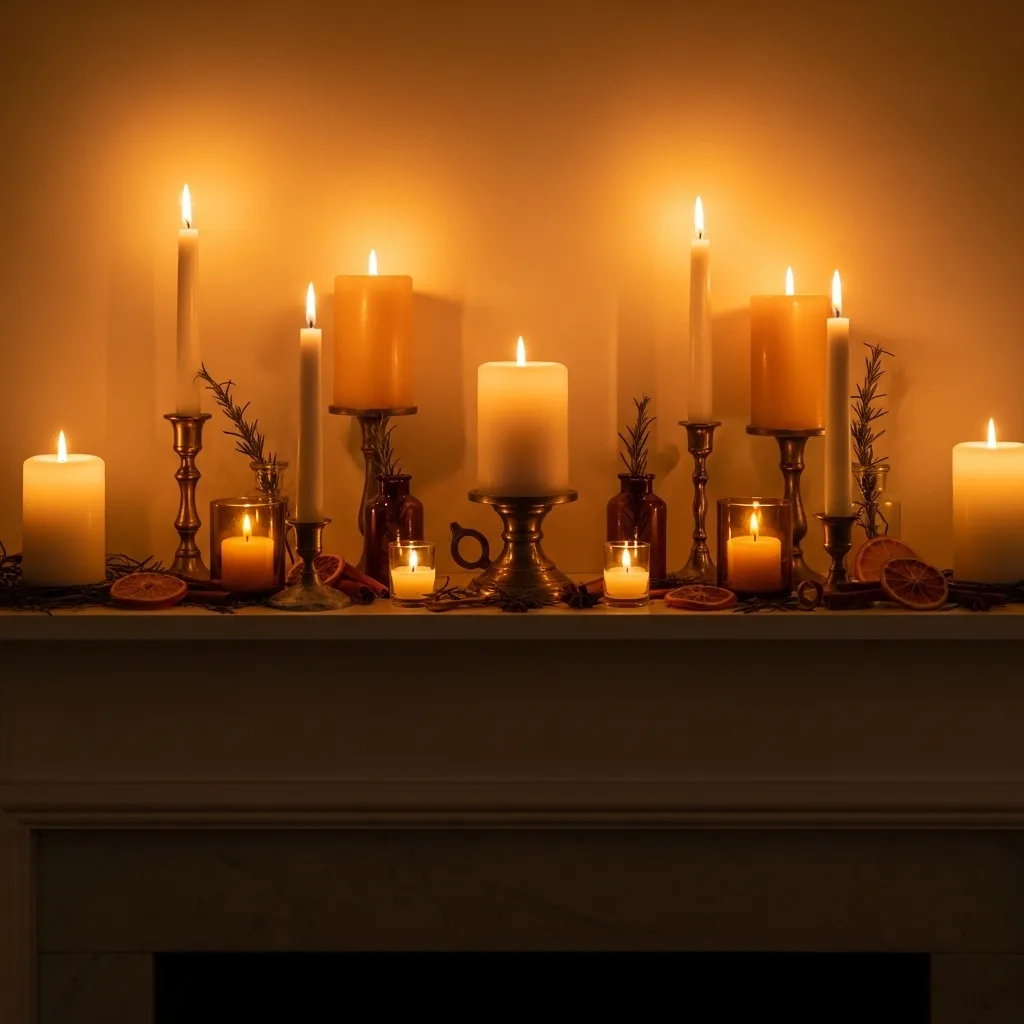
Image Prompt: A warm, glowing winter mantle photographed in dim evening light with no overhead lighting, lit entirely by the warm amber glow of multiple candles of varying heights arranged across the mantle shelf. Pillar candles in ivory, cream, and beeswax yellow stand at different heights on simple candlestick holders in aged bronze and tarnished brass. Votive candles in amber glass vessels are nestled between the pillars. A large church candle in a heavy bronze holder anchors the center. Dried orange slices, cinnamon sticks, and small sprigs of dried rosemary are scattered between the candles. The fireplace surround is pale marble and the mantle shelf is warm white painted wood. The camera shoots from mid-height, straight-on, capturing the full warm glow of the candle arrangement.
A mantle lit entirely by candles in the deep winter evening is one of the most genuinely beautiful domestic scenes you can create — the amber light, the varying heights of the flames, the warmth radiating from the fireplace below all combine into something that feels ancient and comforting in a way that electric light simply cannot replicate. The key to making a candle collection look curated rather than randomly gathered is using vessels in the same metal family — all bronze, all brass, all silver — while varying the height, size, and style of the holders dramatically.
Dried orange slices and cinnamon sticks tucked between the candles add a sensory dimension that makes the mantle feel genuinely seasonal — when the candles warm the dried citrus and spices the subtle fragrance they release is one of those small details that makes a room feel deeply, specifically wintery in the best possible way. It’s the kind of detail that your guests might not consciously notice but that contributes enormously to the overall feeling of warmth and care in the space.
2. Dried Botanical and Branch Installation
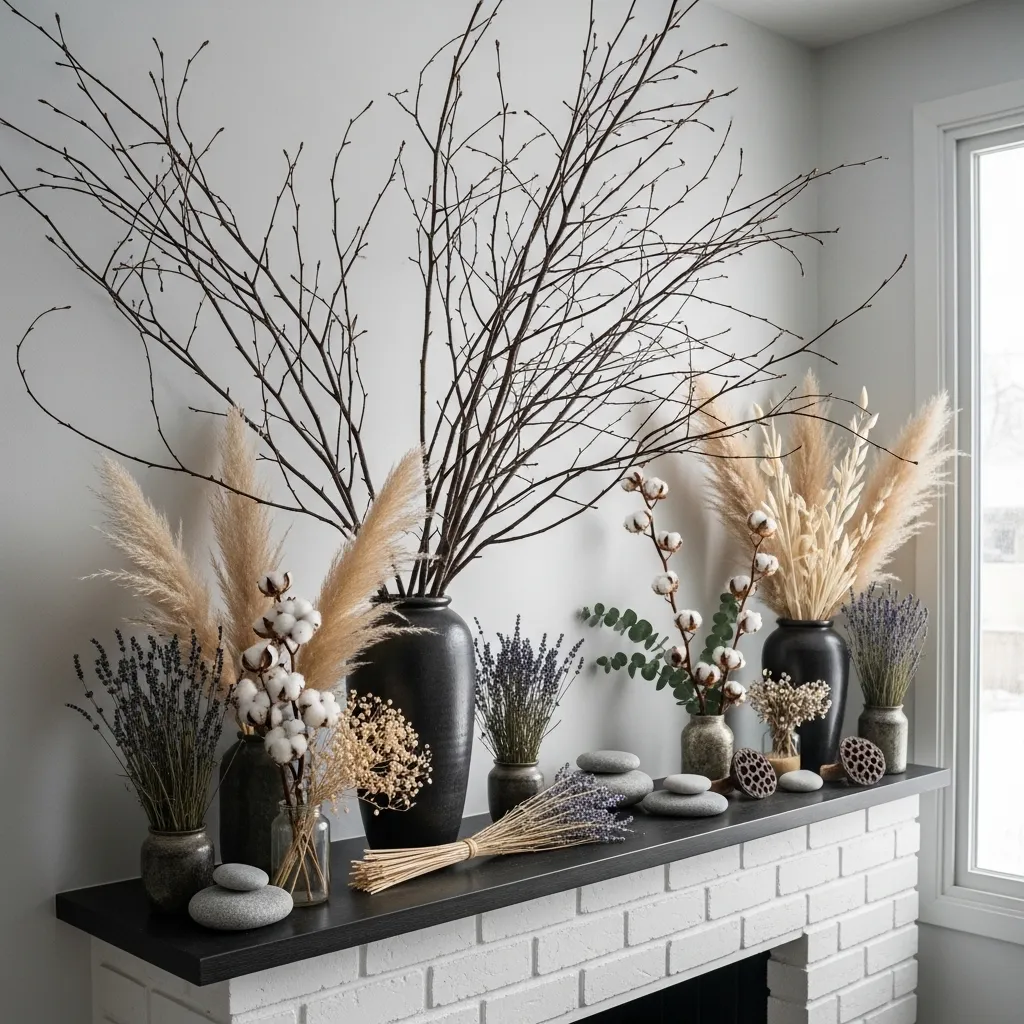
Image Prompt: A sculptural, organic winter mantle featuring a large arrangement of bare birch branches in a tall dark ceramic vase anchoring one end, photographed in soft natural grey winter light from a nearby window. The branches extend upward and outward beyond the mantle edge in a loose, natural composition. Along the mantle shelf, dried pampas grass in cream and warm beige tones fills a shorter vessel. Bundles of dried lavender, dried cotton stems, and preserved eucalyptus are arranged in small vessels between the larger pieces. A few smooth grey river stones and dried seed pods are scattered on the shelf. The mantle surround is white-painted brick. The camera shoots from a three-quarter angle, slightly wide, capturing the full organic sculptural quality of the arrangement.
Bare branches on a winter mantle are one of those ideas that sounds stark until you see it done well — and then the graphic beauty of a sculptural branch arrangement against a pale wall is completely undeniable. Birch branches with their distinctive white bark are particularly beautiful because the bark texture and color adds visual interest that other branch varieties don’t have, and they’re dramatic enough to hold the mantle without needing much supporting material.
The dried botanical companions alongside the branches keep the arrangement from feeling barren — pampas grass, dried cotton stems, preserved eucalyptus, and dried seed pods all have a warm, organic quality that brings softness to what could otherwise be a very spare composition. The whole thing celebrates the actual season outside your window rather than pretending winter doesn’t exist, and there’s something genuinely refreshing about a mantle that leans into the stripped-back beauty of bare trees and dried plants rather than fighting against it with forced color and artificial abundance.
3. Moody Greenery and Dark Taper Candle Mantle
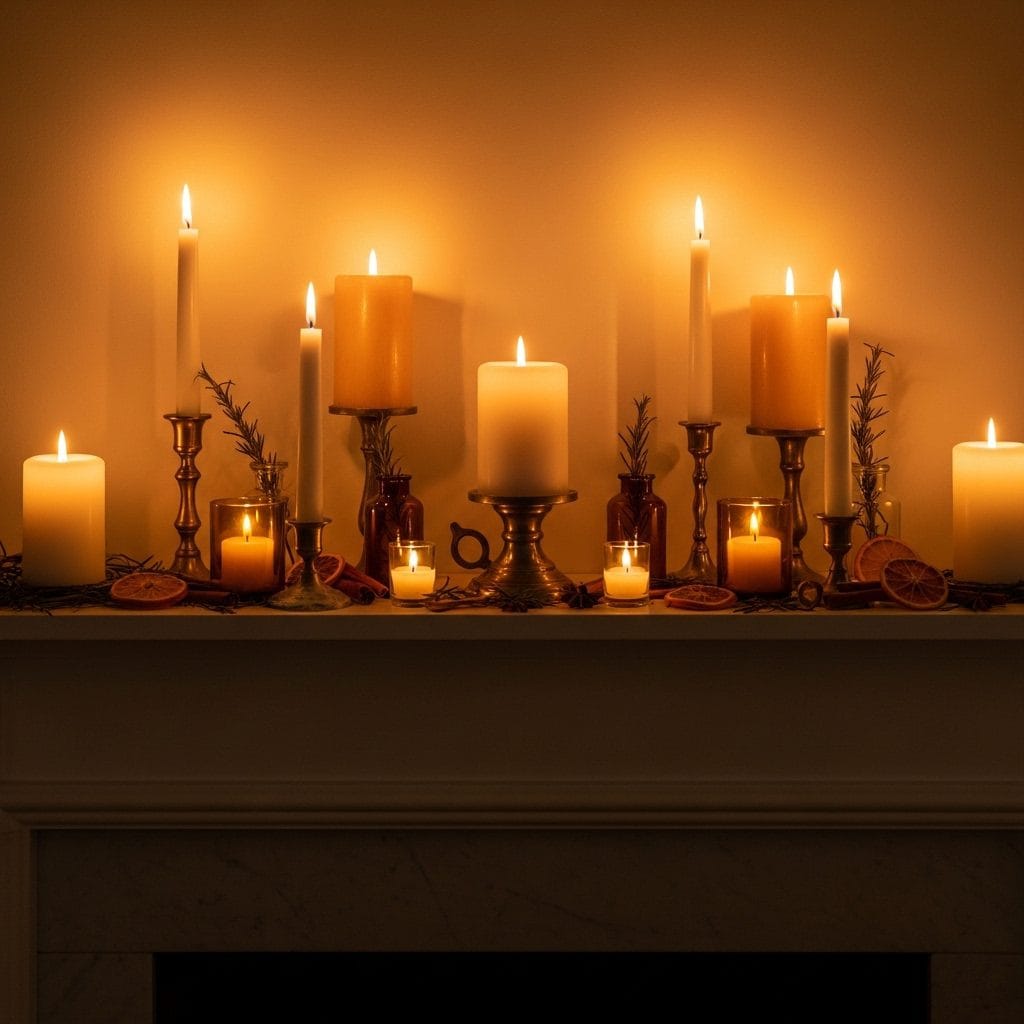
Image Prompt: A dramatic, atmospheric winter mantle photographed in warm low directional lighting, featuring an abundance of dark, lush greenery — deep green pine branches, glossy magnolia leaves, eucalyptus sprigs, and dark ivy — arranged in a loose, generous garland across the mantle shelf. Between and among the greenery, tall thin taper candles in deep forest green and charcoal grey stand in simple brass candlestick holders at varying heights. A large antique gold-framed mirror leans against the wall above the mantle, reflecting the candlelight back into the room. A few small brass pinecones and dried seed pods nestle in the greenery. The fireplace below has a real fire burning. The camera shoots from mid-height, slightly wide, capturing the full moody, atmospheric richness of the scene.
Dark taper candles in forest green and charcoal paired with deep, lush greenery is the winter mantle aesthetic for people who want something dramatic and atmospheric rather than cozy and light — it leans into the darkness of winter rather than fighting against it, and the result is something that feels genuinely sophisticated and intentional rather than cheerful and approachable. It’s the mantle for evenings when you want the living room to feel like a scene from a very beautiful novel.
The large antique gold mirror leaning above the mantle doubles the impact of everything on the shelf by reflecting it back into the room — the greenery appears more abundant, the candle flames multiply, and the whole composition gains a depth and complexity that it doesn’t have without the reflective surface. Leaning a mirror rather than hanging it gives the mantle an informal, collected quality that a properly hung mirror doesn’t have, and it’s the styling move that makes a fireplace look like it was arranged by someone who really understands how to create atmosphere.
4. Hygge Inspired Candle and Textile Mantle
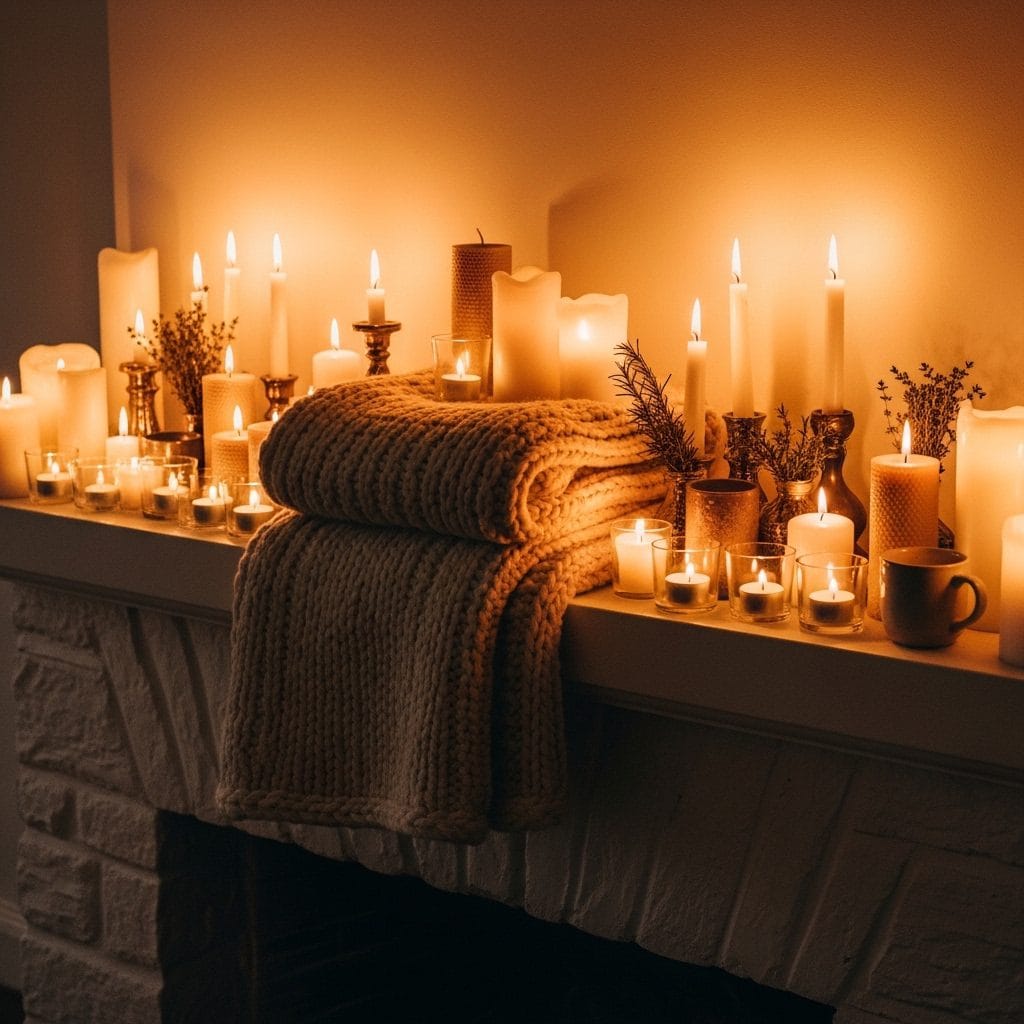
Image Prompt: An incredibly cozy, hygge-inspired winter mantle photographed in the warmest possible amber candlelight with no other light source visible. The mantle shelf is almost entirely covered in candles of every size — stumpy pillar candles, tall pillars, small votives in glass holders, tea lights in tiny glass cups — all in ivory, cream, and natural beeswax colors. Between the candles, a folded chunky knit blanket in oatmeal cream is draped loosely over one end of the mantle. Small sprigs of dried thyme and rosemary are tucked between candle holders. A single small ceramic mug sits at one end. The fireplace surround is rough whitewashed stone. The camera shoots from slightly low at mid-range, looking slightly upward at the glowing candle arrangement in warm amber light.
Hygge — that Danish concept of coziness, warmth, and contentment in simple pleasures — is perhaps the most fitting aesthetic philosophy for a winter mantle because the fireplace is already the most hygge element in any home, and when you lean fully into candles and soft textures on the mantle above it, you create a corner of your living room that genuinely embodies everything that word is trying to describe. The key is abundance without clutter — enough candles that the light feels generous and generous, but arranged with enough breathing room that each flame has presence.
The chunky knit draped casually over one end of the mantle is the detail that brings the textile dimension in without turning the mantle into a full fabric display — it’s just enough softness to contrast with the hard surface of the shelf and connect the mantle to the cozy furnishing world of the sofa and the throw pillows and the rug below. It suggests a room that’s genuinely lived in and comfortable rather than decorated for appearance, and that quality — that sense of real warmth rather than performed warmth — is exactly what hygge is about.
5. Vintage Collected Objects Winter Display
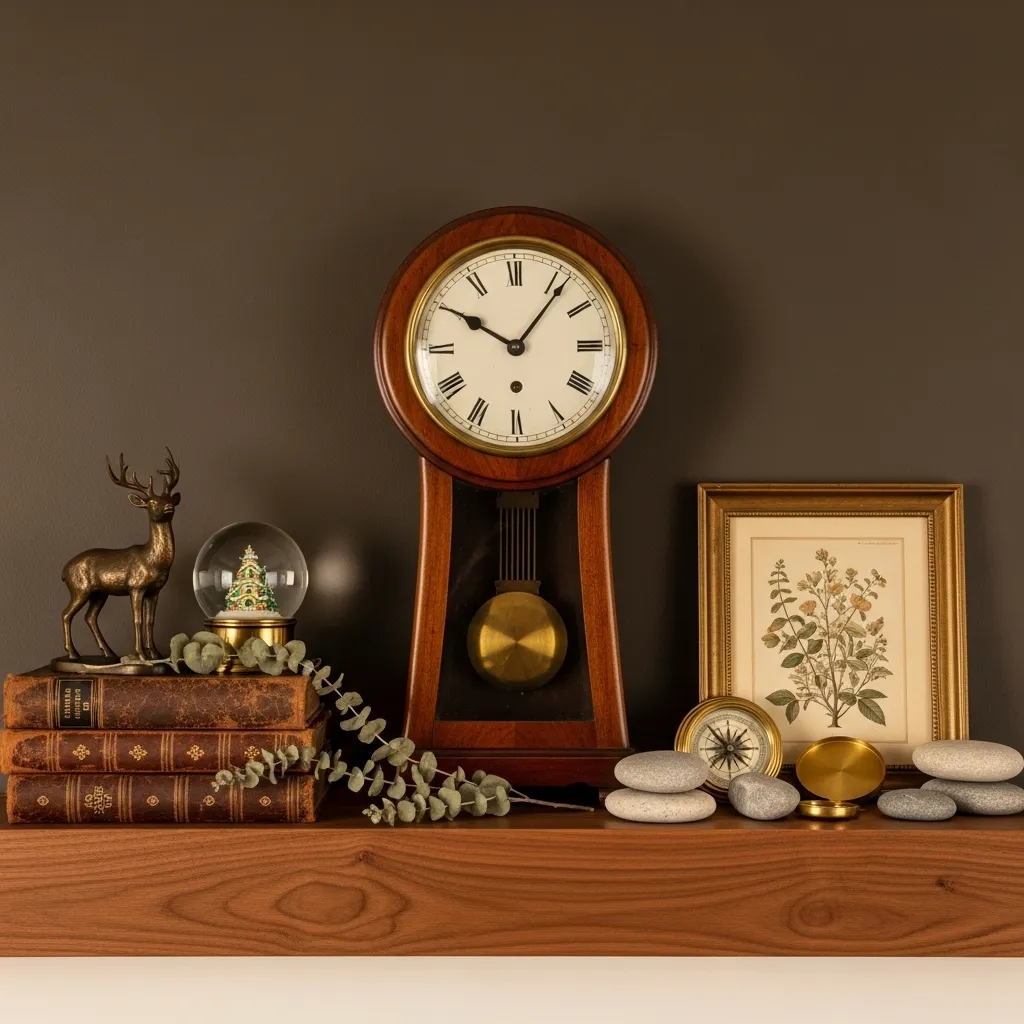
Image Prompt: A charming, eclectic winter mantle featuring a curated collection of vintage objects arranged with deliberate intention, photographed in warm afternoon light from a nearby window. A large antique clock with a dark wood case anchors the center. On either side, collected objects tell a story — a small bronze deer figurine, a stack of three aged leather-bound books, a vintage glass snow globe, a small framed antique botanical print, a brass compass, and a collection of smooth grey and white stones. A few sprigs of dried eucalyptus are laid flat between objects. The mantle shelf is warm walnut wood and the wall above is painted a deep, warm charcoal. The camera shoots straight-on from mid-height, capturing every object in the display with equal clarity.
A vintage collected object mantle is for the person who wants their mantle to feel like a curated cabinet of curiosities rather than a seasonal display — each object has a story, a provenance, a reason for being there, and together they create a composition that feels genuinely personal and considered rather than assembled from a single shopping trip. The winter version of this approach leans into objects that feel cold-weather adjacent — things that suggest exploration, warmth, time, and interiority.
The edit is everything with a collected object mantle — too many objects and it looks chaotic, too few and it looks sparse. The sweet spot is usually between seven and twelve objects of genuinely varying heights and scales, with one anchoring piece at the center (a clock, a large vessel, a framed artwork) and the smaller objects arranged in loose groupings on either side. A few sprigs of greenery or dried botanicals laid flat between objects without being the focus keeps the display feeling organic rather than precious.
6. Plaid and Tartan Textile Winter Mantle
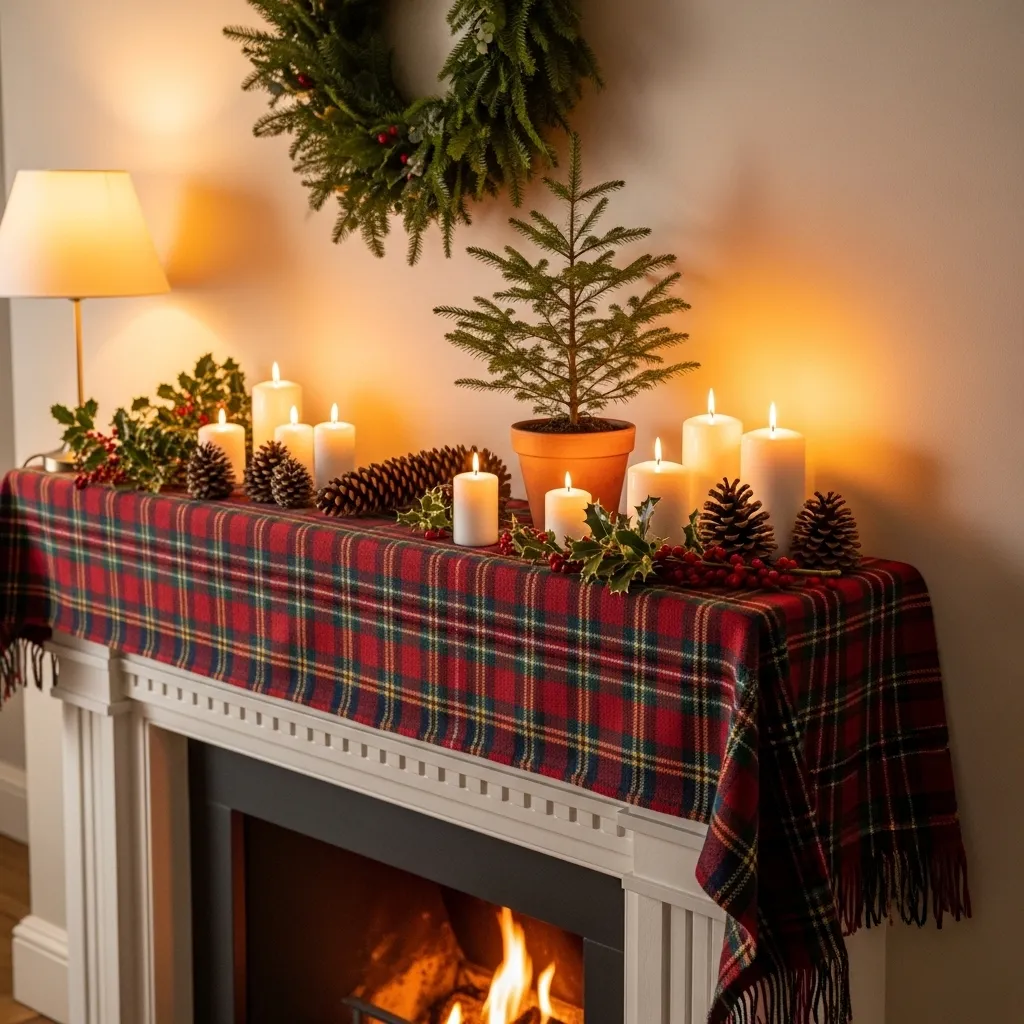
Image Prompt: A warm, heritage-inspired winter mantle with a tartan wool runner laid along the mantle shelf in classic red, green, and navy plaid, photographed in warm firelight and soft lamp light. On top of the tartan runner, a collection of simple white pillar candles in varying heights, a small potted pine tree in a terracotta pot, pinecones of various sizes, and a few sprigs of fresh holly with red berries are arranged in a relaxed, generous composition. A matching plaid throw is draped over the corner of the mantle and falls toward the hearth below. The mantle surround is classic white painted wood with simple dentil molding. A wreath of fresh greenery hangs above the mantle on the wall. The camera shoots slightly wide from mid-height, capturing the full warm tartan-and-green composition.
A tartan runner on the mantle is the winter decorating idea that’s been in the repertoire of traditional home decorators forever and remains completely beautiful because plaid in deep jewel tones just works next to stone and wood and firelight in a way that feels timeless and deeply satisfying. Red and green tartan reads as Christmas-adjacent but doesn’t have to be specifically Christmas — blue and green tartan, navy and camel, or a muted grey and cream plaid all work through the full winter season without any holiday association.
The layering principle is what makes a textile mantle feel rich and considered — the tartan runner underneath, the objects on top of it, a draping throw at one end, and a wreath on the wall above creates multiple layers of texture and depth that a purely object-based mantle can’t achieve. Textiles soften the hard surfaces of a fireplace surround and shelf in a way that makes the whole composition feel more intimate and lived-in, and in the deep winter that quality of physical softness matters emotionally as much as aesthetically.
7. Minimalist Winter Mantle With Single Statement Branch
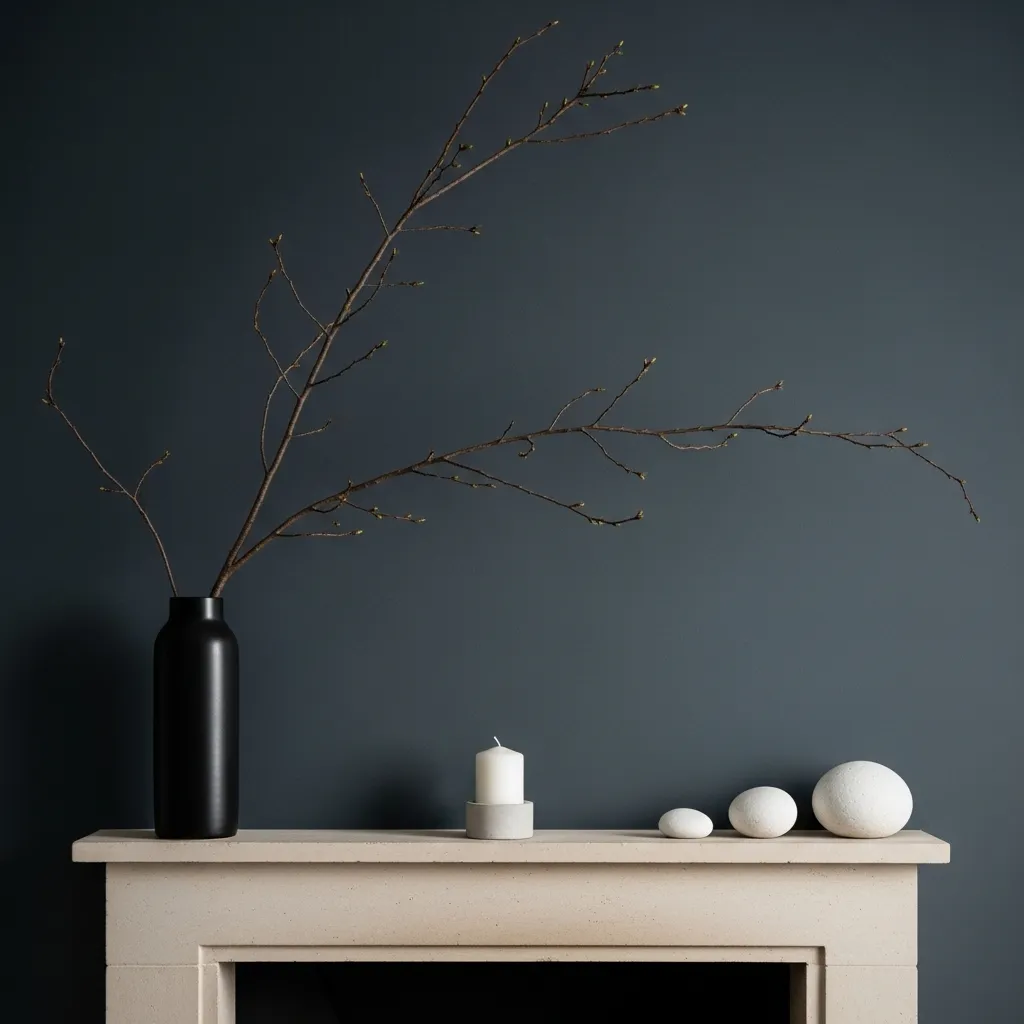
Image Prompt: An exquisitely minimal winter mantle photographed in soft, even grey winter daylight, featuring a single dramatic cherry blossom branch arrangement in a tall, slim, matte black ceramic vase positioned at one end of the mantle shelf. The branch extends up and across, its bare dark wood reaching over the center of the mantle with architectural precision. On the opposite end of the shelf, three smooth white river stones of graduated sizes are placed in a deliberate row. A single white pillar candle in a simple concrete holder sits in the center. Nothing else on the shelf. The wall above is painted a very deep charcoal. The mantle surround is pale natural limestone. The camera shoots straight-on at mid-height, capturing the spare, elegant beauty of the minimal composition.
A truly minimal winter mantle — one branch, three stones, one candle — is the hardest kind to execute and the most beautiful when it’s done right, because every single element is fully visible and fully considered without any other objects to hide behind. The single dramatic branch does all the heavy lifting, creating the height and the sculptural presence that a fully loaded mantle achieves through accumulation but that a minimal one achieves through perfect placement and perfect choice of the one significant element.
The discipline required to leave most of the mantle shelf empty is genuinely difficult when every decorating instinct says to add more — but the empty space in a minimal mantle is as important as the objects themselves. The negative space gives each element room to breathe and be seen, and it creates a quiet, meditative quality that’s actually more impactful in a busy winter living room than a more abundant display. It’s the mantle for people who find simplicity genuinely restful rather than severe.
8. Copper and Warm Metallic Winter Mantle
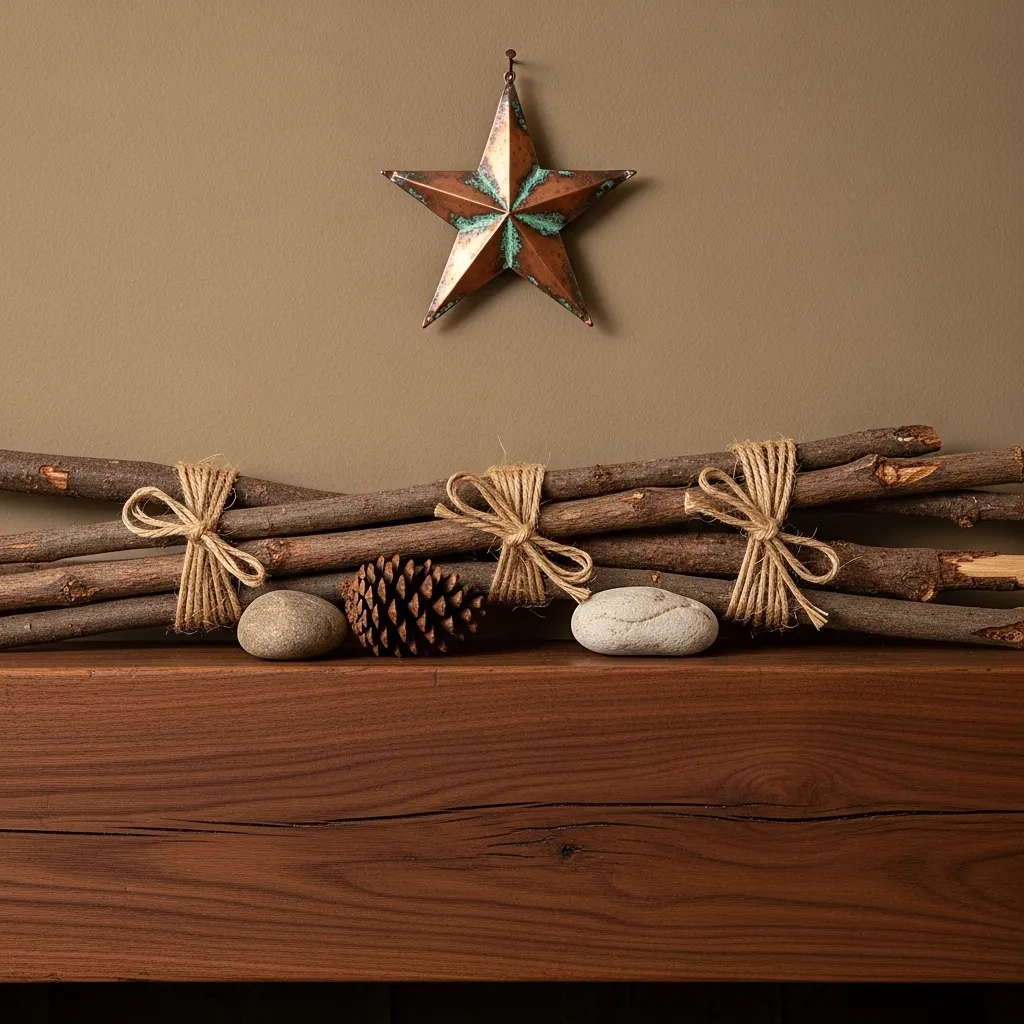
Image Prompt: A warm, glowing winter mantle featuring an abundance of copper and warm metallic objects photographed in soft evening lamp light that makes every metal surface glow. A large copper vase filled with dried pampas grass anchors one end. A cluster of copper pillar candle holders in varying heights holds ivory candles. Small copper geometric lanterns are interspersed throughout. Dried orange slices and cinnamon sticks tied with twine are laid between objects. A copper star hangs from a small nail on the wall above the mantle. The mantle shelf is aged dark walnut wood. The wall behind is painted in a warm deep rust tone. The camera shoots from mid-height, three-quarter angle, capturing the warm copper glow throughout the full composition.
Copper on a winter mantle creates a warmth that gold and brass don’t quite match — it’s warmer, earthier, and more autumnal in quality, which makes it perfect for the non-Christmas winter months of January through March when you want something that still feels warm and seasonal without any holiday associations. A collection of copper objects in different scales and forms creates a unified metallic story that feels collected and rich without being matchy-matchy in a formal way.
The warm rust-painted wall behind the copper mantle is the background detail that makes everything pop — copper against a warm terracotta or rust wall creates a tonal harmony where the colors are in the same warm family and reinforce each other rather than contrasting sharply. It’s a monochromatic approach within a warm palette that feels genuinely sophisticated and particular, and it photographs beautifully in the low winter light of an evening when everything is lit by lamps and candlelight.
9. Eucalyptus and Dried Flower Winter Garland
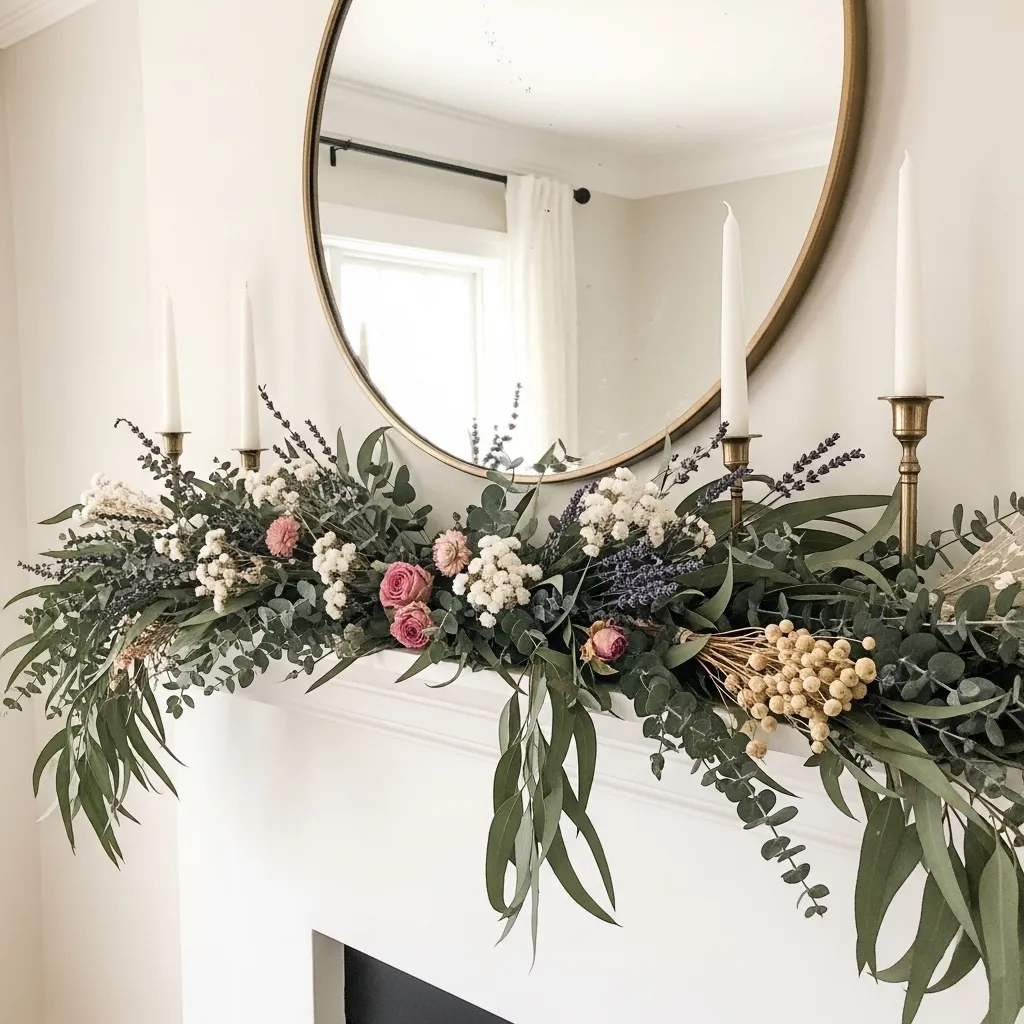
Image Prompt: A soft, romantic winter mantle with a loose, generous garland of preserved eucalyptus draped across the full length of the mantle shelf, photographed in soft warm natural light. The eucalyptus garland — a mix of silver dollar eucalyptus and long-stemmed seeded varieties — forms a flowing, organic drape that spills slightly over each end of the mantle. Nestled within the garland, small bunches of dried lavender, dried white statice flowers, dried pink roses, and cream-colored dried chamomile add color and texture. Three slim taper candles in aged brass holders emerge from the garland at even intervals. The mantle surround is painted white. A large round vintage-style mirror hangs above. The camera shoots from mid-height, slightly wide, capturing the full garland across the complete mantle length.
A eucalyptus garland across the full mantle is the botanical approach to winter decorating that feels genuinely lush and generous without any of the Christmas associations of traditional greenery — eucalyptus reads as year-round and sophisticated rather than seasonal and festive, and its silvery-green color against a white mantle surround is one of those combinations that looks like it came directly from an interior design magazine without any particular effort to make it so.
Preserved eucalyptus holds its shape, color, and fragrance for months without water, which makes it an incredibly practical choice for a mantle display — you make it once in early winter and it stays beautiful through March without any maintenance. The addition of dried flowers within the garland adds the color dimension that pure eucalyptus lacks, and the combination of different dried flower textures and tones — the soft purple of lavender, the papery white of statice, the delicate pink of dried roses — creates a display that rewards close inspection throughout the season.
10. Black and White Winter Mantle With Graphic Impact
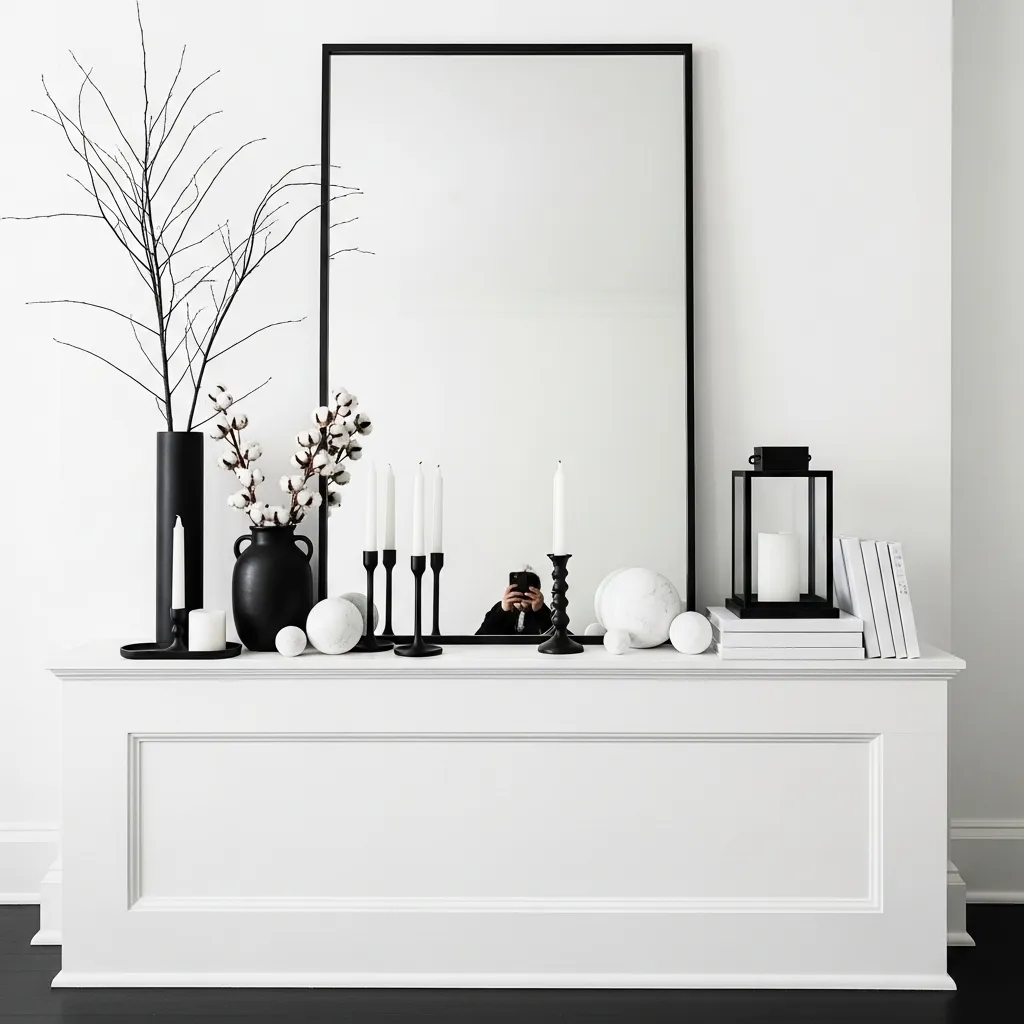
Image Prompt: A striking, graphic winter mantle photographed in clean bright natural light, featuring a bold black and white composition. A large black-framed rectangular mirror leans against the white wall above the mantle. On the mantle shelf, objects are strictly black and white — white pillar candles in matte black iron holders, a black ceramic vase holding white dried cotton stems, small white marble spheres of varying sizes, a matte black lantern with a white pillar candle inside, and white paper-wrapped books stacked at one end. A single branch of black-sprayed twigs in a slim black vase adds height. The mantle surround is crisp white with simple clean molding. The floor below is dark charcoal. The camera shoots straight-on, mid-height, capturing the full graphic black-and-white composition.
A strictly black and white mantle is the modernist approach to winter decorating that works in a contemporary home the way that greenery and candles work in a traditional one — as a design language that’s completely cohesive and confident and reads as genuinely sophisticated rather than seasonally themed. The graphic quality of black and white in winter feels right because winter itself is black and white — bare dark branches against pale grey sky, the graphic shadow of a leafless tree on snow.
Discipline with the palette is what makes this work — the moment you introduce a third color, even a neutral like warm grey or cream, the graphic quality of the composition softens and loses its power. Pure black and pure white only, and then vary texture and form as wildly as you want within those constraints — matte black iron against smooth white marble against rough black-sprayed twigs against glossy white cotton bolls creates enormous visual richness entirely within a two-tone palette.
11. Lantern and Pillar Candle Winter Mantle
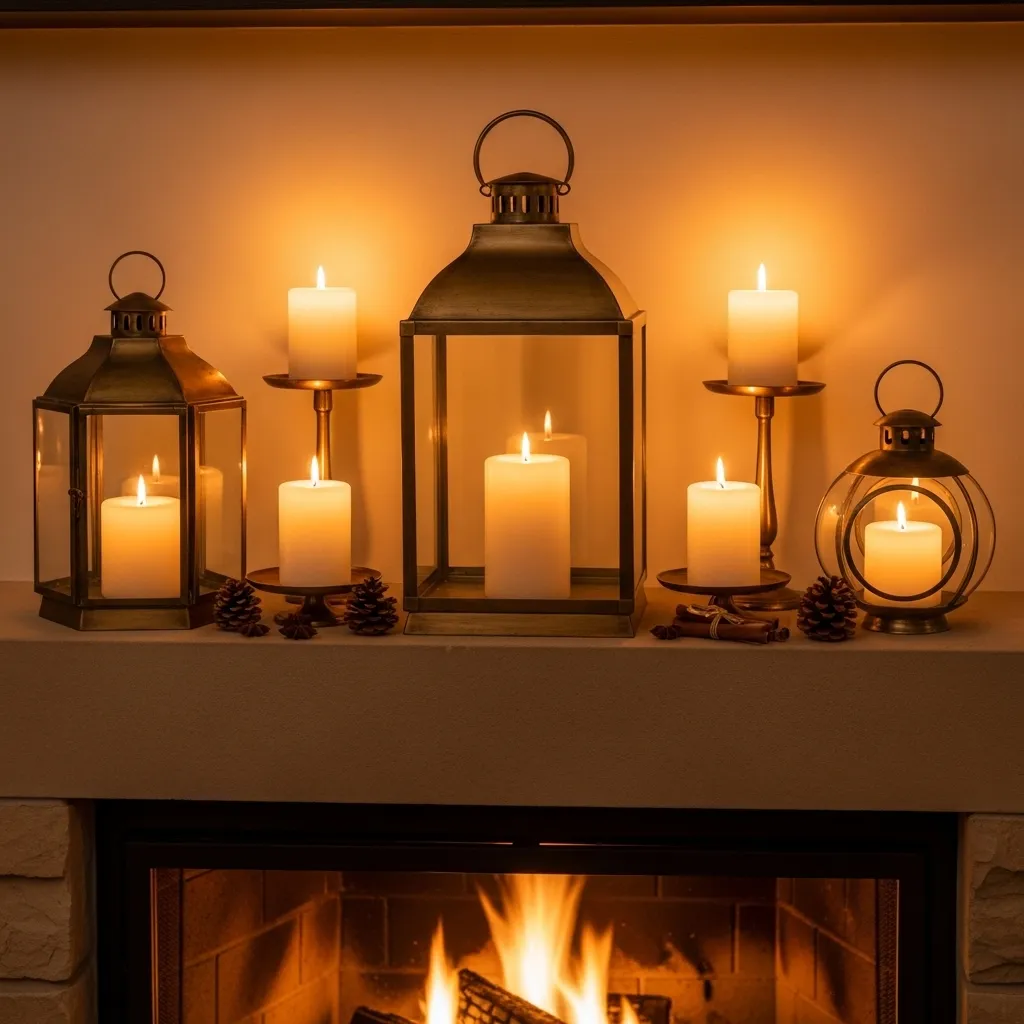
Image Prompt: A warm, traditional winter mantle arranged with a collection of lanterns and pillar candles of varying sizes, photographed in the warm glow of candlelight with a fire burning in the fireplace below. Three lanterns in aged brass and antiqued iron — a large square one in the center, a medium hexagonal one to one side, and a small round one to the other — each hold lit pillar candles inside. Between the lanterns, additional free-standing pillar candles in ivory and cream stand on simple brass and iron plates at different heights. Small dried pinecones, star anise, and cinnamon sticks fill the gaps. The mantle surround is warm stone. The camera shoots from slightly low at mid-height, looking slightly upward at the warm, glowing lantern collection.
Lanterns on a mantle create a quality of light that’s completely different from open candlesticks — the glass or metal sides of a lantern concentrate and shelter the flame, creating a more focused, jewel-like glow that has an old-world, atmospheric quality that open flames can’t quite replicate. A collection of lanterns in complementary styles and finishes — aged brass, antiqued iron, hammered copper — creates a warm, traveled, collected quality on a mantle that makes the display feel like it accumulated from different sources rather than being purchased as a set.
The combination of lanterns and free-standing pillar candles creates two different light sources at two different heights that work together to illuminate the mantle in a layered way — the lanterns provide their concentrated jewel-box light while the pillars spread a wider, softer glow across the whole shelf. In a room lit primarily by this mantle, the effect is genuinely enchanting — exactly the quality you want from a winter evening at home.
12. Fresh Rosemary Topiary Winter Mantle
Image Prompt: A charming, fragrant winter mantle featuring two small rosemary trees trimmed into cone topiary shapes in matching terracotta pots, placed symmetrically at each end of the mantle shelf, photographed in bright winter daylight. Between the two rosemary topiaries, a collection of simple ivory pillar candles on a small wooden tray fills the center of the mantle. A few dried orange slices, small pinecones, and sprigs of loose fresh rosemary are scattered across the shelf. The fragrant character of the rosemary is conveyed through the clearly defined needle texture of the leaves. The mantle is painted white with simple shaker-style paneling below. A simple black-framed print of a winter botanical hangs above. The camera shoots from slightly wide at mid-height, capturing the symmetrical, fragrant, simple composition.
Rosemary trimmed into cone topiary shapes is one of the most charming and fragrant winter mantle additions — the herb is naturally aromatic, grows readily in a small pot, tolerates the warm dry air near a fireplace better than most plants, and when shaped into a simple cone or ball form has a timeless, European quality that fits a winter mantle beautifully. Two symmetrical rosemary topiaries at each end of the mantle create an anchoring framework that makes everything between them feel contained and purposeful.
The practical bonus of using living rosemary is that it actually improves in warmth and light near a fireplace and the fragrance it releases — particularly when you brush the needles as you pass — makes the room smell deeply, specifically wonderful throughout the winter months. A snip of fresh rosemary for cooking is right there at eye level, which makes the mantle display genuinely useful in addition to beautiful. It’s a living, fragrant, edible, and beautiful winter decoration that ticks every possible box.
13. Gallery Wall Mantle With Winter Art Prints
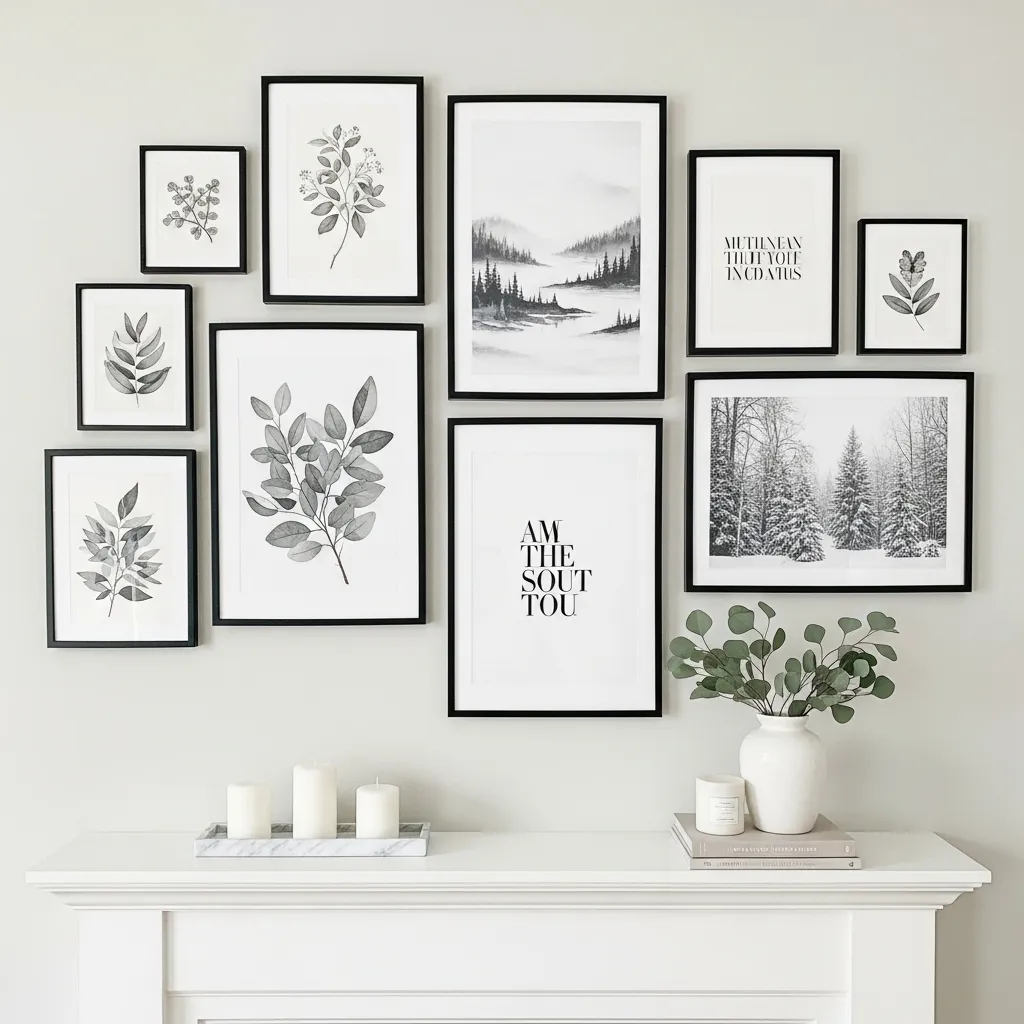
Image Prompt: A curated, art-forward winter mantle with a gallery wall of framed prints covering the full wall above the mantle in a salon-style arrangement, photographed in bright even natural light. The frames are all in the same thin black profile but in varying sizes, holding a curated collection of winter-themed botanical prints, abstract winter landscape watercolors, a simple typographic print, and a black and white photograph of a snowy forest. On the mantle shelf below, a minimal arrangement of three white pillar candles on a long marble tray, a single white ceramic vase with dried eucalyptus, and two small books are the only objects. The mantle surround is classic white. The camera shoots from mid-height, slightly wide, to capture the full gallery wall above and the clean mantle shelf below.
A gallery wall above the mantle that extends fully from the mantle shelf to the ceiling — or as close to it as the ceiling height allows — creates an installation that completely transforms the fireplace wall from a functional architectural element to the primary art feature of the entire room. The mantle itself becomes the pedestal for the gallery wall rather than a display in its own right, which means it can be kept beautifully minimal while the art above it carries all the visual weight and personality.
Winter-specific art prints — botanical illustrations of bare trees, watercolor snow landscapes, moody abstract winter color fields in grey and blue and white — give the gallery wall a seasonal quality that can be updated as seasons change by swapping just a few of the prints. The consistency of the frame profile ties the whole wall together as a coherent collection even when the artwork within the frames is stylistically varied, and the thin black frame on a white wall is the combination that makes almost any art look curated and intentional.
14. Asymmetric Modern Winter Mantle
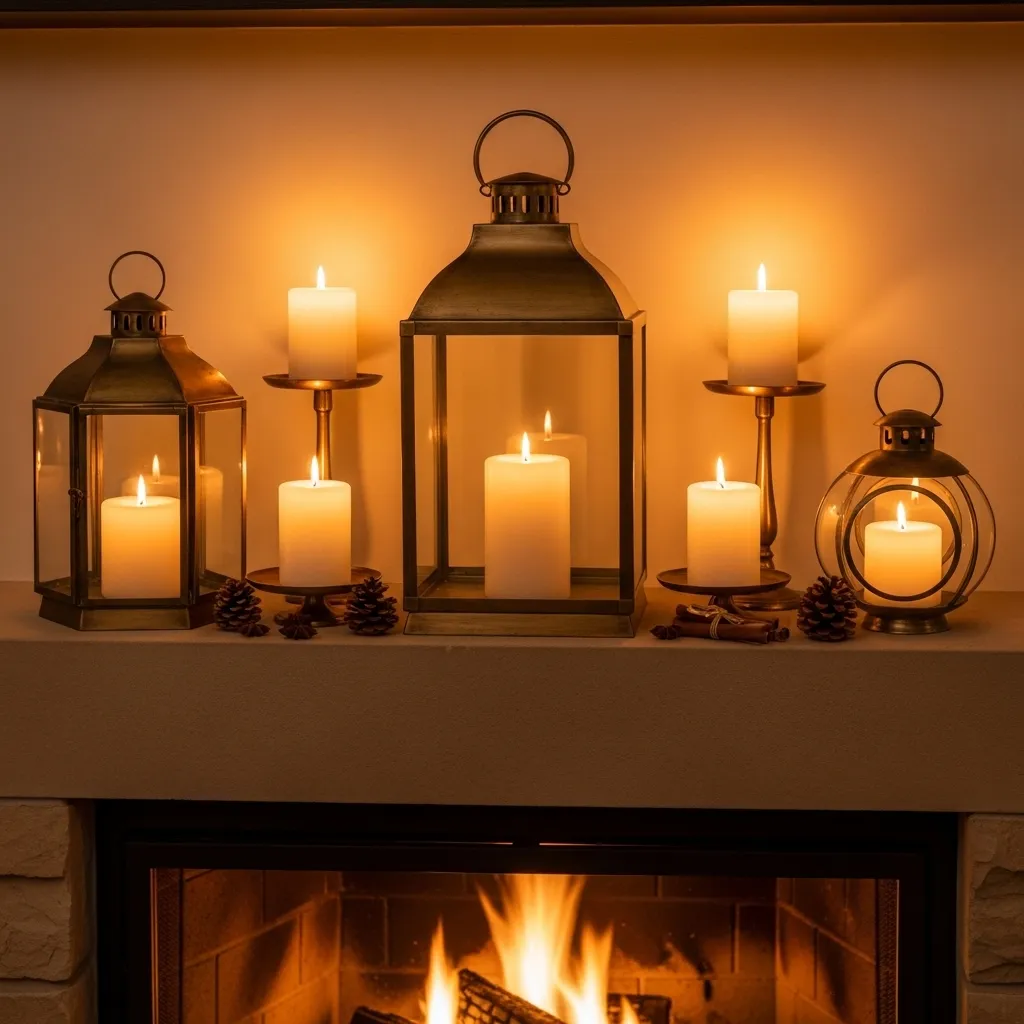
Image Prompt: A confident, asymmetric modern winter mantle photographed in clean even natural light with a slight editorial quality. All the visual weight is on the left side — a tall sculptural dried grass arrangement in a matte black slim vase reaches upward beyond the mantle edge, a short stack of three art books sits at the base of the vase, and a single large round pale grey ceramic vessel sits beside it. The right side of the mantle is almost entirely empty except for one small smooth stone placed at the far right edge. The wall above is a deep moody blue-green. The mantle shelf is thick pale travertine. The fireplace below has a clean modern surround in the same travertine. The camera shoots from a slight angle, slightly wide, emphasizing the deliberate asymmetry and the confident empty space.
Asymmetric mantle styling is the approach that most people are afraid to commit to because it goes against every conventional instinct to create balance and symmetry — but done with confidence it looks more intentional and more sophisticated than any perfectly balanced arrangement, because the imbalance forces you to make really deliberate decisions about what’s present and where, rather than just mirroring objects across a central axis.
The empty space on the right side of this mantle is not emptiness through indecision — it’s a specific choice to let the negative space be part of the composition, to let the eye travel from the full, complex left side across a plain of calm to the single small stone on the right edge. That journey across the empty shelf is what makes the composition dynamic and interesting to look at, and it requires enough confidence in the decision to resist the urge to fill the gap with something that would immediately make the whole thing feel ordinary.