15 Small Closet Organization Tips for 2026 That Actually Make a Difference
If your small closet has been making you quietly miserable every morning — a tangle of clothes you can’t find, shoes piled in a way that makes retrieving any single pair feel like an archaeological excavation, shelves so overstuffed that things fall on you when you open the door, and a general sense that the space has defeated you rather than the other way around — this is the year to actually fix it, because the tools, systems, and approaches available for small closet organization in 2026 are genuinely better than they’ve ever been, with solutions ranging from modular shelf systems that maximize every cubic inch of vertical space, to door-back organizers that turn wasted surface into prime real estate, slim velvet hangers that double your hanging capacity overnight, drawer divider systems for folded items, under-shelf basket additions, clear bin labeling strategies, capsule wardrobe editing that makes organizing possible in the first place, lighting upgrades that transform how usable the space feels, seasonal rotation systems, and several more approaches that address the actual reasons small closets stop working rather than just rearranging the same chaos more neatly.
I spent years in a rental apartment with a single small reach-in closet that was about four feet wide and had one shelf and one hanging rod, and I managed to convince myself that the chaos inside it was an unavoidable consequence of the space rather than a consequence of the system. Then I spent one focused Saturday — not buying anything new, just reorganizing what was already there with different principles — and the closet functioned dramatically better for the next two years without any additional investment. The experience taught me that small closet organization is primarily a thinking problem rather than a shopping problem, and that the most expensive modular system installed without a clear organizational philosophy will fail just as completely as a pile of wire shelves approached without thought.
What I’ve come to understand about small closets specifically — as distinct from large walk-ins or spare room wardrobes — is that they punish disorganization far more severely than larger spaces because there’s no slack in the system. A large closet can absorb some chaos and still function adequately. A small closet cannot absorb any chaos at all — every inch matters, every decision about what stays and what goes matters, every organizational choice matters. That severity is actually useful information, because it means that small closet organization done well creates a space that’s genuinely satisfying to use and that maintains its functionality over time in a way that casually organized larger spaces never quite manage.
1. Edit Ruthlessly Before Organizing Anything
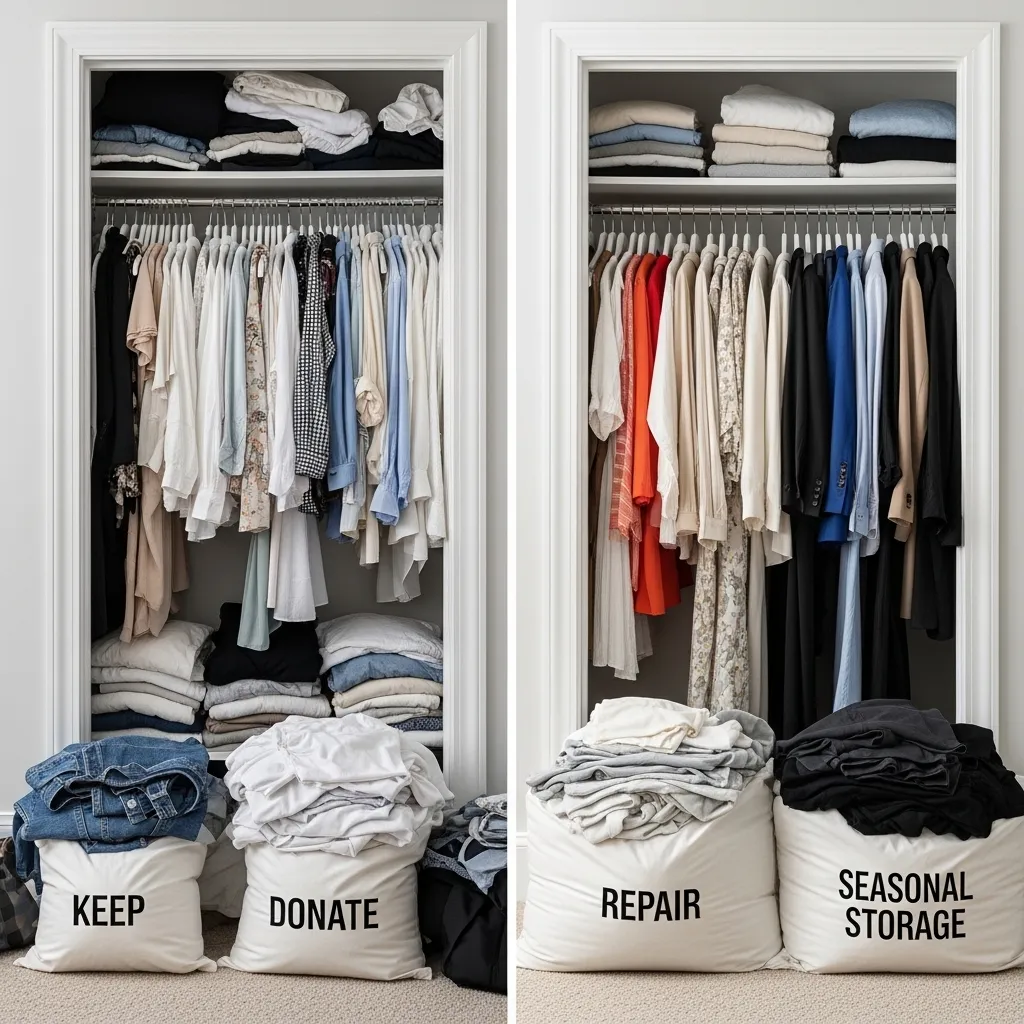
The single most impactful small closet organization action you can take has nothing to do with buying any organizing products and everything to do with removing things that shouldn’t be in the closet in the first place — and most small closets, if you’re honest about it, contain somewhere between twenty and forty percent of items that are staying purely through inertia rather than active choice. Clothes that don’t fit, clothes you haven’t worn in over a year, clothes that need repairs you’ve been meaning to make for months, clothes you keep because you paid a lot for them rather than because you actually wear them. Every one of those items is consuming space that functional, loved clothing needs.
The editing process works best with a genuinely decisive approach rather than a sentimental one — the question to ask about every single item is not whether you like it or whether it was expensive or whether you might wear it someday, but whether you have worn it in the last twelve months and whether you would buy it again today knowing what you know now. Two nos to those questions and the item leaves the closet. The freedom that comes from an edited closet — the ease of getting dressed, the visibility of every item you own, the daily pleasure of opening a closet that contains only things you actually want — is worth far more than the sentimental retention of things you’re keeping out of guilt.
2. Double Your Hanging Space With Slim Velvet Hangers
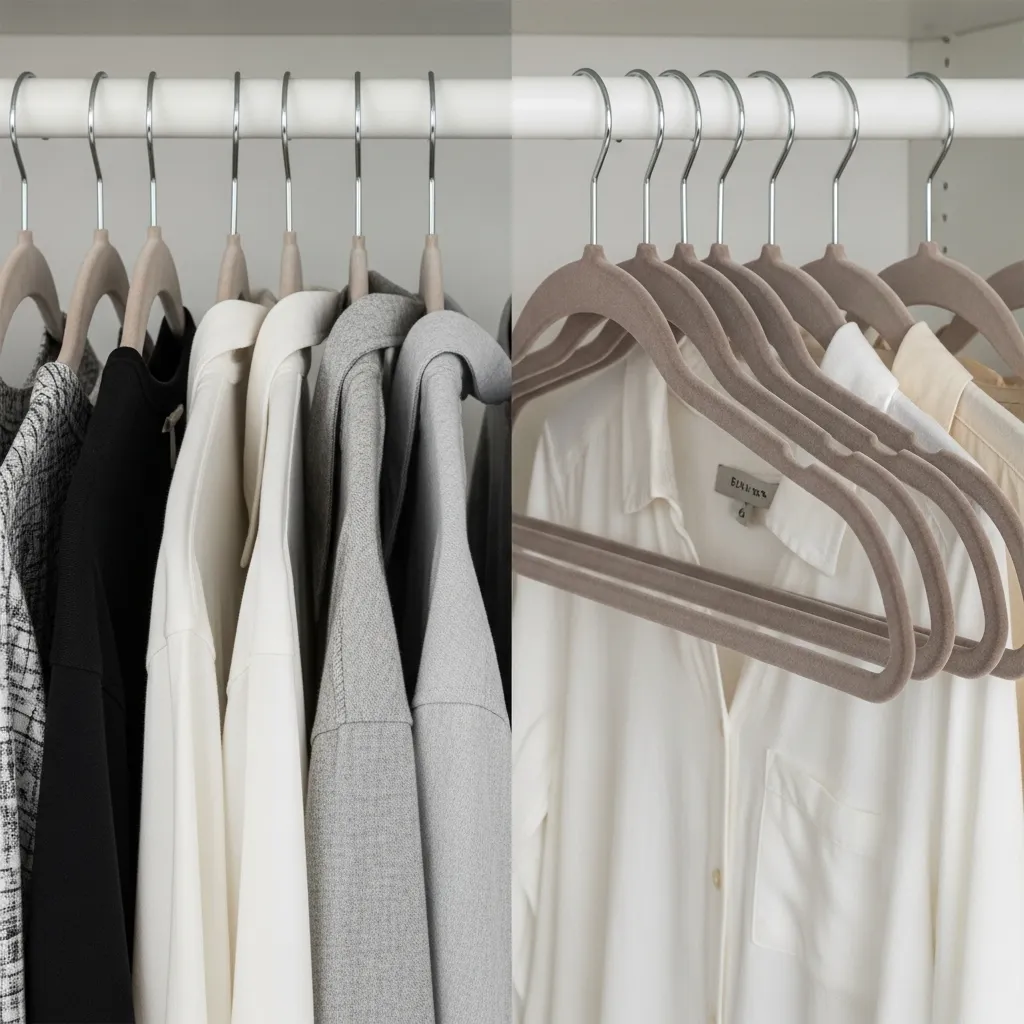
Switching from standard plastic or wire hangers to ultra-slim velvet hangers is the single cheapest and most impactful organizational purchase for a small closet — the width of a standard plastic hanger is roughly three-quarters of an inch to an inch, while slim velvet hangers are about a fifth of an inch, which means you can fit nearly five times as many garments in the same linear rod space. In a four-foot closet that previously held thirty items on standard hangers, slim velvet hangers can accommodate fifty to sixty items with better visibility between each one.
The velvet texture serves a practical purpose beyond aesthetics — it grips fabric gently so that slippery items like silk blouses and spaghetti-strap dresses stay on the hanger rather than sliding off onto the floor, which is one of the persistent small frustrations of closet organization that the velvet surface completely eliminates. Buying a full set of matching hangers in a single color also has a visual organization effect that’s surprisingly significant — a closet full of identical slim charcoal velvet hangers looks dramatically more organized than the same closet with a mix of plastic, wire, and wooden hangers regardless of how the clothes themselves are arranged.
3. Add a Second Hanging Rod for Double Hanging
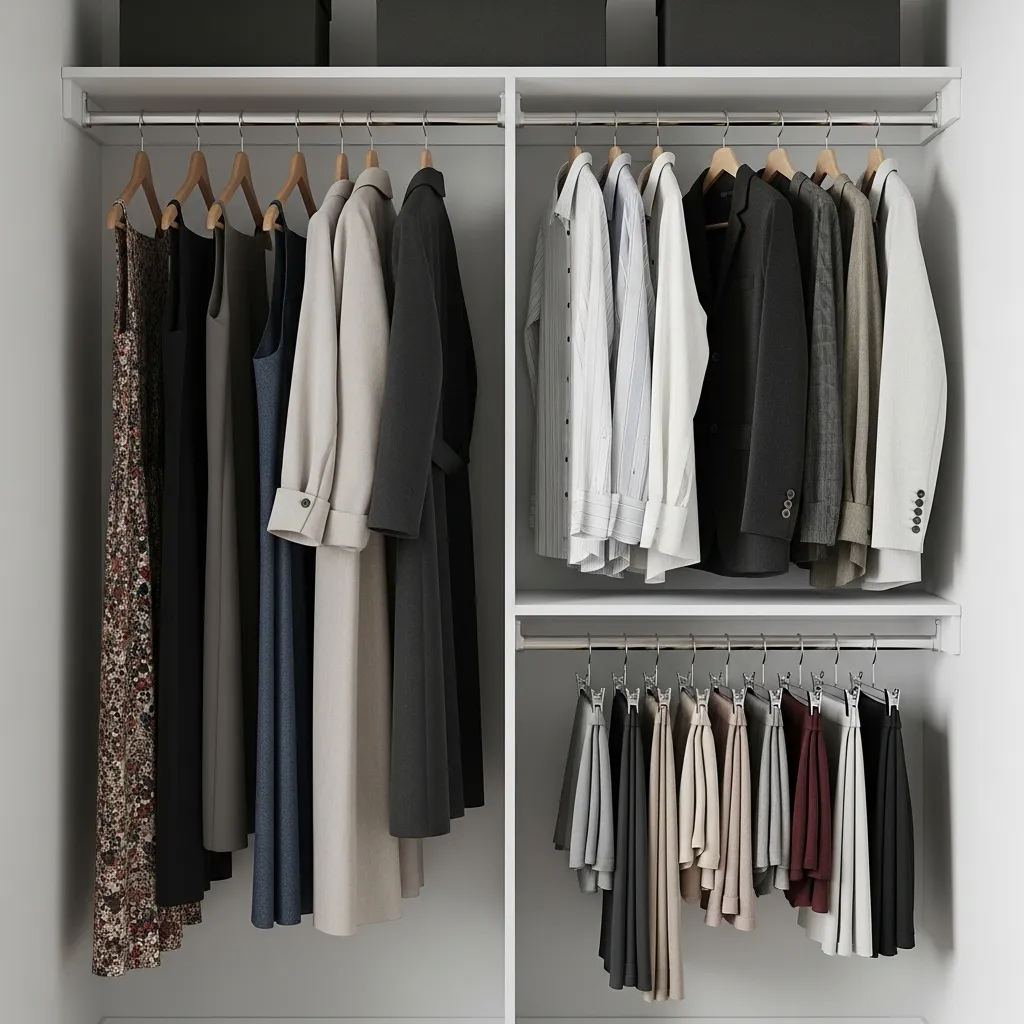
Adding a second hanging rod below the first is the structural modification with the highest return on investment in a small closet — for garments that don’t require full-length hanging (shirts, jackets, folded trousers, skirts, shorts), a second rod at half height effectively doubles the hanging capacity of that section of the closet without requiring any additional floor or wall space. In a closet that previously had one rod running the full width, converting half of it to double hanging creates room for dramatically more garments while actually improving the organization by separating short-hang items from long-hang items.
The key to double hanging working well is being realistic about which garments actually need full-length hanging and which can be shortened — a pair of trousers folded over a clip hanger needs only half the vertical space of trousers hung full length, and most everyday shirts, blouses, and jackets hang comfortably in a space that’s about forty-two inches high rather than the seventy or eighty inches of a standard single rod. The full-length hanging section on the other side of the closet accommodates dresses, long coats, and full-length trousers, and the double hang section absorbs everything else at twice the capacity.
4. Maximize the Door Back With an Over-the-Door Organizer
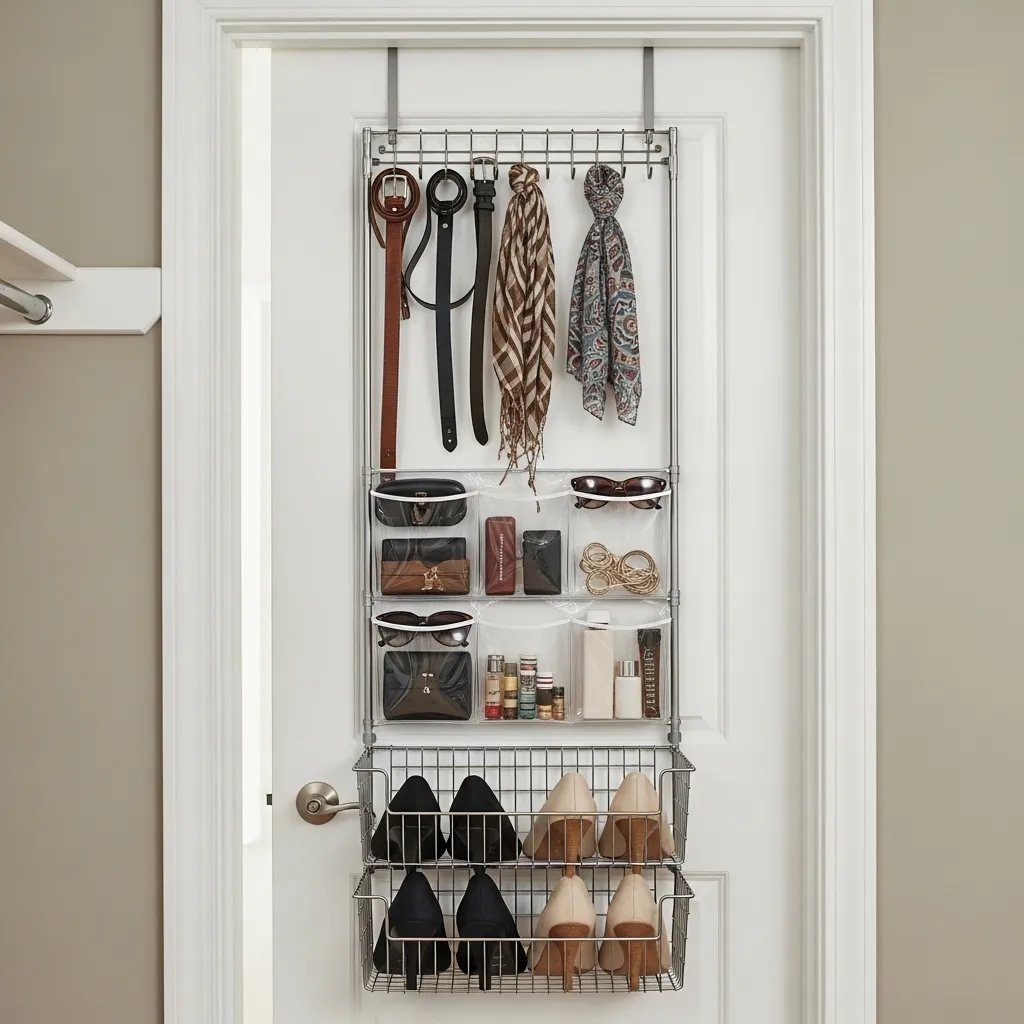
The back of a closet door is one of the most consistently wasted surfaces in a home — it’s typically sixty to seventy inches of vertical real estate in a three to four foot width that sits completely unused while the closet interior struggles to accommodate everything that needs to live there. A well-chosen over-the-door organizer turns that dead surface into active, accessible storage that’s often more convenient than interior shelf storage because it’s visible and reachable the moment you open the door without having to reach past anything to get to it.
The items best suited to door-back storage are the ones that most commonly create small-closet chaos when they don’t have a proper home — belts, scarves, and accessories that get tangled on hooks or piled on shelves, shoes that overflow the closet floor, small items like sunglasses and jewelry that disappear into drawers, and seasonal accessories that need to be accessible but not taking prime shelf space. Assigning these items specifically to the door back removes them from the interior of the closet entirely and creates a separate organizational zone that often solves several persistent closet problems simultaneously.
5. Install a Modular Shelf System Instead of Builder Shelves
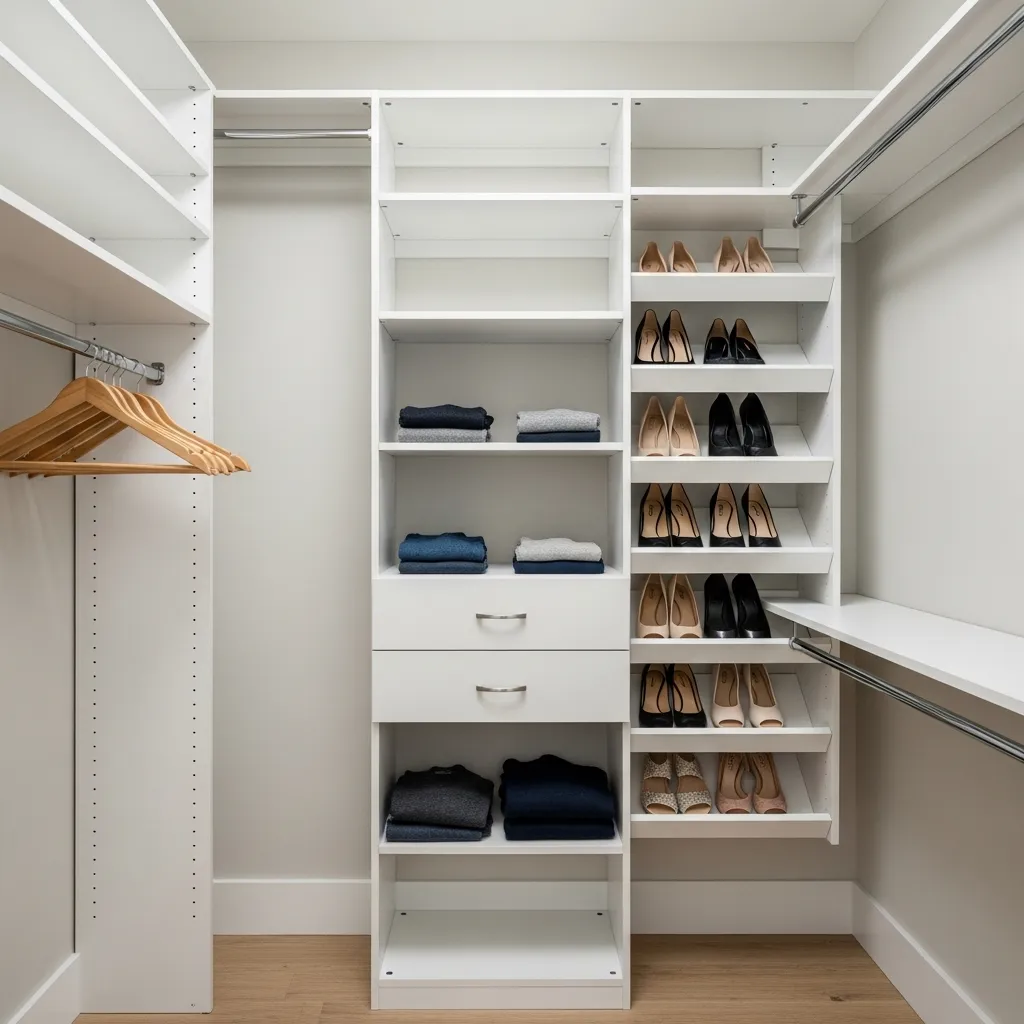
Replacing a standard builder-installed closet — typically one shelf and one rod that uses roughly forty percent of the available cubic space efficiently — with a properly designed modular system is the small closet upgrade that creates the most dramatic functional improvement because it addresses the fundamental problem of vertical space waste. Most small closets have twelve to fourteen inches of dead space above the top shelf that a modular system uses for additional shelving, and significant floor area that a system with a full-height tower of shelves or drawers can claim for folded storage.
The modular systems available in 2026 from retailers across every price point have improved significantly in both quality and flexibility — the best of them are genuinely adjustable to the exact dimensions of your specific closet, can be configured and reconfigured as your needs change, and in white laminate finishes look clean and considered rather than utilitarian. The planning step before installation is the one that determines whether the system works brilliantly or just adds more structure to the same organizational chaos — measure your closet in every dimension, categorize everything that needs to live in it, and design the system around the actual contents rather than buying a standard configuration and trying to make your wardrobe conform to it.
6. Use Clear Bins and Consistent Labeling
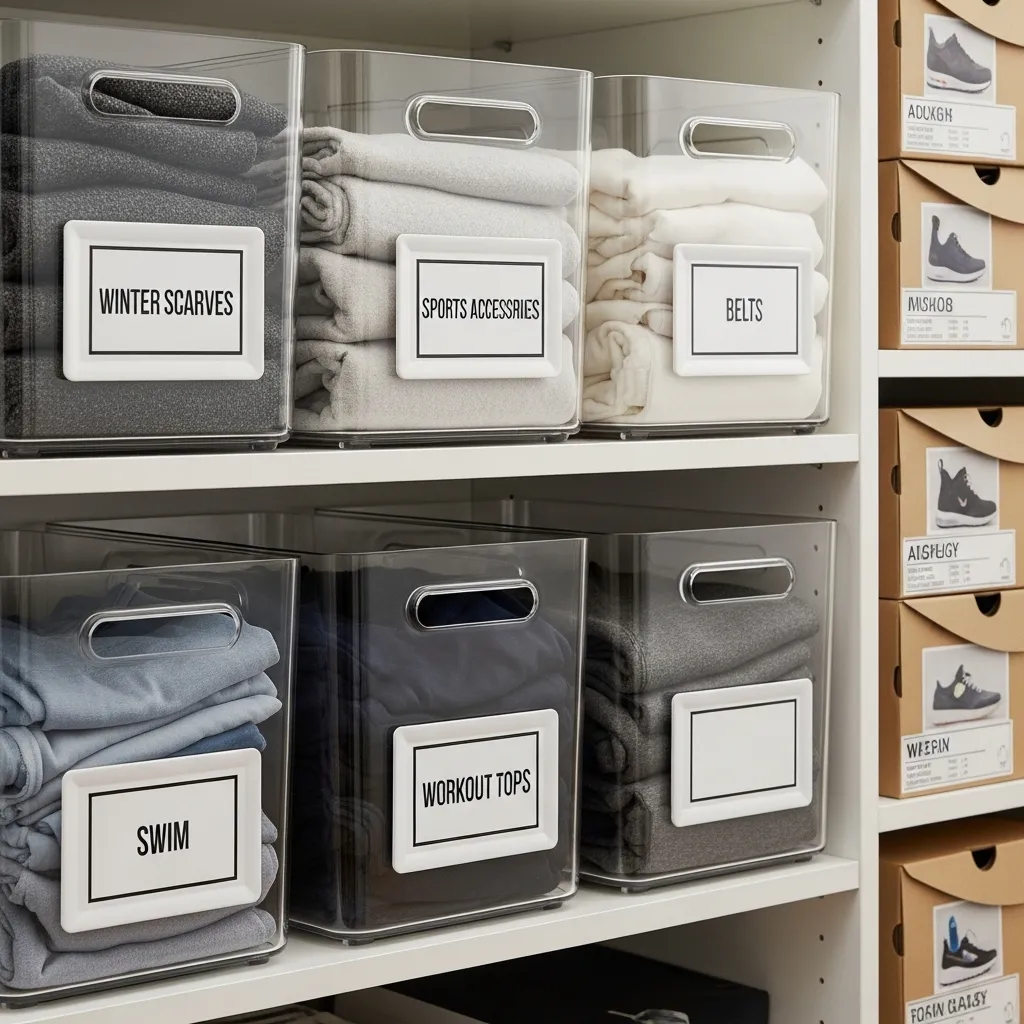
Clear bins with consistent labeling are the organizational system that makes a small closet genuinely functional for the long term rather than just organized at the moment of installation — because the fundamental problem with most closet organization attempts is that they look great immediately after completion and then gradually deteriorate back to chaos over the following weeks as items get put back in the wrong place, wrong bin, or wrong section. Labels remove the ambiguity from the return process and mean that everyone who uses the closet (including yourself in a hurry at seven in the morning) knows exactly where things go.
The visual uniformity of identical clear bins is a secondary organizational benefit that has a significant psychological effect — a shelf of identical clear containers looks dramatically more organized than the same items in a mix of different bags, boxes, and mismatched containers regardless of whether the contents are actually better organized. That visual calm translates into a sense of control and ease when you open the closet that makes the space feel genuinely pleasurable to use rather than stressful to navigate.
7. Implement a Color-Coded Hanging System
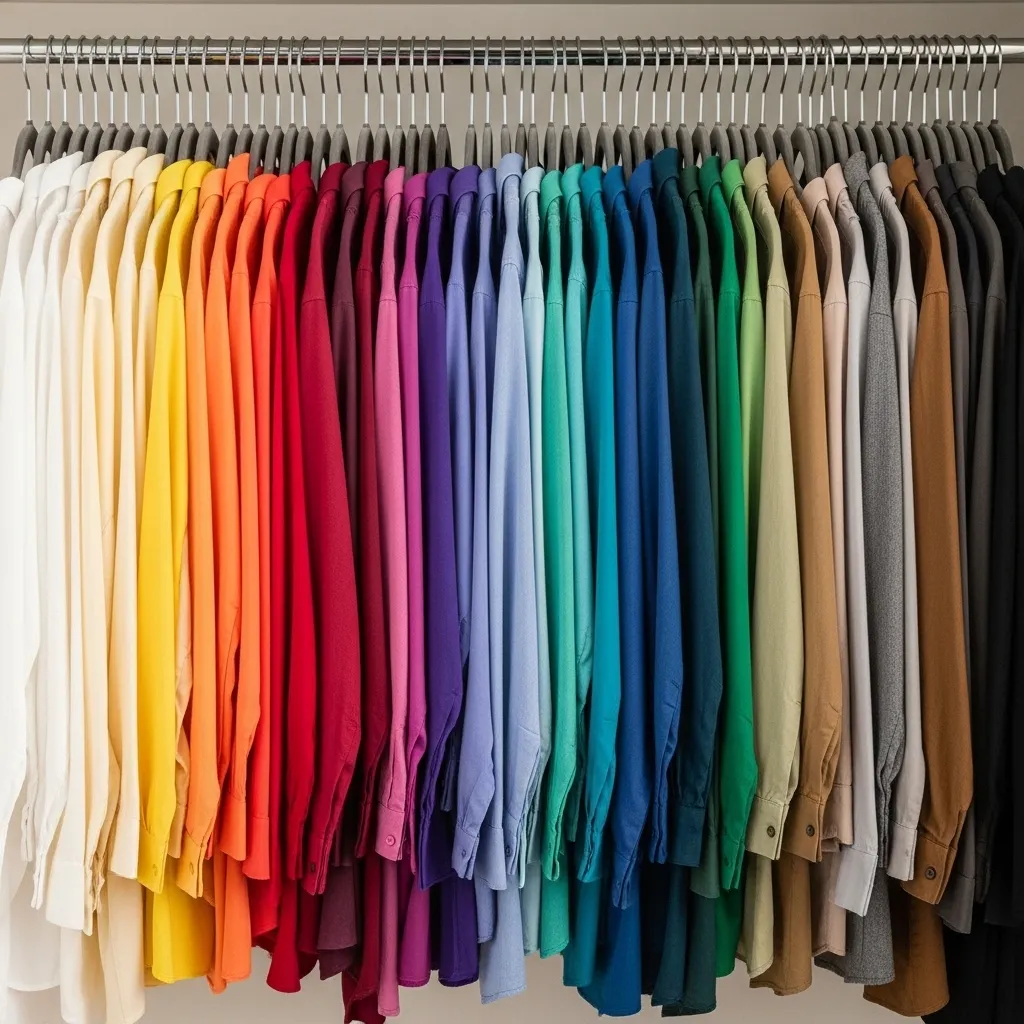
Color-coding a hanging wardrobe — arranging all garments in spectrum order from white through colors to black — is the organization system that makes finding any specific item dramatically faster and that maintains itself almost automatically because putting a garment back in the right color section requires no thought or decision. It’s also the system that most effectively reveals what you actually own — when all your navy garments are together and all your grey garments are together, you see immediately how many similar items you’ve accumulated and whether your wardrobe actually has the variety and balance you thought it did.
The psychological benefit of a color-arranged wardrobe is genuinely significant and slightly surprising — the visual order of a color spectrum in your closet creates a sense of calm and control every time you open the door that a randomly arranged wardrobe can’t provide, and that daily experience of opening a closet that looks genuinely beautiful as well as organized affects how you feel about getting dressed in a way that’s hard to articulate but very real to experience. It’s one of those small daily pleasures that costs nothing and gives back consistently.
8. Upgrade the Lighting
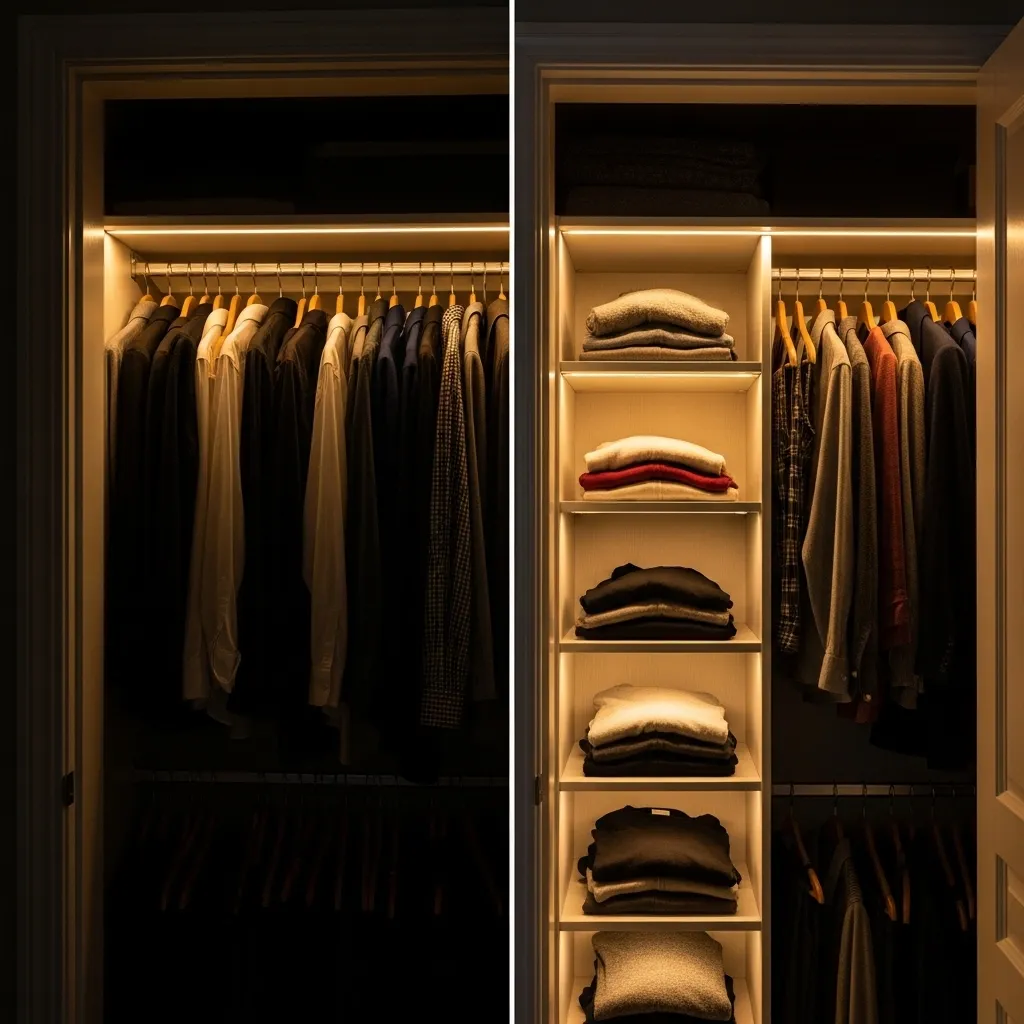
Poor lighting is one of the most significant and least discussed contributors to small closet dysfunction — when you can’t clearly see what’s in your closet, you default to the items at the front and the items that are most visible, which means everything at the back of a shelf or the far end of the rod effectively doesn’t exist for practical daily use purposes. This is why people who swear they have nothing to wear often have a closet packed with clothes — they can see about thirty percent of what they own clearly and the rest is functionally invisible.
LED strip lighting installed under each shelf level — or a single motion-activated LED light mounted inside the closet if it has a door that creates darkness — is a genuinely transformative upgrade that costs very little and takes less than an hour to install. The ability to see every item in your closet clearly, at accurate colors, in every corner and at every depth, changes how you use the space profoundly and immediately. Clothes get worn that never got worn before. Items that were forgotten about resurface. Getting dressed becomes faster and more enjoyable. It’s the upgrade with the best quality-of-life return relative to cost.
9. Use Shelf Risers and Undershelf Baskets
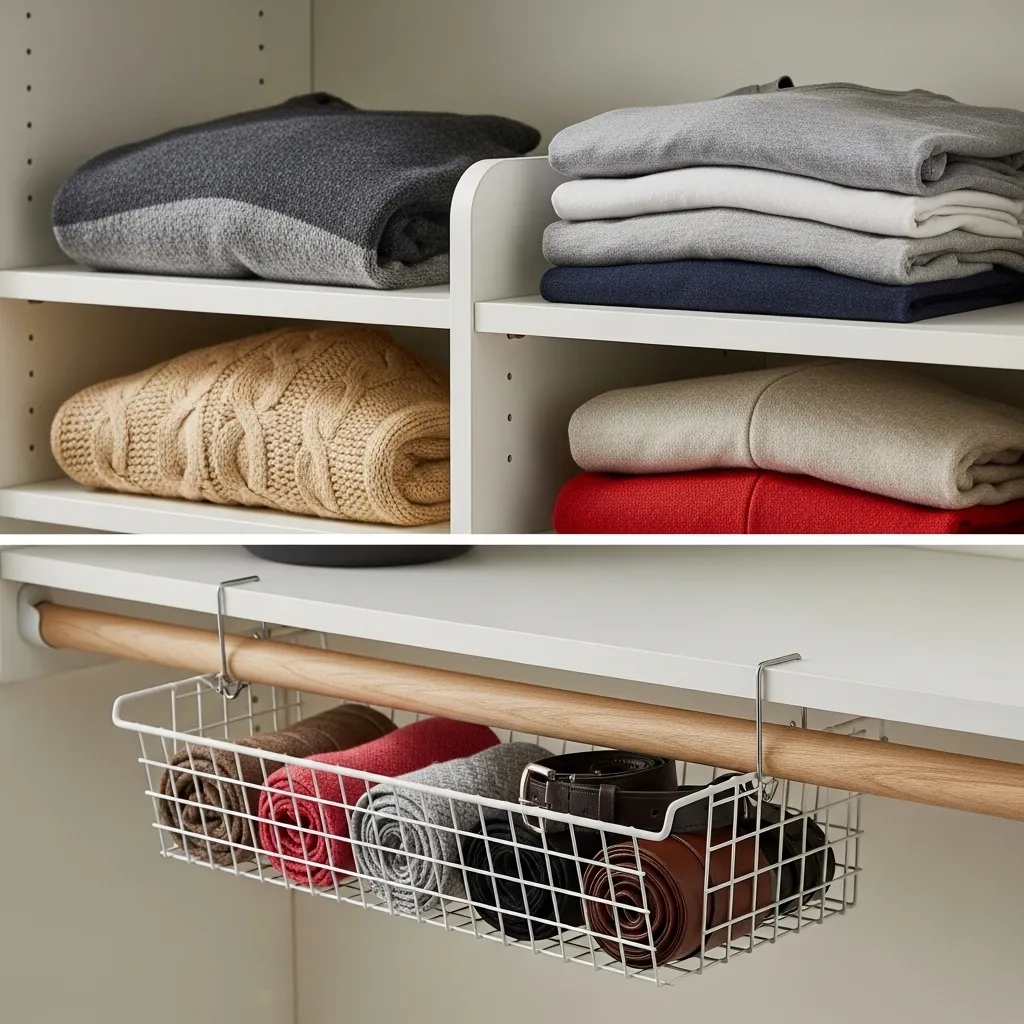
Shelf risers — the simple acrylic or wire structures that create a second level on a single shelf — are the organizing product that most people haven’t tried and that most people find transformative when they do, because they turn a single flat shelf into two storage surfaces in the same footprint without requiring any installation or structural modification. A shelf that previously held one layer of folded sweaters now holds two separate categories of folded items at two different heights, effectively doubling the folded storage capacity of that shelf.
Undershelf baskets that clip to the underside of a shelf are the organizing product for the items that most commonly end up piled on shelves because they’re too small for a bin and too numerous for a hook — rolled scarves, belts, small accessories, pairs of gloves, things that look messy when stacked but fit beautifully in a hanging basket below an existing shelf. The basket uses dead air space between shelf levels rather than taking any new shelf surface, and it creates a designated, visible home for items that otherwise migrate to wherever there’s a temporary gap.
10. The Vertical Shoe Storage Revolution
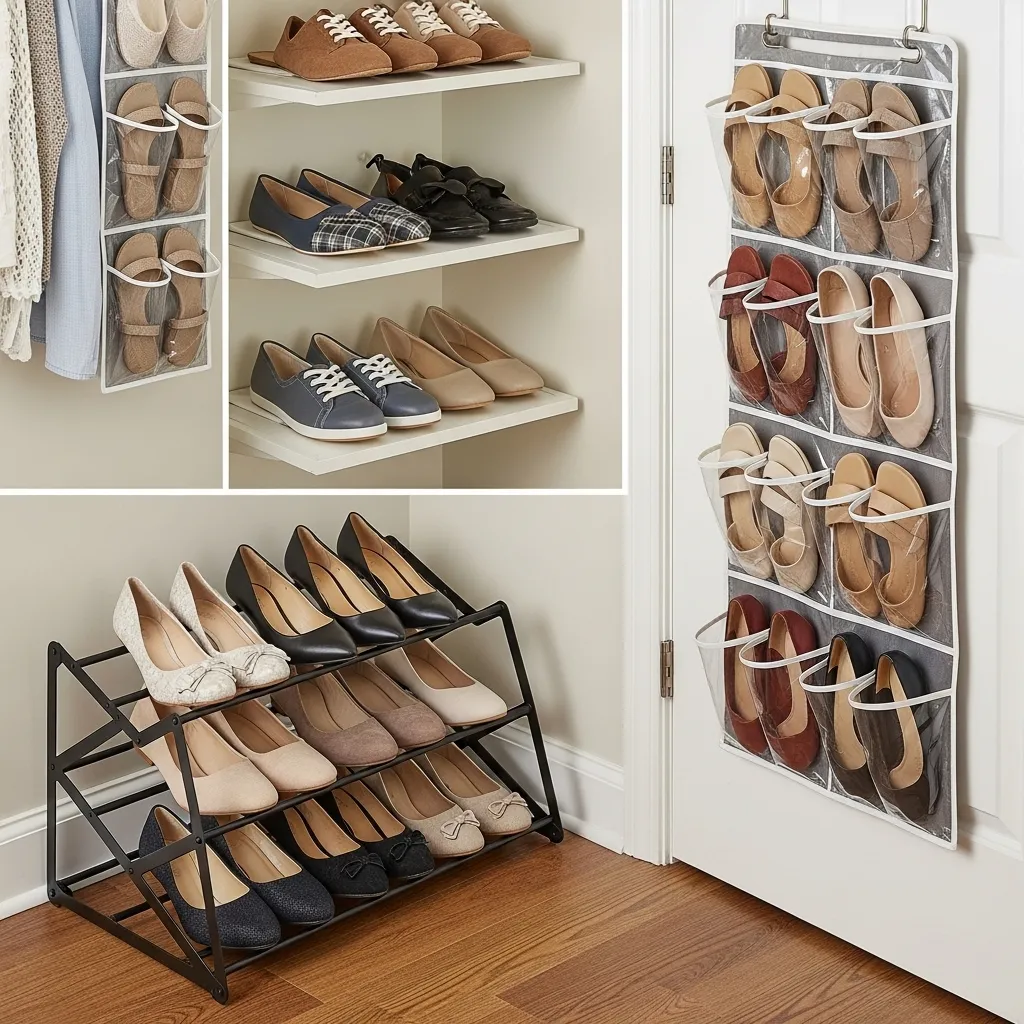
Vertical and angled shoe storage — storing shoes nose-down at a forty-five degree angle rather than flat — is the technique that creates the most dramatic increase in shoe storage capacity per square foot of any shoe organization method, because the angled position reduces the footprint of each pair significantly compared to flat storage while stacking two shoes in the vertical dimension they were previously using anyway. An angled shoe rack that holds twelve pairs takes up roughly the same floor space as flat storage for four pairs, which means you’re getting three times the storage in the same footprint.
The clear-pocket door organizer for flats and sandals is the complementary solution that handles the other category of shoes that standard racks don’t accommodate well — thin, flexible shoes that don’t stand up on angled racks can be folded flat into clear pockets on the door, stored vertically and visibly in a way that makes finding the right pair quick and keeps them from getting crushed or tangled at the bottom of a pile. Together, angled floor racks and door pocket organizers can accommodate genuinely impressive shoe collections in a small closet without using any shelf space for shoes at all.
11. Implement the One-In-One-Out Rule Going Forward
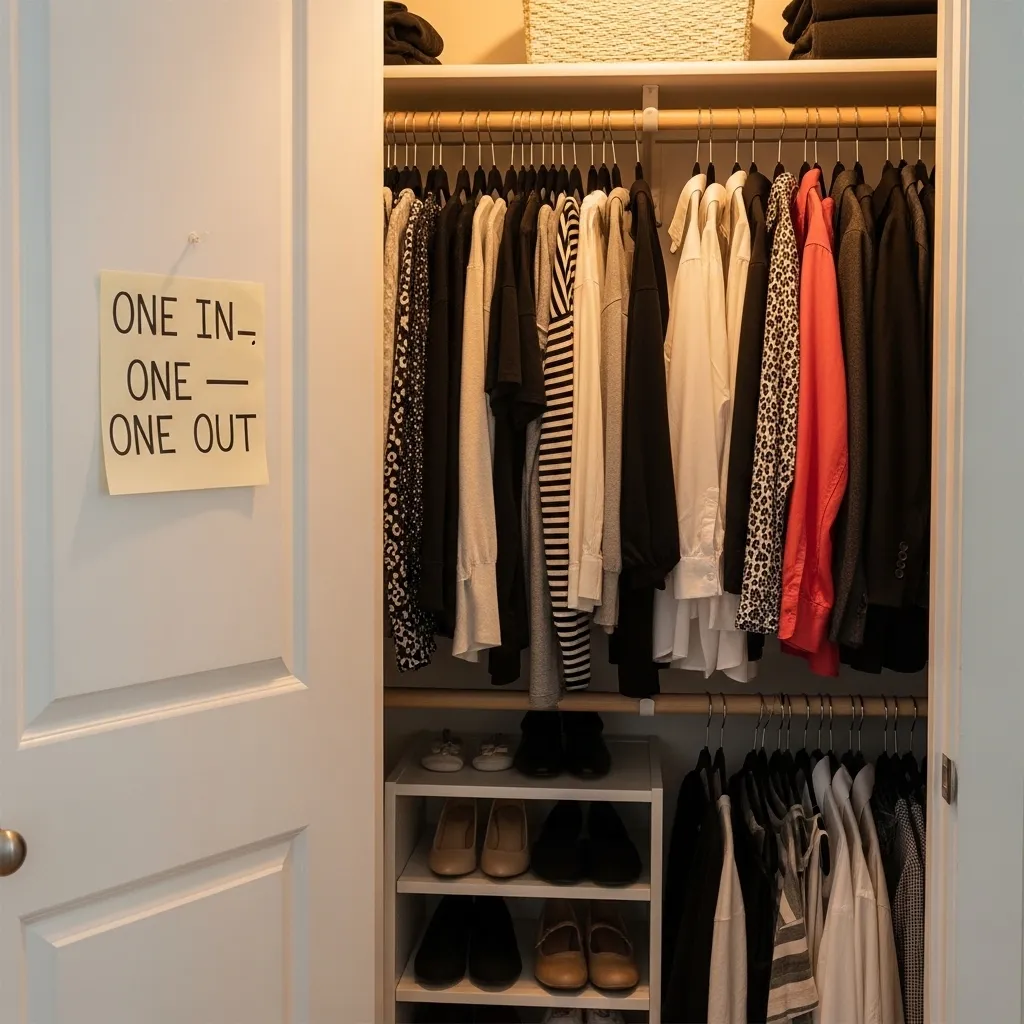
The one-in-one-out rule — committing to removing one item from the closet for every new item that enters it — is the organizational policy that makes all the other small closet work you’ve done sustainable rather than temporary. Without this rule, a beautifully organized closet will return to overcrowded chaos within one or two shopping seasons, not because the organization system failed but because the volume of contents exceeded the capacity of the space. With the rule consistently applied, the closet stays at the capacity you’ve designed it for indefinitely.
The practical challenge of the one-in-one-out rule is that it requires making the removal decision at the moment of acquisition — when the new item arrives, you have to identify and remove the item it’s replacing before it goes into the closet rather than deferring the decision to a future wardrobe edit that never quite happens. That moment of deliberate decision-making at the point of addition is actually an excellent filter for impulse purchases too — if you can’t immediately identify what you’d remove to make room for a new item, that’s useful information about whether you actually need the new item.
12. Create Zones for Different Clothing Categories
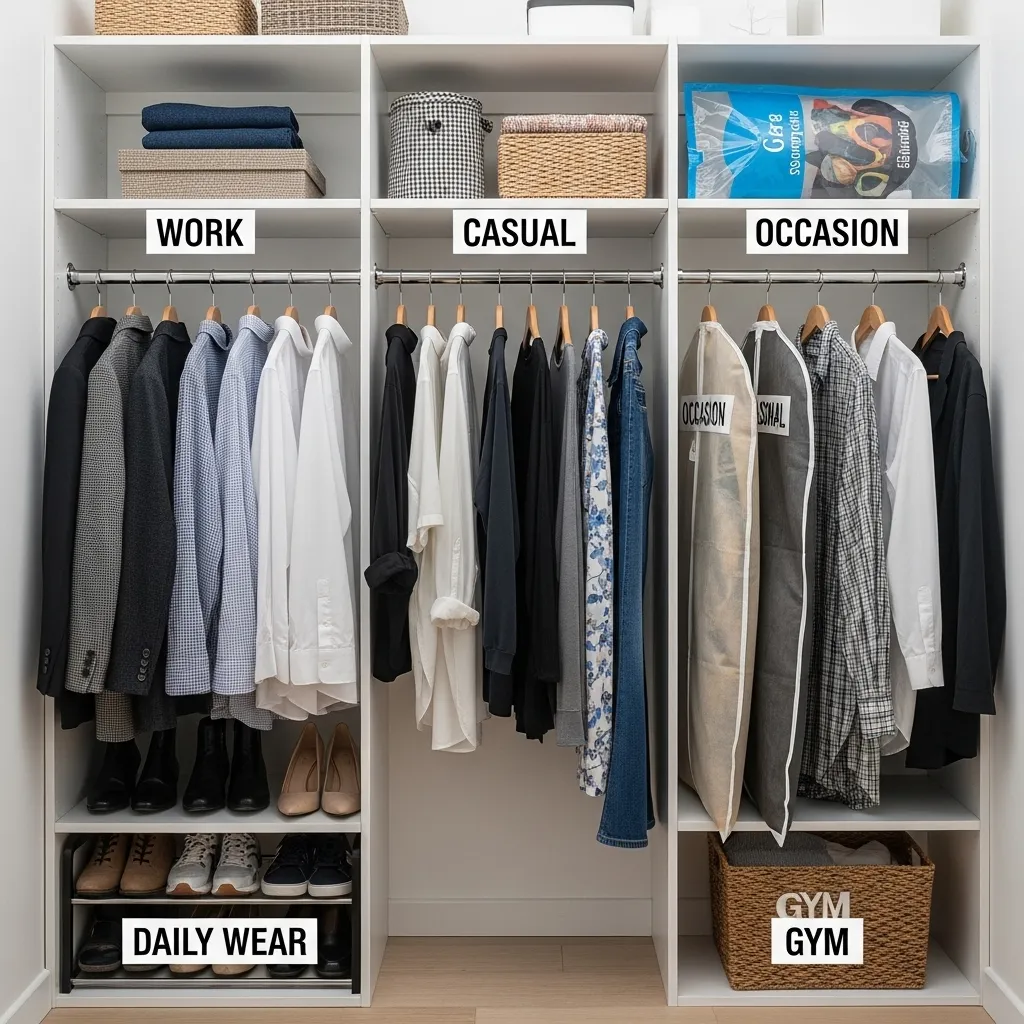
Zoning a small closet by clothing category — creating dedicated sections for work clothes, casual clothes, athletic wear, and occasion wear rather than mixing everything together — is the organizational approach that most dramatically reduces the time and cognitive energy required to get dressed every day. When all your work clothes live in one section of the closet, getting ready for work requires looking at only that section rather than scanning the entire closet to assemble an appropriate outfit from randomly distributed items.
The zone system also makes it visually obvious when any category is becoming overcrowded — when your casual section is overflowing and your occasion section has plenty of room, you know exactly where your future editing attention should focus. The zones make the closet self-reporting in a way that an unzoned closet never is, and that self-reporting quality is what keeps the organizational system honest and functional over months and years rather than drifting back into chaos as things get put away approximately rather than precisely.
13. Fold and Store Vertically Using the KonMari Method
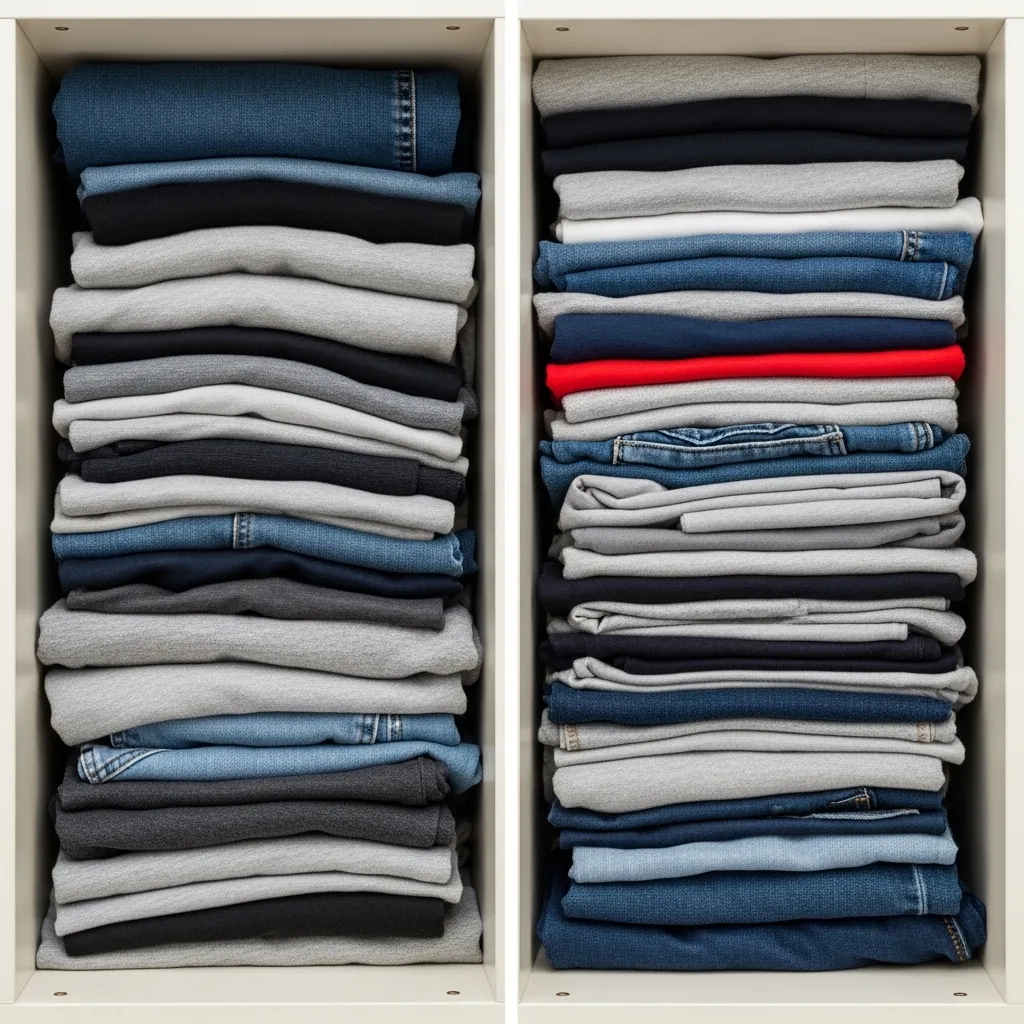
Vertical filing of folded garments — the technique associated with Marie Kondo but genuinely revolutionary regardless of its source — is the folding approach that solves the most persistent problem of folded storage in a small closet: the problem that only the top item in a horizontal stack is visible and accessible, which means everything below the top item effectively disappears and gets ignored. When every item stands upright in a row like a file in a filing cabinet, every item is equally visible, equally accessible, and removing or replacing any item doesn’t disturb the items around it.
The practical technique for vertical filing is to fold each garment into a small, self-supporting rectangle that can stand on its own edge — the exact folding dimensions vary by garment type but the principle is consistent: fold enough times that the item is a compact rectangle approximately the same height as the drawer or shelf space, and place it standing upright rather than flat. T-shirts, jeans, shorts, underwear, socks, and most knitwear all fold and stand well using this method, and the transformation in visibility and accessibility of a drawer organized this way versus a traditionally stacked drawer is genuinely remarkable the first time you see it.
14. Seasonal Rotation With Proper Off-Season Storage
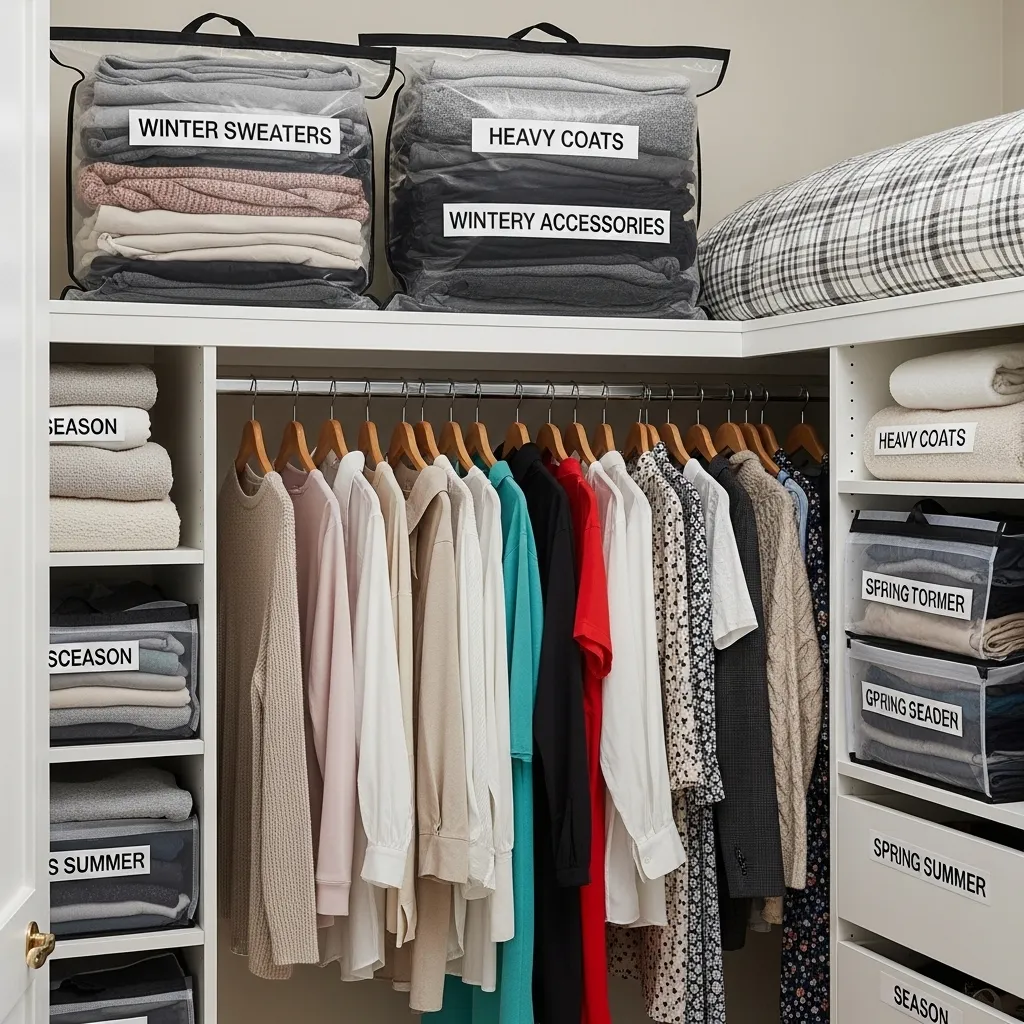
Seasonal rotation — moving off-season clothing out of the primary closet and into proper off-season storage — is the organizational strategy that makes a small closet functional year-round by ensuring that only the clothes you’re actually going to wear in the current season are taking up the valuable active closet space. A closet that contains four seasons of clothing has roughly twenty-five percent of its contents potentially useful at any given time; a closet containing only the current season’s clothing has close to one hundred percent of its contents relevant and wearable, which is a completely different organizational experience.
Vacuum compression storage bags are the off-season storage technology that makes this approach work in apartments and small homes where under-bed and top-shelf space is limited — compressing winter sweaters, heavy coats, and bulky knitwear to a flat bag that occupies a fraction of their normal volume means you can store a genuinely significant amount of off-season clothing in the limited high-shelf and under-bed spaces available without needing a dedicated storage room. The twice-yearly rotation is also a natural edit point — when you bring the off-season clothes back out, you evaluate each item before it re-enters the active closet, which prevents the gradual accumulation of clothing that the one-in-one-out rule is designed to prevent.
15. The Weekly Reset Habit That Keeps Everything Working
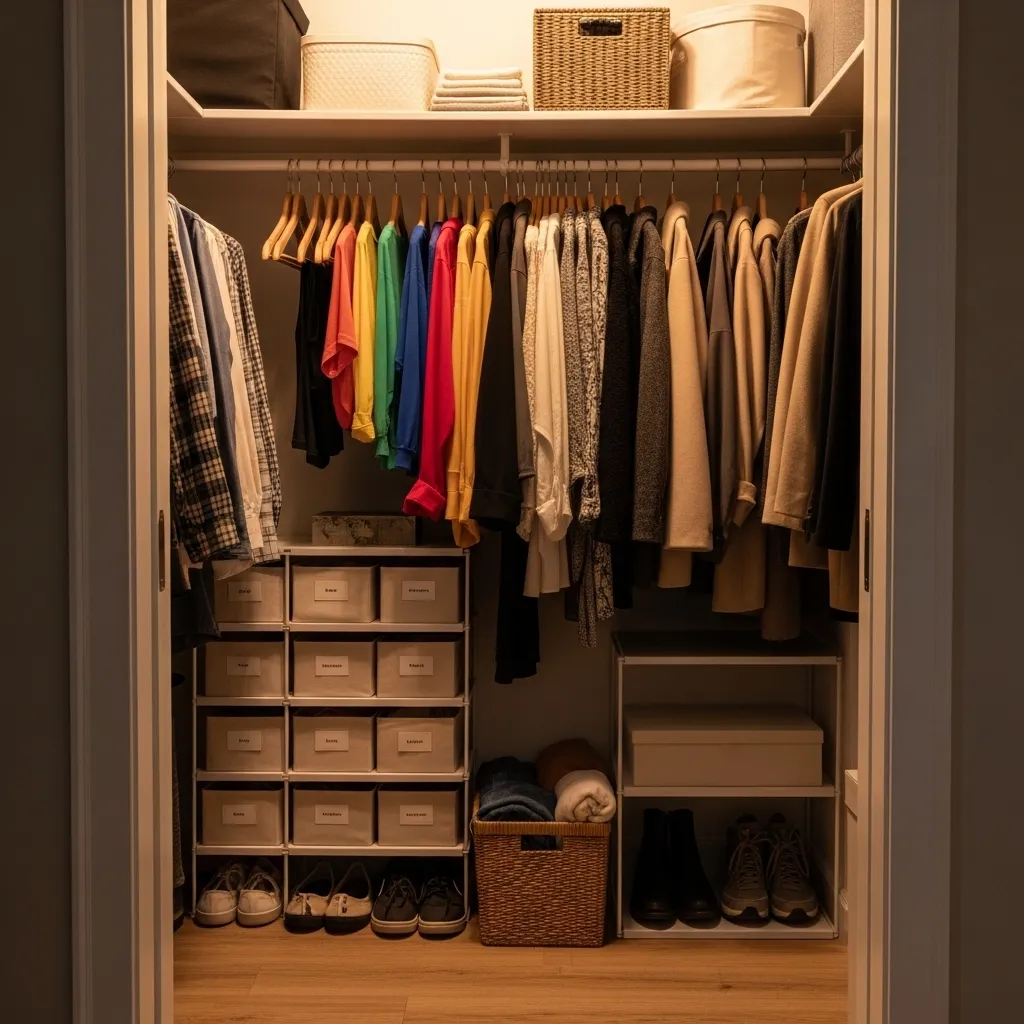
A weekly reset habit — spending ten to fifteen minutes returning everything to its proper place, addressing the items that have drifted from their designated zones, replacing hangers that have been turned the wrong direction, and doing a quick visual scan for anything that needs attention — is the practice that keeps a well-organized small closet functioning well indefinitely rather than cycling between organized and chaotic every few months. Organization is not a one-time event but an ongoing practice, and small closets require that practice to be genuinely small and regular rather than large and infrequent.
The specific time and cadence of the weekly reset matters less than the consistency of it — some people do it on Sunday evening as preparation for the week ahead, some do it on Friday afternoon as a clearing ritual at the end of the work week, some do it whenever the closet reaches a specific threshold of drift. What matters is that it happens regularly enough that no single reset takes more than fifteen minutes, because a closet that’s maintained weekly never gets far enough from its organized state to require the kind of extended, effortful reorganization that makes closet organization feel like a burden rather than a practice. Small, regular investment in maintenance is what separates a closet that works from one that used to work.