15 Modern Farmhouse Wall Decor Ideas That Create Warmth, Character, and the Specific Feeling That a Home Has Been Loved Over Time
If you’ve been trying to nail the modern farmhouse aesthetic on your walls and finding yourself either veering too far into the territory of mass-produced shiplap-and-buffalo-check that feels more like a theme park version of farmhouse than the real thing, or overshooting into a purely contemporary direction that loses the warmth and character and sense of accumulated history that makes farmhouse spaces feel specifically beautiful — this roundup covers every significant wall decor approach that hits the specific tonal balance the modern farmhouse aesthetic is actually after. The ideas here span the full range: the gallery wall approach done with specifically farmhouse-appropriate content and framing, the architectural salvage piece that brings genuine history into a contemporary interior, the oversized clock that references agricultural timekeeping tradition, the botanical and natural specimen print approach, the shiplap and board-and-batten wall treatments that are the aesthetic’s most characteristic architectural interventions, the vintage mirror approach, the woven textile wall hanging, the floating shelf as a wall decor moment, the DIY wooden sign approach done with restraint and genuine craft, the gallery of black and white family photography, the antique tool or agricultural implement collection, the large-format landscape or nature artwork, the iron and metal wall sculpture, the vintage window or door frame as wall object, and the whitewashed wood panel treatment that creates texture without the full commitment of architectural wall treatment.
The modern farmhouse aesthetic has a specific challenge that most interior styles don’t face in quite the same way — it’s a style that has been so thoroughly commercialized, so completely translated into a product category available at every price point in every home goods store, that the version of it you can buy off the shelf at a mass retailer looks almost identical to the version you’d find in a genuinely beautiful farmhouse home, at least in a quick glance photograph. The difference between the two versions is only perceptible in person, through sustained attention, and it’s the difference between objects that have genuine material quality and genuine historical resonance and objects that are performing those qualities through stylistic reference. A real antique clock with genuine patina and working mechanism is different in a room from a reproduction clock with artificially distressed paint, even if both have similar visual profiles. A genuine vintage botanical print found at an estate sale is different from a licensed reproduction of the same print, even if the image is identical. The modern farmhouse wall decor that creates genuinely beautiful spaces is made from the former rather than the latter, and the consistent thread through this guide is prioritizing authentic material quality and genuine historical character over stylistic references to those qualities.
What makes modern farmhouse wall decor work at its best is the quality of tension it maintains between old and new — between the rough and the refined, the salvaged and the contemporary, the handmade and the precise, the weathered and the crisp. The purely old farmhouse is a museum; the purely contemporary space with farmhouse references is a costume. The modern farmhouse that succeeds lives genuinely in the tension between those two poles, and the wall decor is where that tension is most visible and most expressible because walls are where the largest, most characterful, most personally expressive decisions in a home live.
1. The Modern Farmhouse Gallery Wall
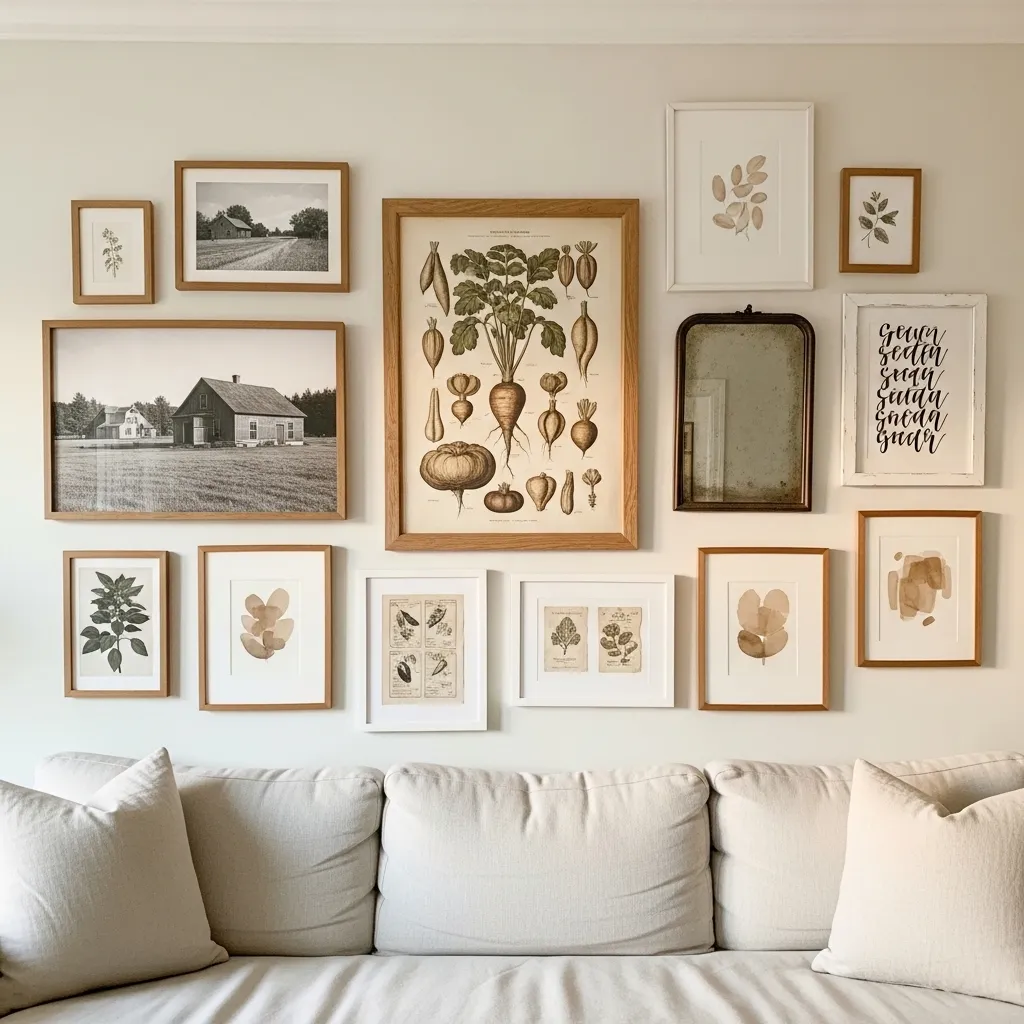
A modern farmhouse gallery wall distinguishes itself from other gallery wall styles primarily through its content and its frame selection — the content should reference the natural world, agricultural history, or personal family narrative in a way that feels genuinely connected to the farmhouse tradition rather than decoratively gesturing toward it, and the frames should be simple, slightly imperfect, and natural in material rather than ornate, matching, or aggressively contemporary. The mix of botanical prints, vintage agricultural art, black and white photography, and simple typography within natural and aged frames creates the specific visual language of a modern farmhouse gallery — personal, warm, historically connected, and specifically not corporate or designed to within an inch of its life.
The loose, organic arrangement of a farmhouse gallery wall — where pieces are hung at slightly different heights and at varying distances from each other, where the overall composition has visual logic but not geometric precision — is the arrangement approach that most naturally creates the feeling of a collection assembled over time rather than installed as a designed unit. A gallery wall with military precision in its alignment and spacing reads as recently installed; a gallery wall where the spacing varies organically and where the alignment is approximate rather than exact reads as accumulated, and it’s that quality of accumulation over time that most characterizes genuinely beautiful farmhouse interiors.
2. Shiplap Feature Wall
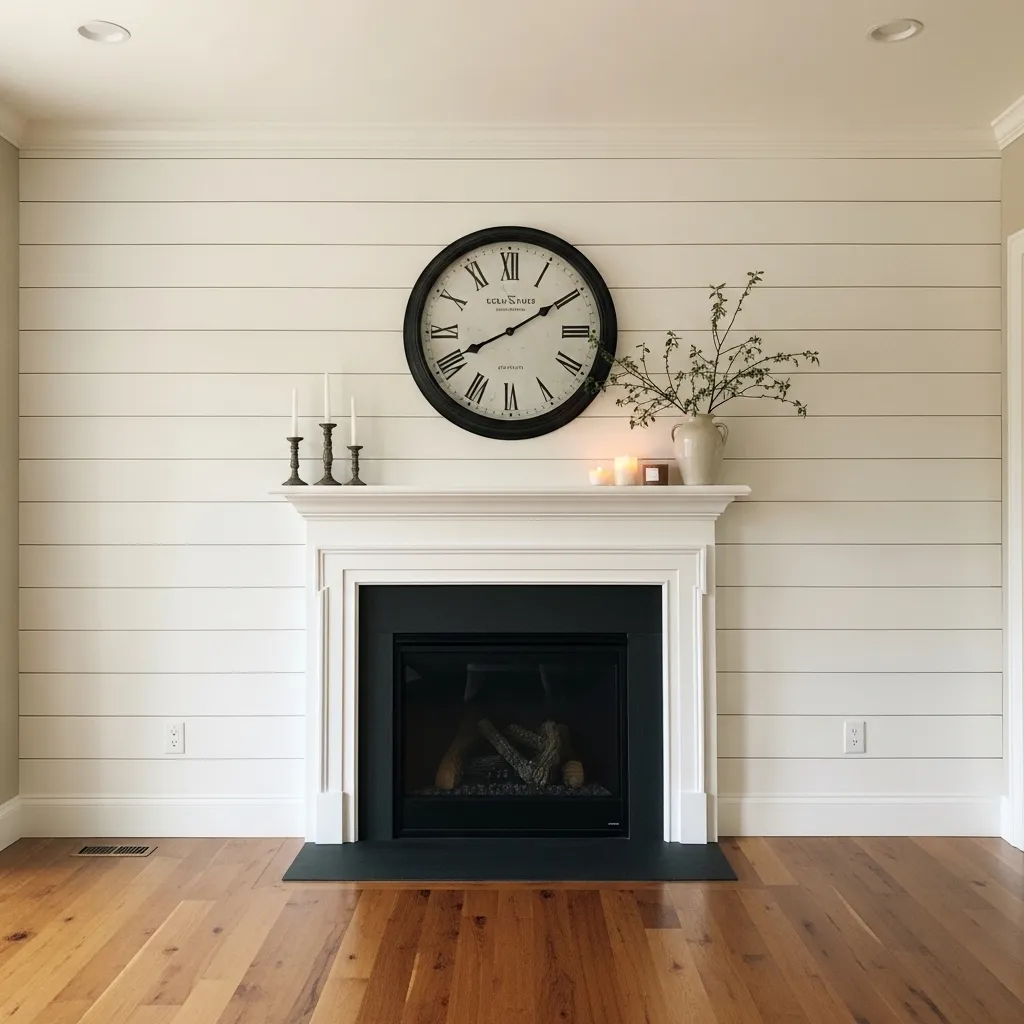
Shiplap is the wall treatment most completely identified with modern farmhouse design — and it retains its relevance precisely because it references a genuine and long tradition of horizontal board cladding in American agricultural vernacular architecture, where overlapping horizontal boards were the most practical exterior and sometimes interior wall cladding available in areas where timber was abundant. The modern farmhouse shiplap wall is not a decorative invention but a simplified, cleaned-up version of a genuinely historical construction approach, and that historical authenticity is what gives it the specific warmth and architectural character that flat drywall simply can’t replicate regardless of paint color.
The specific quality of shiplap that creates its characteristic visual effect is the shadow line — the narrow horizontal gap between courses that creates a fine shadow when light rakes across the wall surface. This shadow line adds a subtle horizontal texture to the wall surface that reads as architectural detail at close range and as a slightly warm, textured surface at room distance, without adding the visual complexity that more elaborate wall treatments create. The shadow line also makes light work differently across a shiplap wall than it does across a flat wall — as the light angle changes through the day, the shadows in the gaps shift and the wall appears to change its texture slightly, creating a wall surface that’s alive and light-responsive in a way that painted drywall isn’t.
3. Oversized Vintage-Style Clock
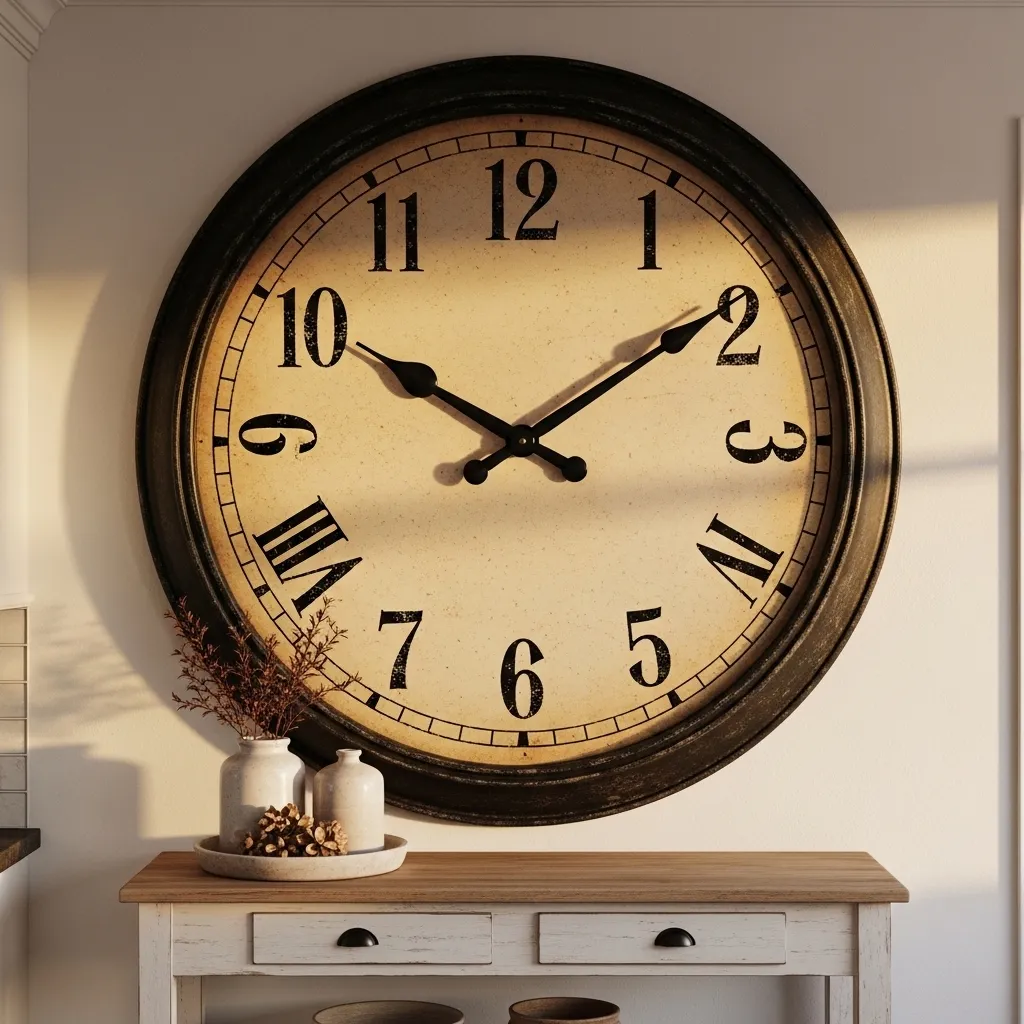
An oversized farmhouse clock — genuinely large, in aged metal or wood with a distressed or industrial quality — is the wall decor element that most efficiently creates the sense of agricultural timekeeping tradition that’s central to the farmhouse aesthetic. Clocks in agricultural settings were practical instruments of genuine importance — timing planting and harvesting cycles, coordinating the work of multiple people across large properties, marking the hours of a working day that began before dawn and ended after dark — and an oversized clock in a farmhouse kitchen or living room references that tradition of practical timekeeping while creating a wall focal point of genuine visual authority.
The scale is the critical decision — a standard twelve-inch clock on a farmhouse wall reads as a domestic accessory; a thirty-inch or larger clock reads as an architectural feature, as something that anchors the wall and creates a visual center of sufficient gravity to organize the surrounding space. This scale difference is the difference between a clock hung on a wall and a clock that is the wall’s primary design moment, and the farmhouse aesthetic requires the latter — a piece of such confident scale that it needs nothing around it to justify its presence.
4. Botanical and Natural Specimen Prints
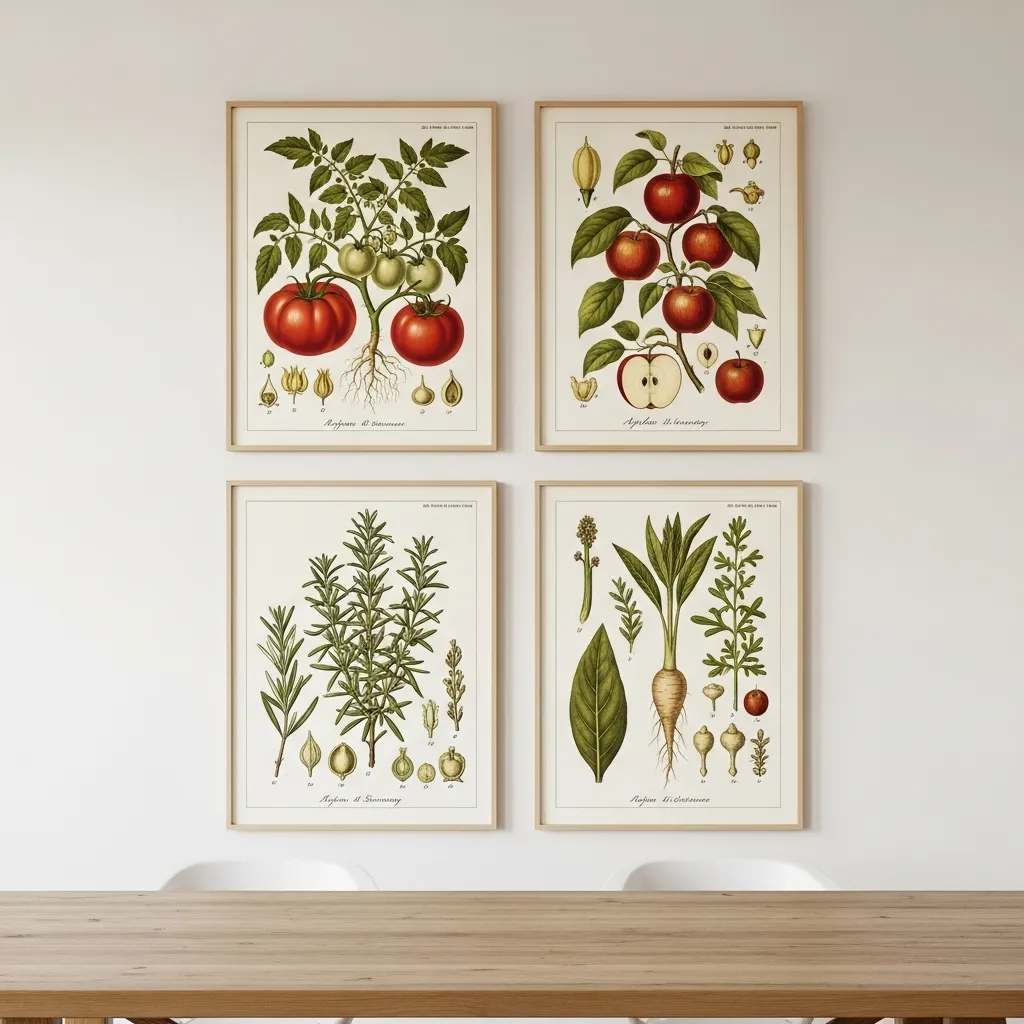
Botanical and natural specimen prints in the tradition of nineteenth-century scientific illustration create the most intellectually rich and most historically grounded wall decor available in the farmhouse aesthetic — they reference the tradition of careful natural observation and precise documentary illustration that was central to agricultural science in the eighteenth and nineteenth centuries, when understanding plants in precise detail was a matter of practical agricultural importance rather than decorative interest. This historical connection to agricultural and botanical knowledge gives specimen prints a quality of intellectual and historical resonance that purely decorative botanical art lacks.
The specific content that creates the most authentically farmhouse-appropriate botanical print collection is the content of the kitchen garden and the orchard rather than tropical exotica or garden flowers — heirloom vegetables, fruit varieties, culinary herbs, root vegetables. These are the plants of the working agricultural landscape rather than the ornamental garden, and their appearance on a farmhouse wall connects the interior directly to the productive landscape outside in a way that purely decorative floral prints don’t. A collection of heirloom tomato variety illustrations, apple variety prints, and culinary herb studies creates a wall that reads as genuinely connected to food and growing and the agricultural tradition.
5. Board and Batten Wall Treatment
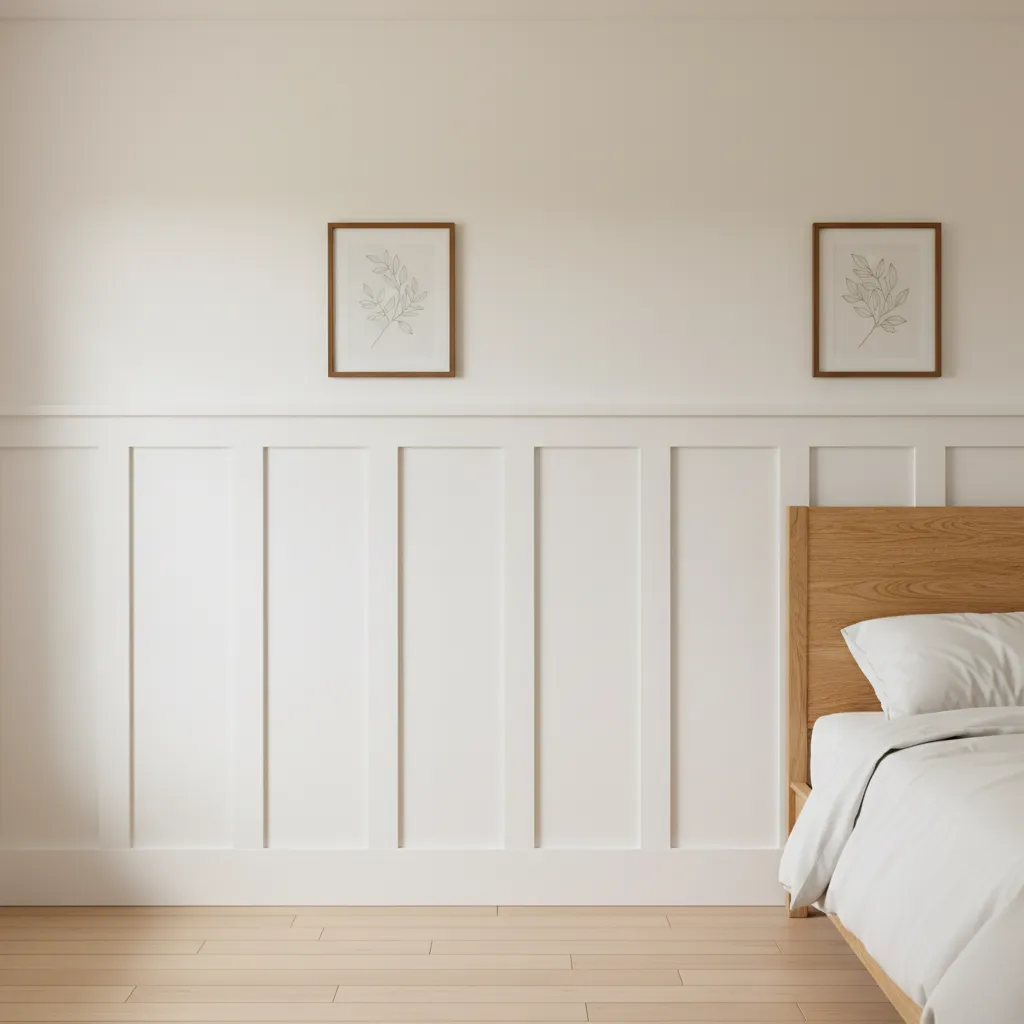
Board and batten wall treatment creates a more architectural and more vertically oriented interpretation of the farmhouse paneling tradition than shiplap — where shiplap is horizontal and creates a low, grounded, cabin-like quality, board and batten is vertical and creates a taller, more refined, more architecturally formal quality that suits formal farmhouse spaces like dining rooms, entryways, and master bedrooms. The vertical battens draw the eye upward and make ceilings feel higher, which makes board and batten particularly valuable in rooms where the ceiling height is modest and additional perceived height is welcome.
The installation of board and batten to wainscot height — with the paneling running from baseboard to a horizontal cap rail at chair-rail height and the upper wall in plain painted surface — creates a beautifully proportioned wall that uses the paneling’s architectural detail in the zone where it’s most seen and most appreciated, while keeping the upper wall simple enough to receive art, mirrors, and other wall decor without the paneling competing for visual attention. The cap rail that separates the paneled lower zone from the plain upper zone is itself a small architectural detail of significant importance — its precise height and its profile determine the proportional relationship between the paneled and plain zones, and getting those proportions right is what makes the difference between a board and batten installation that looks architecturally considered and one that looks applied.
6. Architectural Salvage as Wall Art
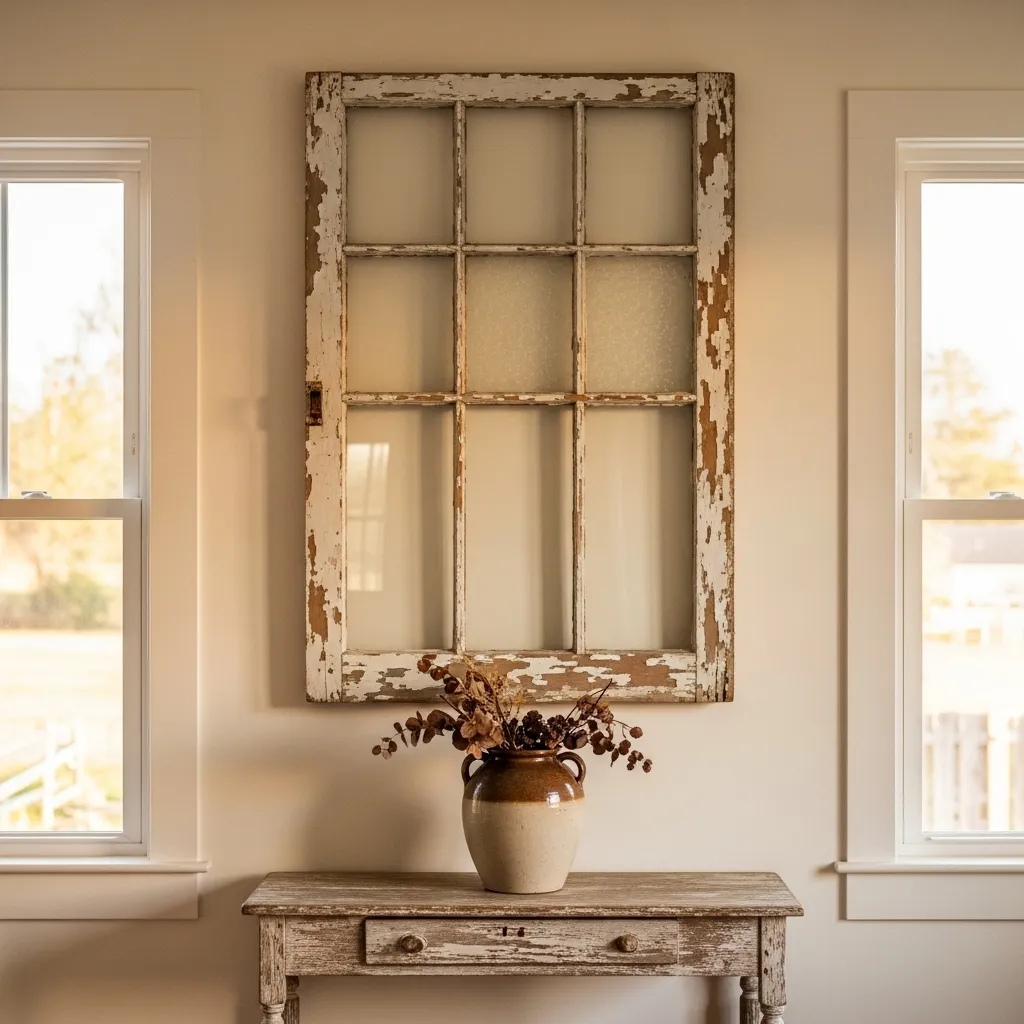
An architectural salvage piece — an antique window frame, a section of carved molding, an old door with original hardware, a section of iron fencing, a vintage sign — used as wall art is the farmhouse wall decor approach that most completely achieves the quality of genuine historical presence that reproduction pieces can only reference. Authentic salvage brings actual history into the room — the specific building it came from, the specific decades of use and paint accumulation it carries, the specific quality of old-growth timber or hand-forged iron that contemporary materials simply don’t possess — and that genuine historical presence is irreplaceable by any reproduction regardless of its craft quality.
The antique window frame is particularly effective as farmhouse wall art because it creates a visual play between the real and the fictive — a window-shaped object on a wall creates the suggestion of an opening, a view, a connection to space beyond the wall, without being an actual window. This visual suggestion of depth-beyond-the-wall is especially valuable in smaller farmhouse rooms where additional perceived depth is welcome, and the layered paint and wavy antique glass of a genuine old window frame adds a specific quality of beauty and age that makes it as interesting at close range as it is from across the room.
7. Oversized Vintage or Antique Mirror
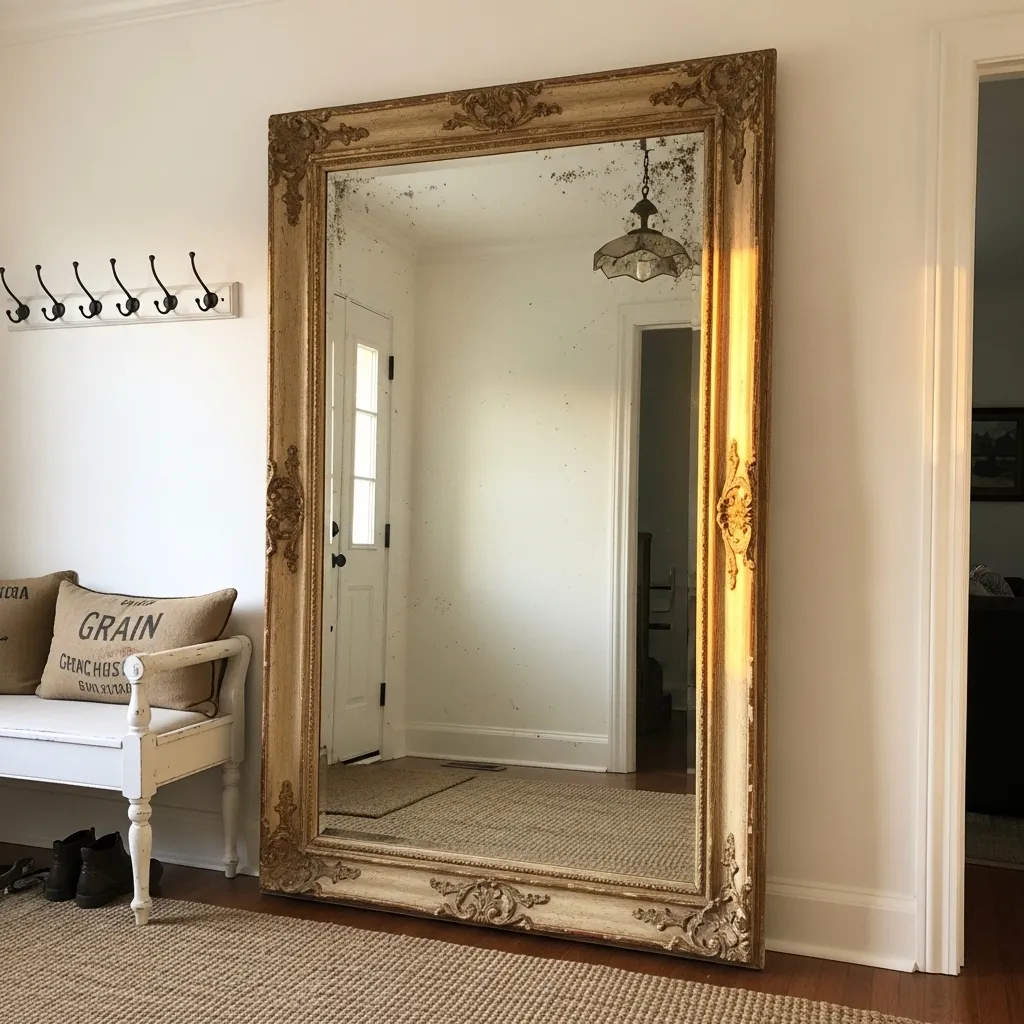
An oversized antique or vintage mirror in a farmhouse space creates the wall element with the highest ratio of impact to visual complexity — because a large mirror is simultaneously a powerful visual presence and a neutral surface, one that creates the impression of additional space and additional light while being itself relatively simple in its decorative demands. The farmhouse interior specifically benefits from large mirrors because farmhouse spaces often have modest window sizes relative to contemporary standards, and a large mirror reflecting the available natural light effectively doubles the apparent brightness of a room without any electrical or structural intervention.
The aged frame is the quality that distinguishes a genuinely farmhouse-appropriate mirror from a purely contemporary one — the weathered gold and cream paint of a vintage French or provincial mirror, the distressed white of an American farmhouse mirror, the simple aged wood of a rustic colonial mirror all have the quality of genuine age that connects the mirror to the farmhouse’s historical aesthetic rather than sitting in contrast with it. The specific warmth of aged gilding — where the gold has worn and the underlying layers have come through in a complex, warm, slightly tarnished way — is a beauty that can’t be manufactured and can only be found in genuinely old objects.
8. Woven Textile Wall Hanging
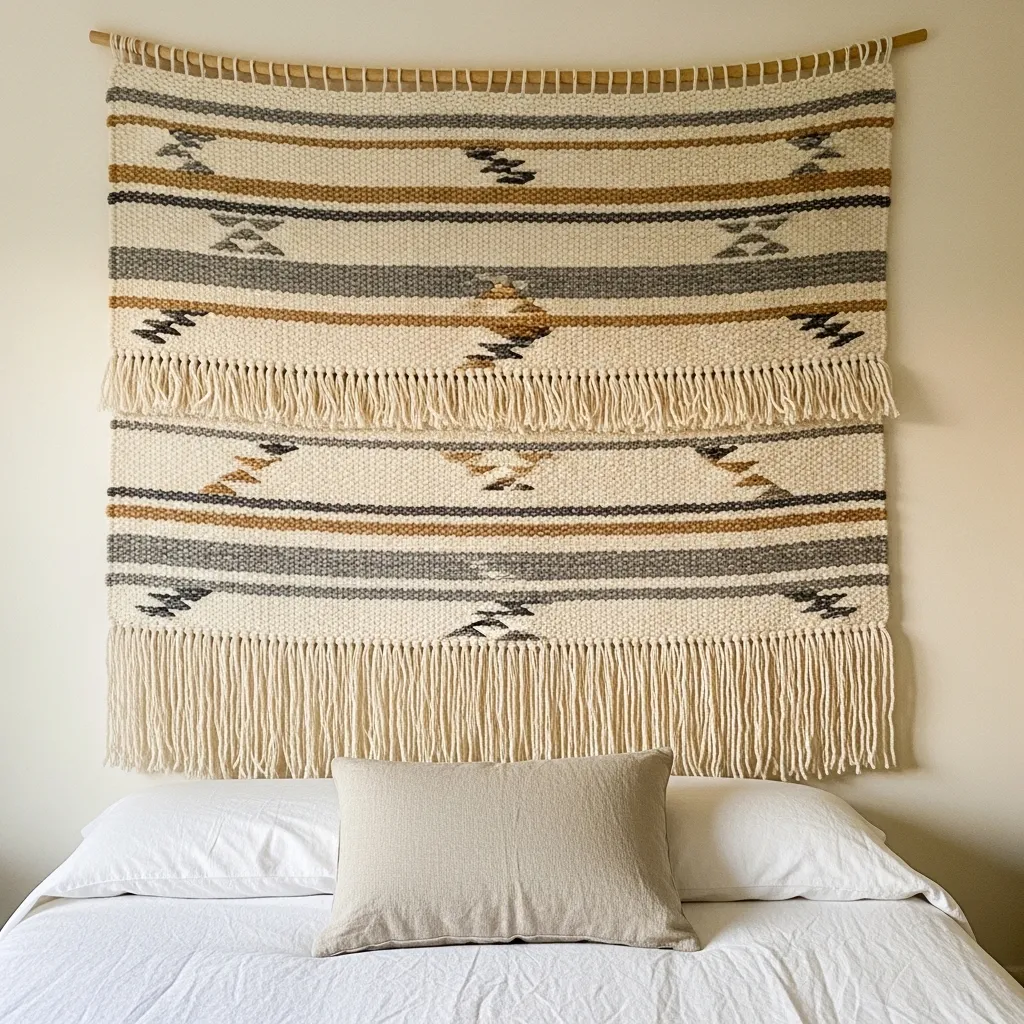
A handwoven textile wall hanging in natural fibers is the farmhouse wall treatment that adds the most warmth and tactile richness of any flat wall decor approach — because textile has the specific quality of absorbing light rather than reflecting it, of creating warmth through material density rather than surface decoration, of making a wall feel physically warmer simply through its presence. A large woven hanging above a bed creates a visual headboard equivalent that’s softer and more personally expressive than a painted or printed artwork, and its natural fiber quality connects directly to the farmhouse aesthetic’s consistent valuing of natural, handmade, agricultural materials.
The specific textile content and color palette for a farmhouse wall hanging should reference the handcraft traditions of American domestic textile production — the geometric patterns of early American weaving, the natural undyed tones of farm-produced wool and cotton, the simple stripe patterns of utilitarian domestic textile rather than the elaborate pattern of decorative tapestry. These references connect the wall hanging to the farmhouse tradition of practical domestic craft — the blankets and rugs and cloth woven on farm looms for actual use — and create a hanging that reads as genuinely connected to that tradition rather than as a contemporary decorative object referencing it.
9. Black and White Family Photography Gallery
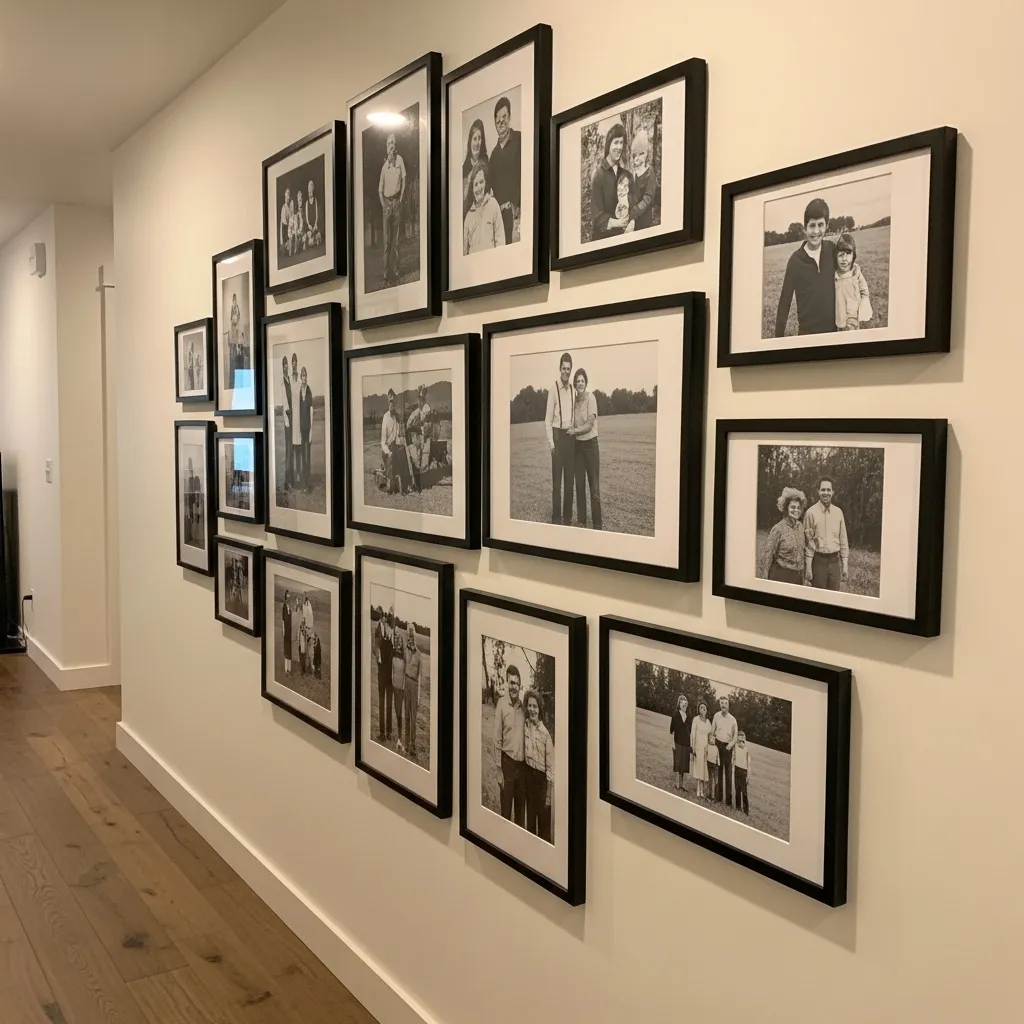
A gallery of genuine black and white family photographs is the wall treatment that most completely personalizes a farmhouse interior and most directly creates the feeling that a home has been inhabited and loved across generations rather than recently renovated. Photographs of actual family members — grandparents in their working years, parents as children, children now grown — create a wall that tells a specific family’s story in a way that no purchased or decorative imagery can approach, and in a farmhouse context where the connection to family history, to agricultural heritage, and to the long continuity of domestic life are central aesthetic values, that personal family narrative is precisely the right wall content.
The black and white format is the specific photographic choice that makes a family photograph gallery feel farmhouse-appropriate rather than contemporary and photographic — black and white removes the visual complexity of color variation across photographs taken in different eras and different lighting conditions, creates a consistent vintage quality across the whole collection regardless of when individual photographs were taken, and connects contemporary family photographs to the historical photographic tradition of farm family portraiture in a way that color photographs, however beautiful, don’t quite manage.
10. Vintage Agricultural Tool or Implement Collection
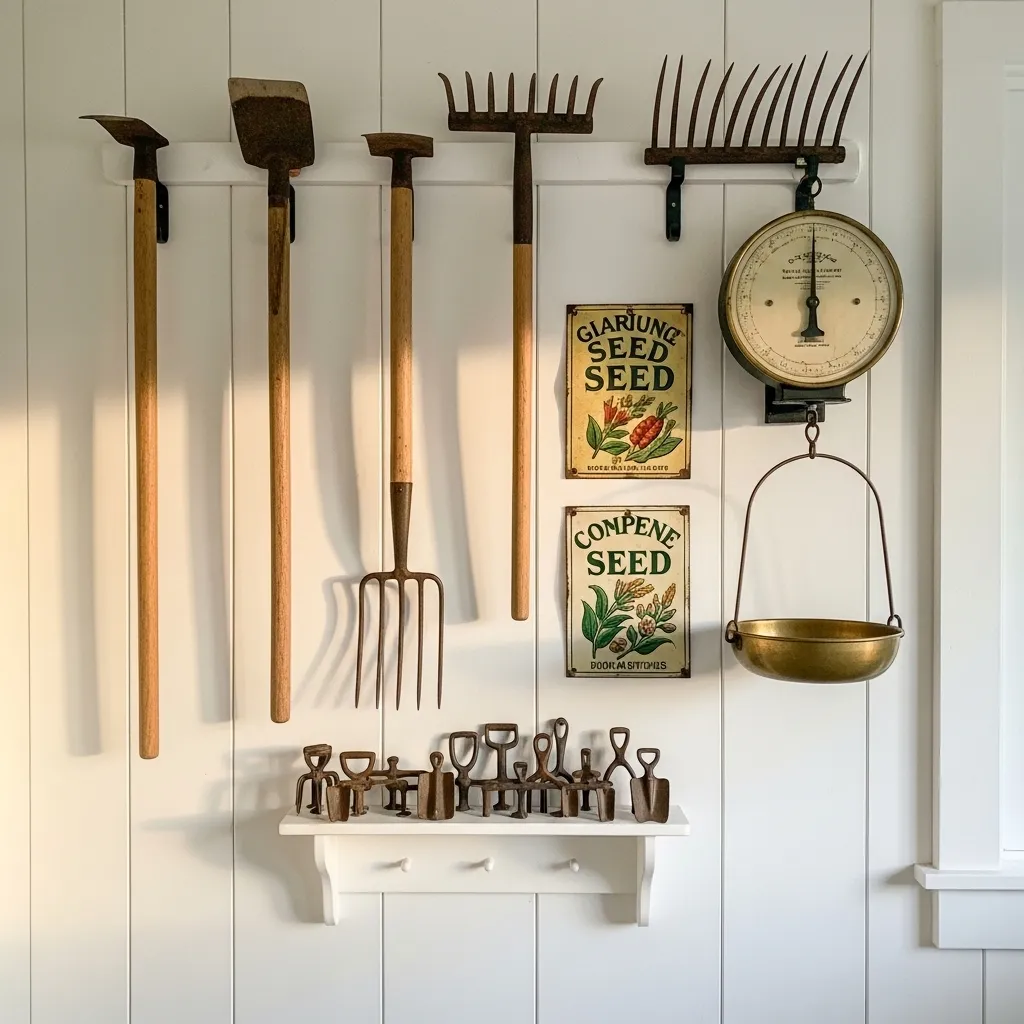
A collection of vintage agricultural tools and implements displayed on a farmhouse wall creates the most authentically connected-to-agricultural-history wall treatment available — these are the actual objects of farm work, the tools that were used in the fields and gardens that produced the agricultural abundance the farmhouse aesthetic celebrates, and displaying them on the wall acknowledges their cultural and historical significance rather than treating them as merely decorative objects. The worn wooden handles, the rust-patinated iron heads, the aged tin of vintage seed company signs all carry the specific material history of actual farm use, and that authenticity creates a wall treatment that no reproduction can replicate regardless of its craft quality.
The display arrangement should reference the practical organization of a working tool wall — hooks at appropriate heights for different tool types, logical grouping of related tools, the visual rhythm of repeated forms hanging at consistent intervals — rather than the purely aesthetic arrangement of a gallery or collection display. This practical organizational logic creates a wall that reads as genuinely functional in its original context, as a section of a working farm’s organizational system that has been moved into a contemporary home, rather than as a decorative arrangement assembled purely for aesthetic effect.
11. Large-Format Landscape or Nature Artwork
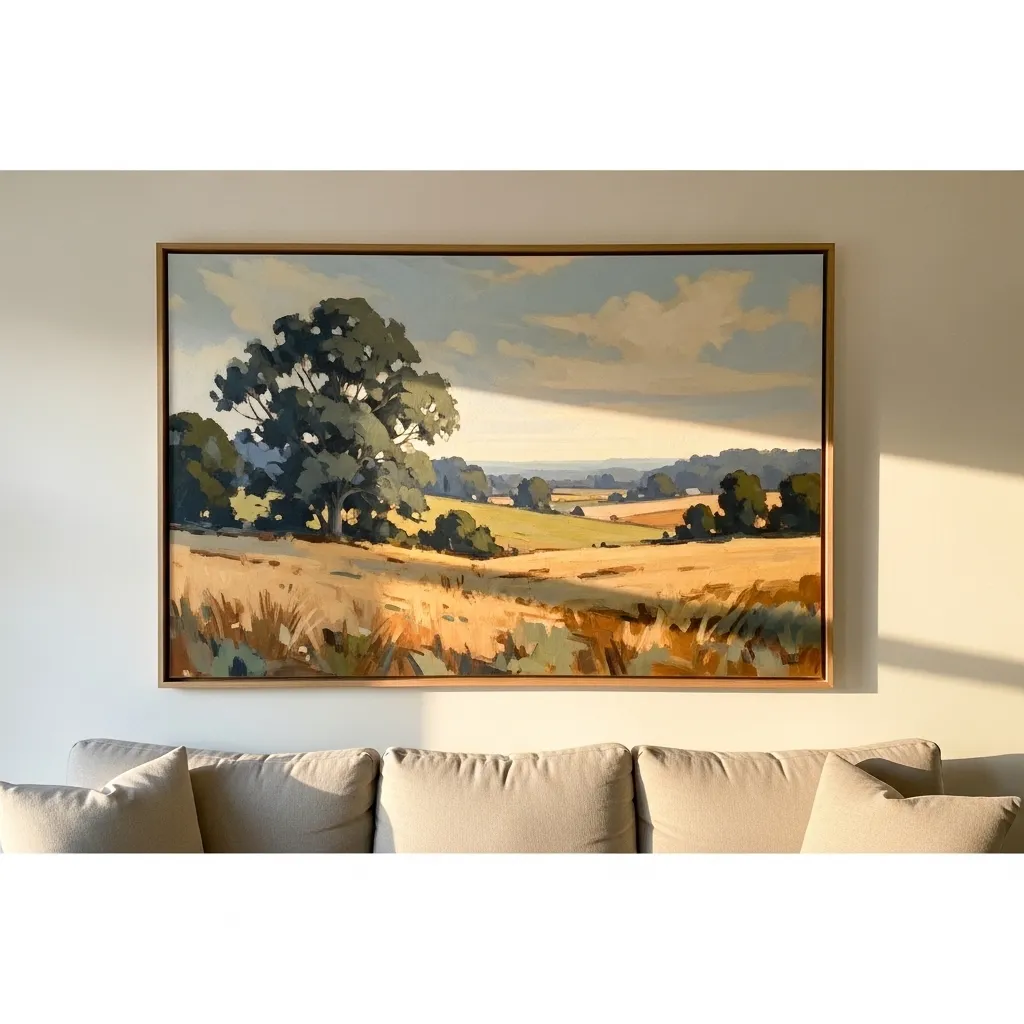
A large-format landscape or nature painting — in the warm, painterly style that references American pastoral painting traditions — creates the farmhouse wall’s most direct visual connection to the agricultural landscape outside, bringing the fields, trees, sky, and seasonal change of the exterior world into the interior space in a form that’s both aesthetically rich and specifically farmhouse-appropriate. The landscape painting on a farmhouse wall is not a decorative convention but a genuine expression of the farmhouse aesthetic’s fundamental value — the belief that the natural world, the agricultural landscape, the changing seasons are beautiful and worthy of contemplation and that bringing that beauty inside through art is a way of maintaining the connection to the outdoor world that farmhouse living is built on.
The specific landscape content that works best in a farmhouse context references the working agricultural landscape rather than the wilderness or the purely picturesque — fields in varying seasonal states, orchards, kitchen gardens, farm buildings within landscape, the sky above agricultural land. These subjects reference the specific beauty of farmed land rather than untouched wilderness, and that connection to the cultivated, working landscape creates a painting that reads as genuinely connected to the farmhouse tradition rather than as generic nature art.
12. Iron and Metal Wall Sculpture
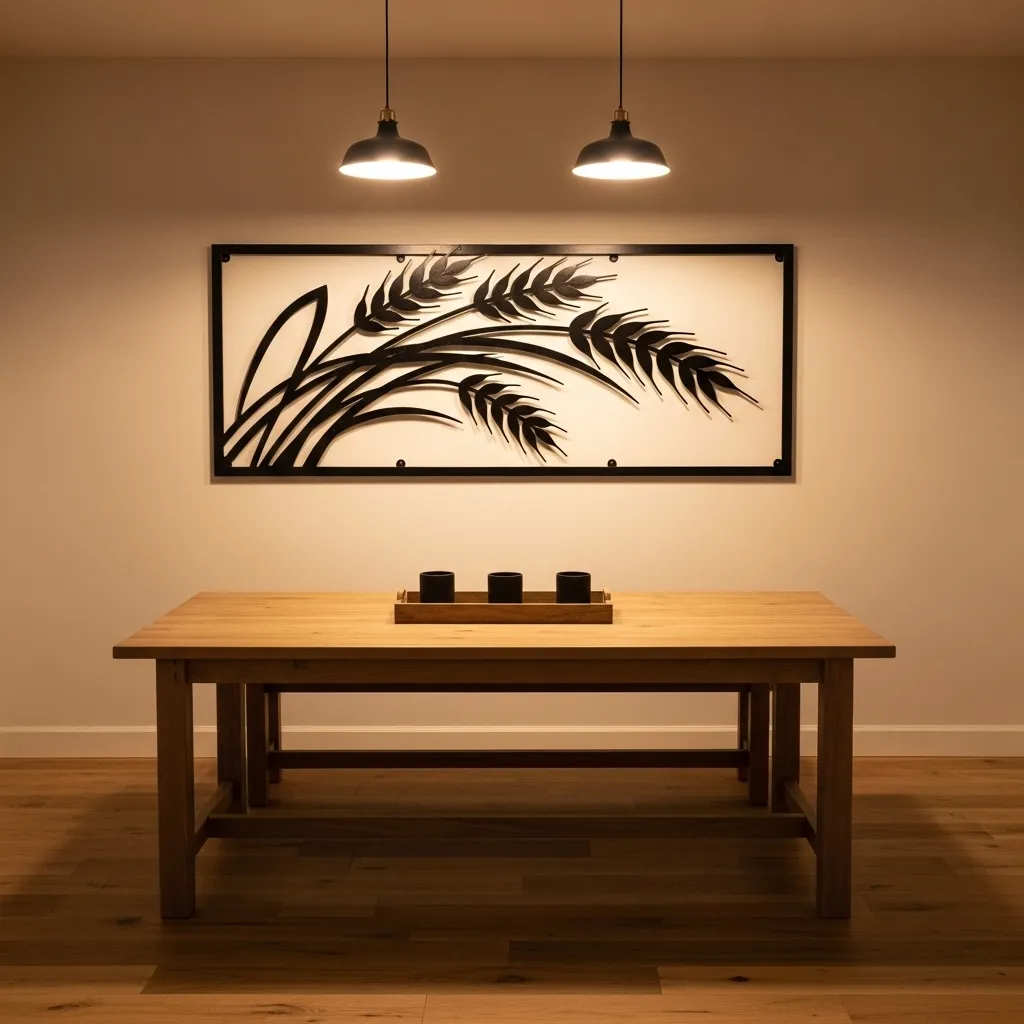
An iron or metal wall sculpture with an agricultural or botanical motif — a wheat sheaf, a botanical branch, a simple animal form, a geometric pattern referencing traditional iron craft — brings the specific material and craft tradition of agricultural blacksmithing into the farmhouse interior as art. Iron has been central to agricultural life for centuries — the plows, the gate hinges, the tool heads, the stove components — and hand-forged iron in a farmhouse wall sculpture acknowledges that material centrality while creating a piece of genuine visual and material interest.
Hand-forged iron specifically — as opposed to cast iron or fabricated steel — carries the evidence of its making in its surface texture, the slight irregularities that come from hammer work, the specific surface quality of heated and worked metal that cast or machined metal doesn’t possess. These qualities of hand-making connect the iron sculpture to the long tradition of agricultural blacksmithing and create a wall object with genuine material character and genuine craft quality that mass-produced metal wall decor can’t replicate. The specific gravity and visual weight of iron — its darkness, its matte surface, its physical density — also creates a wall object with genuine presence that lighter or more reflective materials don’t quite achieve.
13. Vintage Window Frame as Wall Feature
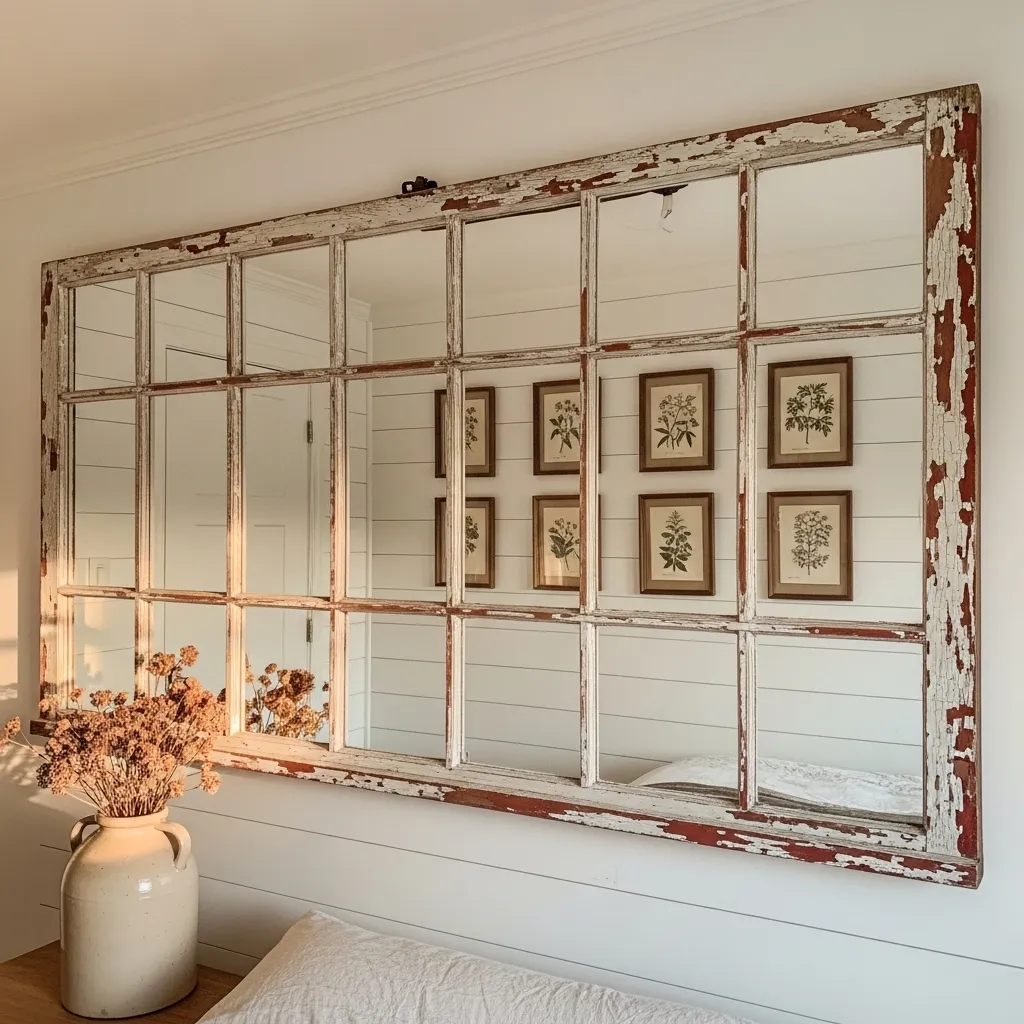
A vintage window frame used as a wall feature — mounted on the wall with or without glass, either alone or as a layered compositional element in front of other wall art — is the farmhouse wall treatment that creates the most architectural presence from a single salvage object. The window frame references its original architectural context — the wall it once sat in, the view it once framed, the building it once belonged to — while creating a new context on the current wall that’s simultaneously practical (it takes up no floor space) and visually powerful (a window-shaped object on a wall creates a strong architectural statement).
The chippy, layered paint of a genuinely old window frame is the specific quality that makes vintage window frames more beautiful as wall art than new window frames dressed to look old — the layers of paint that have accumulated over decades, each application representing a different owner’s decision about the right color for that window, create a surface of genuine archaeological interest that rewards close inspection. The warm chippy white over barn red over whatever previous layers exist beneath creates a surface that tells a story of continuous habitation and continuous care, and that story is precisely what farmhouse wall decor at its best should communicate.
14. Floating Shelf as a Complete Wall Decor Moment
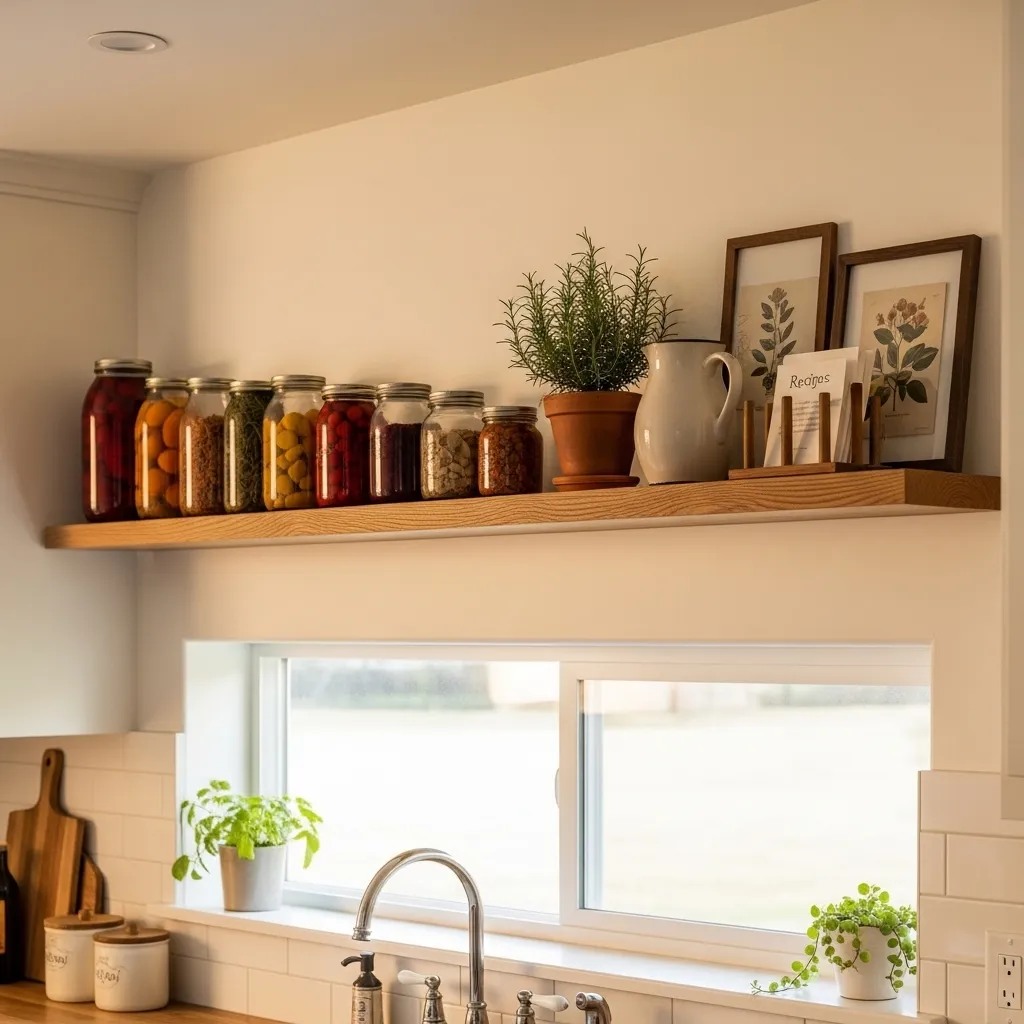
A floating shelf styled as a complete wall decor moment — where the shelf, its brackets, and its contents are designed together as a single integrated wall feature rather than as a storage solution that happens to look nice — creates the farmhouse wall treatment that most seamlessly bridges functional and aesthetic purposes. In a farmhouse kitchen specifically, where the tradition of displaying functional objects beautifully (the hanging copper pots, the displayed ceramic jars, the visible herb garden) is central to the aesthetic, a well-styled floating shelf embodies the farmhouse principle that useful things can and should be beautiful, that there’s no necessary conflict between the functional and the decorative.
The specific objects on a farmhouse kitchen shelf should be simultaneously beautiful and genuinely functional — vintage glass storage jars that actually hold preserved foods or dry goods, a ceramic pitcher that’s actually used for water or flowers, a potted herb that’s actually used in cooking. The functional integrity of the display objects is what creates the specifically farmhouse quality of the shelf — a farmhouse shelf displaying genuinely used functional objects is different in character from the same shelf displaying purely decorative objects that merely look like functional ones, and that difference, while subtle, is the specific quality that distinguishes farmhouse from farmhouse-themed.
15. Whitewashed Wood Panel Wall Treatment
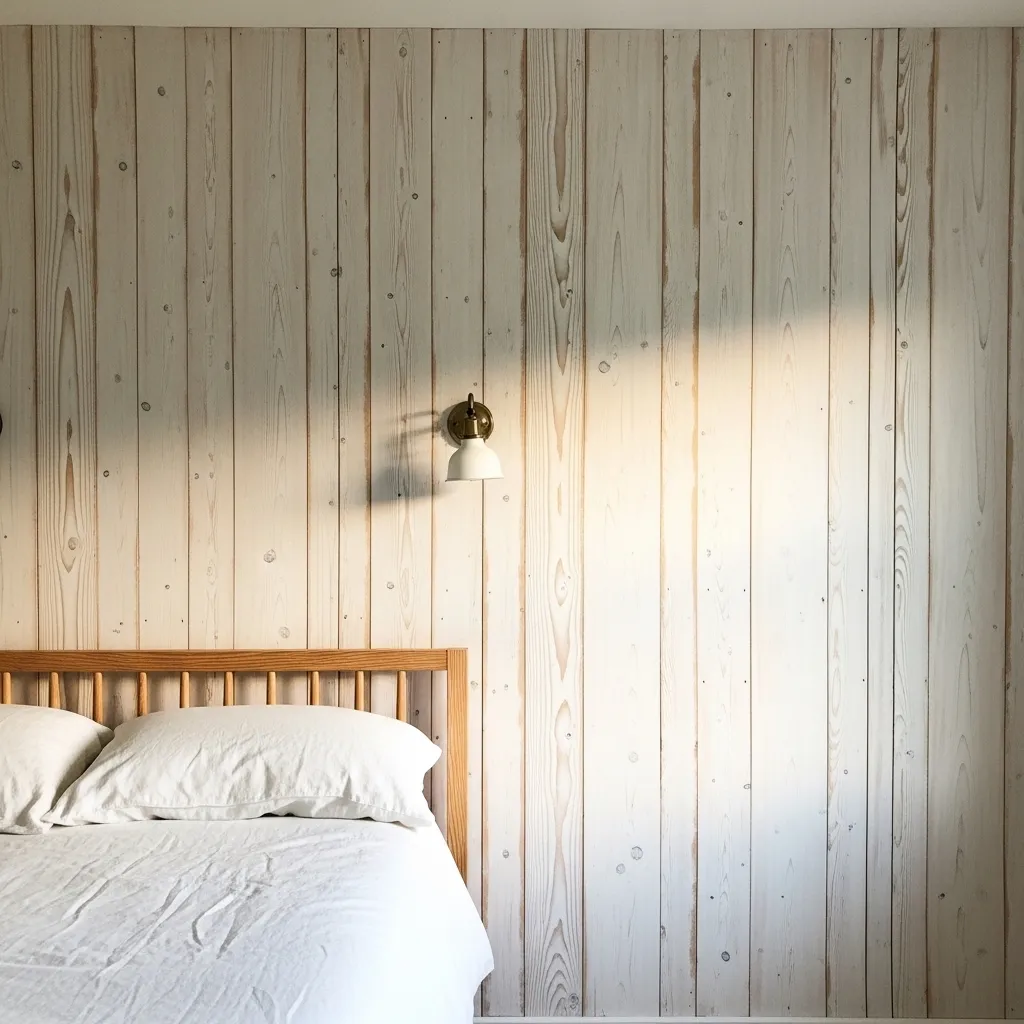
Whitewashed vertical plank paneling is the farmhouse wall treatment that creates the warmest and most specifically traditional farmhouse character of all the wall treatment options — the whitewash technique itself is among the oldest domestic surface treatments, used in farmhouses and agricultural buildings throughout American and European history as an inexpensive, practical, and beautiful way to brighten and protect interior wood surfaces while allowing the material character of the wood to remain visible beneath the wash. Contemporary whitewashed wood paneling references this historical technique in a way that creates genuine warmth and genuine historical connection rather than merely decorative texture.
The specific quality of whitewash — the way it settles more deeply into the grain valleys and sits more thinly on the grain ridges, creating a surface that appears to have depth and dimension even though it’s flat — is what makes whitewashed wood different from and more interesting than painted wood. A painted board has its grain obscured beneath a film of pigment; a whitewashed board has its grain enhanced by the white wash that sits within it, making the natural pattern of the wood more visible rather than less. This quality of enhancing rather than obscuring the material’s natural character is specifically aligned with the farmhouse aesthetic’s fundamental value of celebrating natural materials in their most honest and most beautiful forms.