15 Ways to Organize a Tiny Room So It Functions Brilliantly, Feels Generous, and Never Becomes the Overwhelming Disaster It Could So Easily Be
If you are living with a room that’s too small for everything it needs to contain — a bedroom that has to be an office, a studio apartment where the kitchen and the living room and the sleeping area are all the same room, a child’s room that needs to hold a bed and a desk and storage for everything a child owns in an amount of space that seems engineered specifically to make that impossible, a bathroom so small that turning around in it requires a strategy — this guide is specifically for you, and it’s going to cover every significant organizational approach that makes the difference between a tiny room that works and a tiny room that defeats you every single day. The fifteen approaches here address the full range of what tiny room organization actually requires: the vertical storage principle that most small room dwellers dramatically underuse, the furniture-with-storage approach that eliminates the false choice between seating and storage capacity, the zone-definition strategy that makes a single room serve multiple functions without chaos, the door and wall space utilization that finds hidden storage in the most overlooked places, the decanting and container system that transforms the visual complexity of accumulated objects into calm visual order, the digital-and-minimal philosophy that addresses the most fundamental small room problem at its root, and many more approaches that together create the conditions for a tiny room to function at a level that seems impossibly good for its square footage.
I want to be honest about something that most small room organization guides avoid saying directly: the best organizational system in the world cannot compensate for too much stuff. The foundational truth of tiny room organization — the one that precedes every system, every storage solution, every clever piece of furniture — is that a tiny room can hold a specific quantity of objects well, and that quantity is almost certainly smaller than the quantity of objects most people bring into the room with the hope that the right organizational system will accommodate them all. The genuinely well-organized tiny room is almost always also a genuinely edited tiny room — one where the decision about what to keep has been made with more ruthlessness than feels comfortable, and where the organizational systems address a curated collection of genuinely needed objects rather than attempting to create order from an accumulation that exceeds the room’s actual capacity.
What I’ve learned from living in small spaces and from thinking carefully about what makes them work is that the organization question and the design question are not separate questions in a tiny room — they’re the same question. The way a tiny room is organized determines how it looks and how it feels to be in it just as much as any aesthetic decision does, and the aesthetic quality of an organizational system (the visual calm created by consistent containers, the spatial expansiveness created by floor-level clearance, the sense of intentional design created by storage solutions that look considered rather than improvised) is not a luxury consideration but a functional one. A visually calm, well-organized tiny room feels larger and functions better than a visually complex, poorly organized room of identical dimensions, and that quality of visual calm is achieved through organizational decisions as much as through decorative ones.
1. Go Vertical — Use Every Inch From Floor to Ceiling
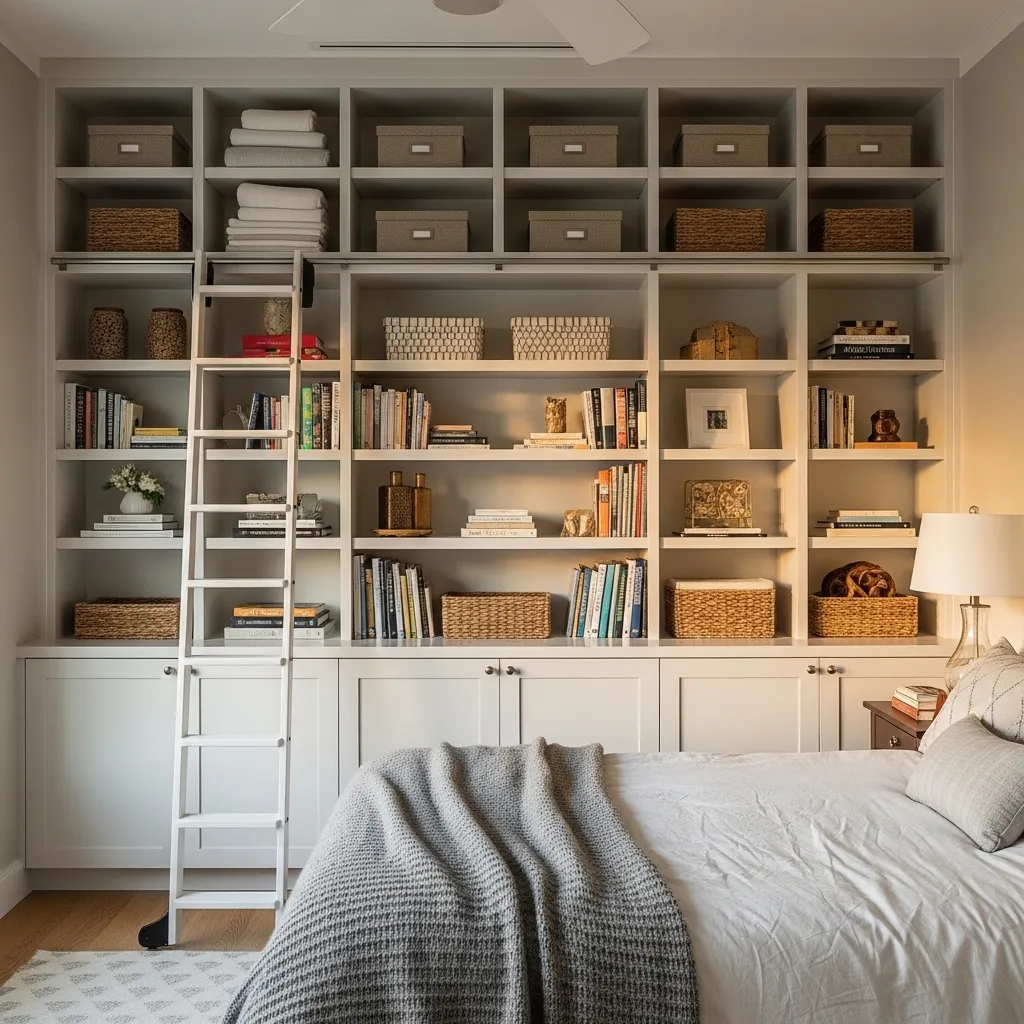
Going vertical — utilizing the full height of the room from floor to ceiling for storage rather than stopping at the conventional six or seven feet of standard shelving and cabinet height — is the single most powerful storage expansion available in any small room because it uses the room’s complete vertical dimension rather than a portion of it. The space between the top of a standard bookshelf and the ceiling in a nine-foot room is approximately two to three feet of completely unused storage volume that extends across the full width and depth of any shelving unit, and across a ten-foot wall that unused vertical zone represents an extraordinary amount of wasted storage capacity — the equivalent of several large storage boxes per linear foot of shelving.
The psychological barrier to floor-to-ceiling storage is the perceived difficulty of accessing upper shelves, which is real but easily solved — a rolling library ladder on a ceiling-mounted track is the most elegant and most functional solution, turning upper shelf access into a specific but not onerous retrieval process rather than a precarious climbing operation. Alternatively, the upper zone can be designated specifically for items accessed infrequently — seasonal clothing, extra bedding, archived documents, occasional-use equipment — reducing the frequency of upper shelf access to a few times a year rather than requiring daily or weekly access to items stored above reach.
2. Choose Furniture That Does Double Duty
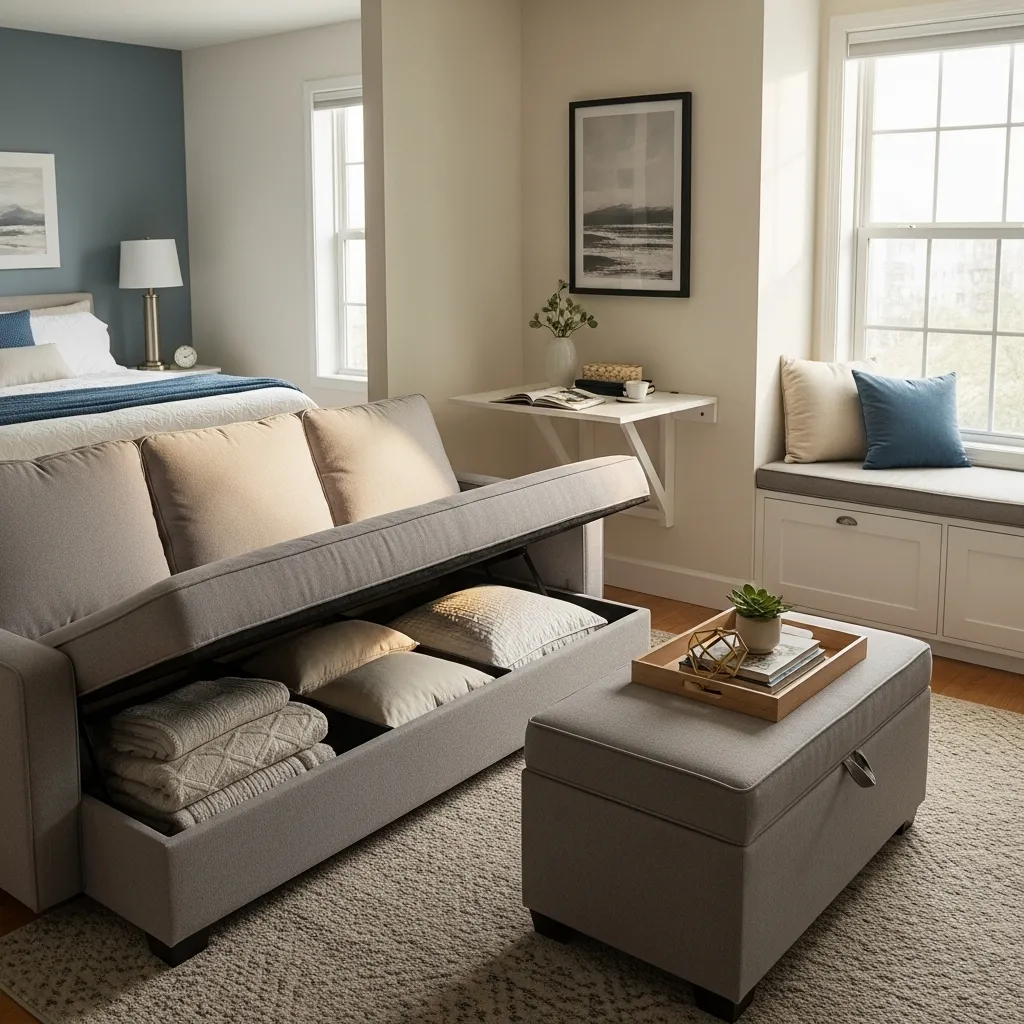
Furniture that does double duty — that serves its primary functional purpose as seating, sleeping, or surface while simultaneously providing substantial storage capacity — is the organizational approach that most completely solves the tiny room’s fundamental problem of needing more storage capacity than the floor area can accommodate with dedicated storage furniture. Every piece of furniture that provides storage eliminates the need for a separate dedicated storage piece, which means a studio furnished entirely with storage-integrated furniture can have the functional storage capacity of a much larger room without the floor area dedicated to it.
The specific double-duty furniture pieces with the highest storage-to-footprint ratio are the storage bed (drawers or lift-up access below the mattress, providing the room’s largest single storage volume in a footprint the bed occupies regardless), the storage ottoman (serving as coffee table, extra seating, and substantial storage in a piece that takes up less floor space than any equivalent furniture combination), and the storage sofa (providing the room’s most visible seating function while concealing storage in its base that would otherwise require a separate piece of furniture). Together these three pieces can provide the equivalent storage of a full chest of drawers, a large ottoman, and a storage bench — all in furniture that the room would need anyway for its primary seating and sleeping functions.
3. Define Zones With Rugs, Lighting, and Furniture Arrangement
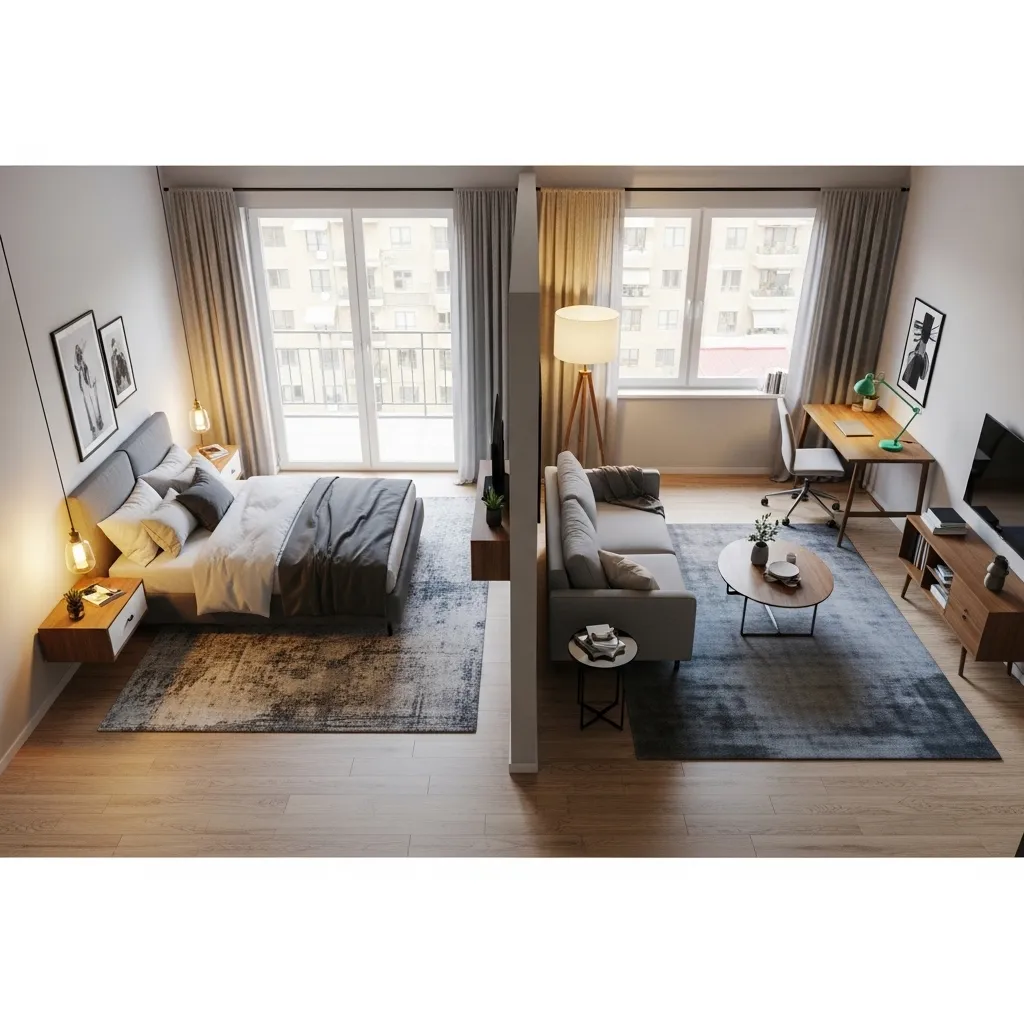
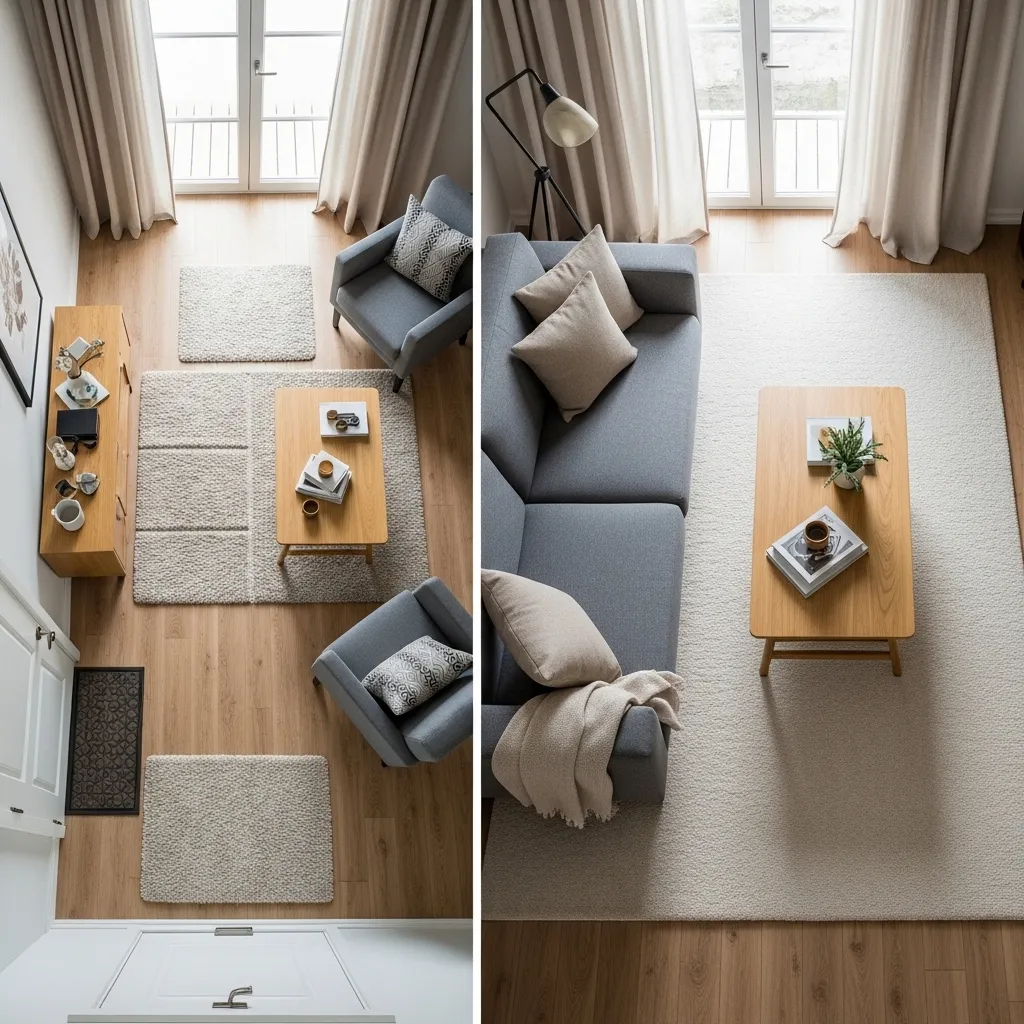
Defining functional zones within a single tiny room through rugs, lighting, and furniture arrangement — rather than through physical walls or room dividers that reduce the apparent size and compromise the light quality of the space — is the organizational approach that allows a tiny room to serve multiple functions without any of those functions feeling provisional or improvised. When the sleeping, living, and working zones of a studio apartment each have their own rug, their own light quality, and their own furniture arrangement that serves their specific function, the studio functions as three rooms while remaining visually one — maximizing both the functional utility and the perceived spaciousness of the space simultaneously.
The rug is the most fundamental zone-definition tool because it defines the floor plane of each zone — the specific territory that belongs to each function — in a way that’s visually immediate and spatially unambiguous. A rug under the bed defines the sleeping zone; a rug under the sofa and coffee table defines the living zone; the absence of a rug at the desk defines the working zone as a different quality of space. These floor-plane definitions create the spatial organization that allows a single room to serve multiple purposes without any single purpose overwhelming or invading the territory of another.
4. Use the Back of Every Door
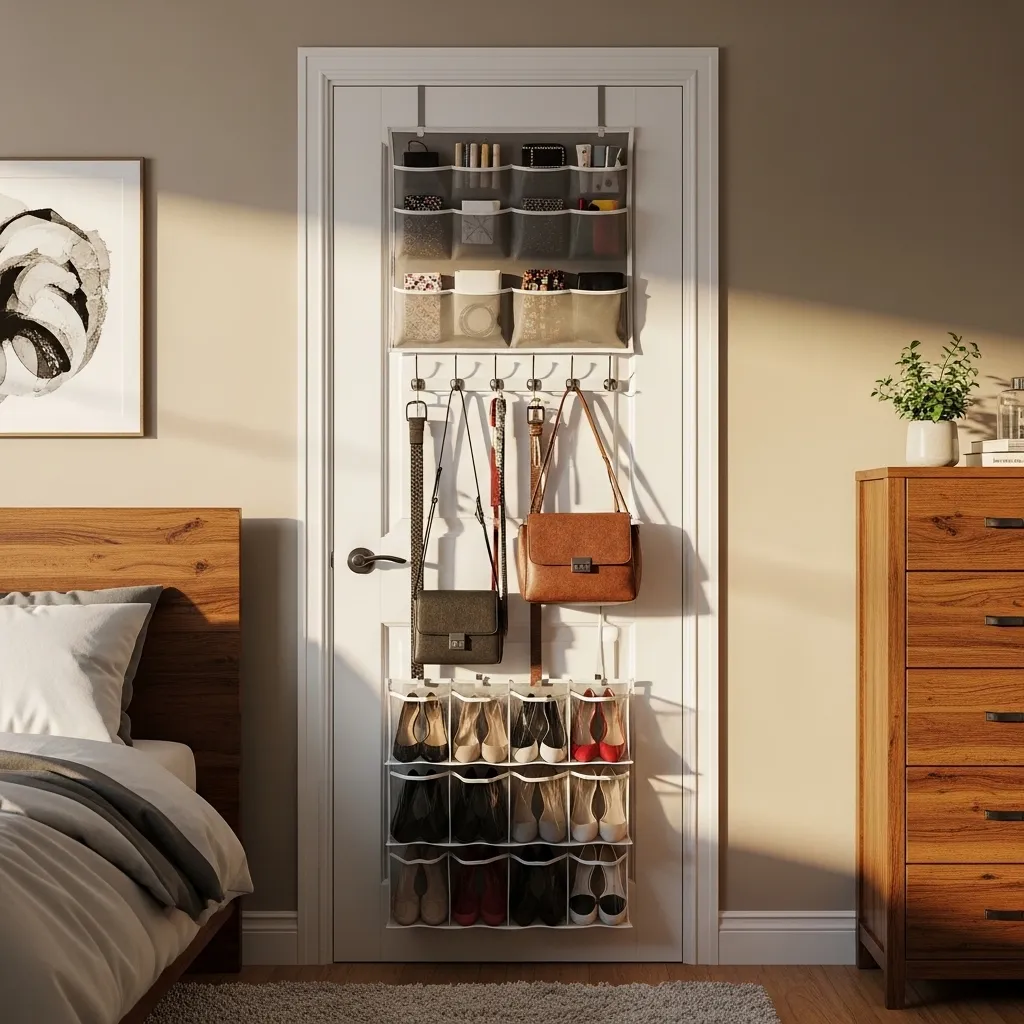
The back of every door in a tiny room is a storage surface that most people leave completely unused despite being one of the most accessible and most practically located storage zones available — because the back of a door is at eye level, at arm’s reach, and opens and closes multiple times every day, making everything stored on it maximally accessible with minimal effort. An over-door organizer system on a bedroom door can hold the equivalent of a full dresser drawer of accessories, a complete shoe rack, and a hanging organizer for bags and belts — all in a footprint of zero floor space, on a surface that the room contains regardless of whether it’s used for storage or not.
The principle extends beyond the bedroom door to every door in every tiny room — the back of a bathroom door can hold a towel bar, a robe hook, an over-door mirror, and a small shelving unit for bathroom products; the back of a closet door can hold a shoe organizer, a belt and tie organizer, and jewelry storage; the back of a pantry door can hold a full spice rack and small item storage. Every door in a small home is a storage opportunity that doesn’t require floor space, doesn’t require wall space, and doesn’t reduce the perceived size of the room — it’s free storage capacity that’s already there, waiting to be used.
5. The Decanting and Container System
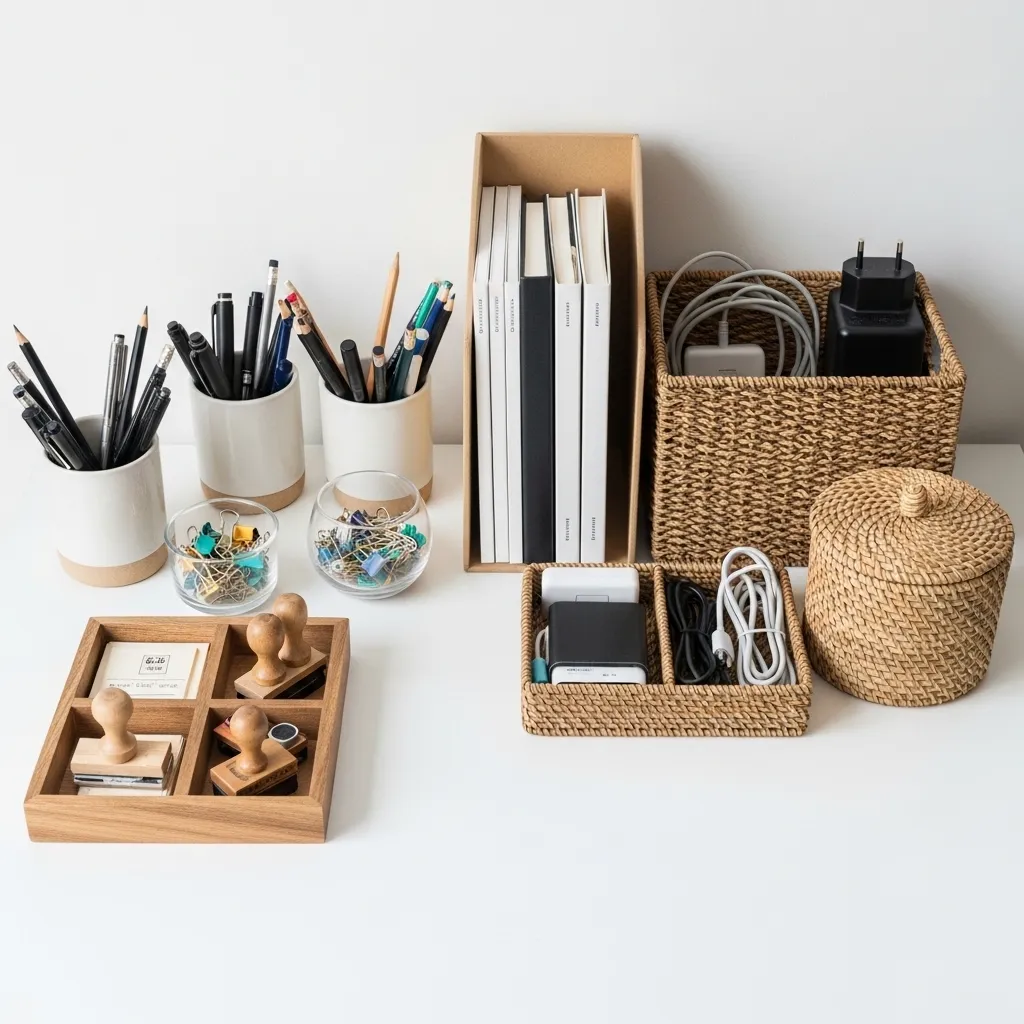
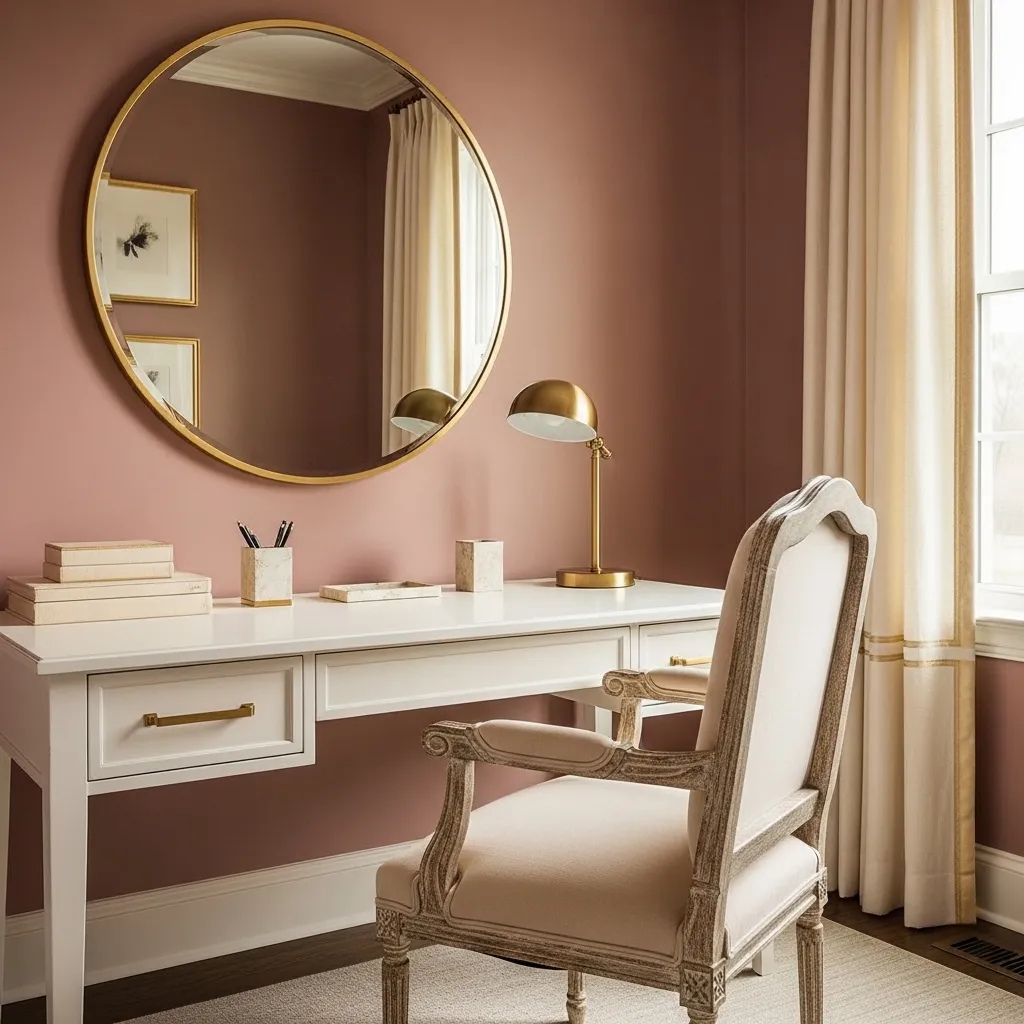
A decanting and container system — removing items from their original retail packaging and storing them in consistent, beautiful containers of the same material family — is the organizational approach that creates the most immediate and most dramatic visual transformation of any storage area, because it replaces the visual complexity of multiple different retail packages (each with its own color, its own typography, its own visual noise) with a visually unified collection of consistent containers that reads as organized and intentional rather than accumulated and chaotic.
The specific visual calm created by a consistent container system is not merely aesthetic — it has a functional dimension in a tiny room because visual complexity consumes cognitive attention, and visual calm frees that attention for other purposes. A desk with ten items in ten different retail packages requires the eye and mind to process ten different visual identities every time it scans the workspace; the same desk with ten items in ten matching ceramic or glass containers requires the mind to process one material family, creating a visual rest that the retail-packaged version never provides. Over the course of a working day spent at that desk, the cognitive difference between those two experiences is genuinely significant.
6. Maximize Closet Interior Organization
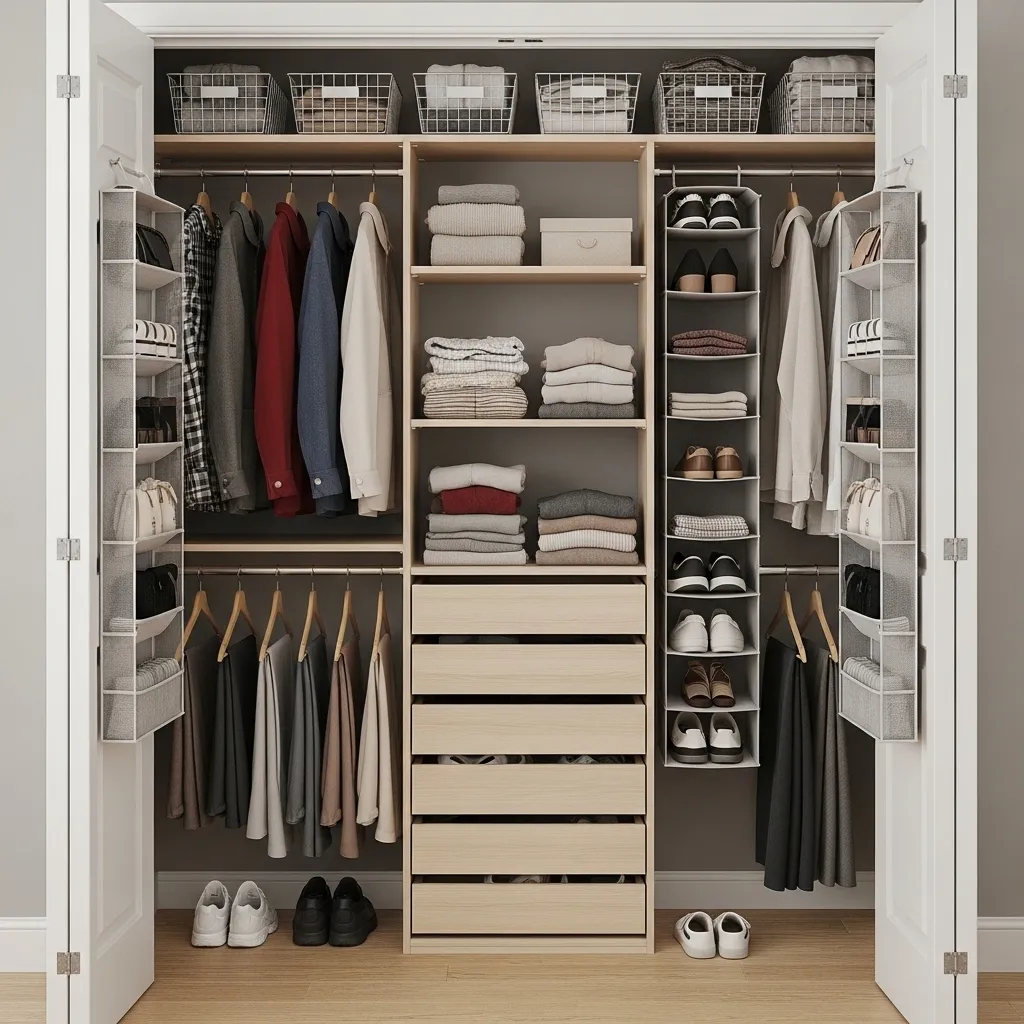
Maximizing the interior organization of a closet — using a modular shelving system that converts a single large hanging space into a multi-zone storage system with hanging sections at multiple heights, shelves, drawers, and door storage — multiplies the effective storage capacity of a standard closet by two to three times without adding any square footage. A standard closet with a single hanging rail and one shelf above it is one of the most dramatically underutilized storage environments in most homes; the same closet with a properly designed modular interior can hold twice as many hanging items, add multiple shelves for folded items, add drawers for small items, and add door storage for shoes and accessories.
The double-hanging configuration — replacing a single full-height hanging rail with two half-height rails stacked vertically — is the single modification that provides the most immediate storage increase in a standard closet, because most hanging items in most wardrobes are shorter than full hanging height (shirts, jackets, folded trousers) and the space below a full-height hanging item is almost entirely wasted. Converting that single full-height space into two half-height spaces doubles the hanging capacity for shorter items while providing a shelf in the gap between the two rails for folded items — a complete reorganization that adds substantial capacity without adding any external furniture.
7. Build a Bed Platform With Storage Beneath
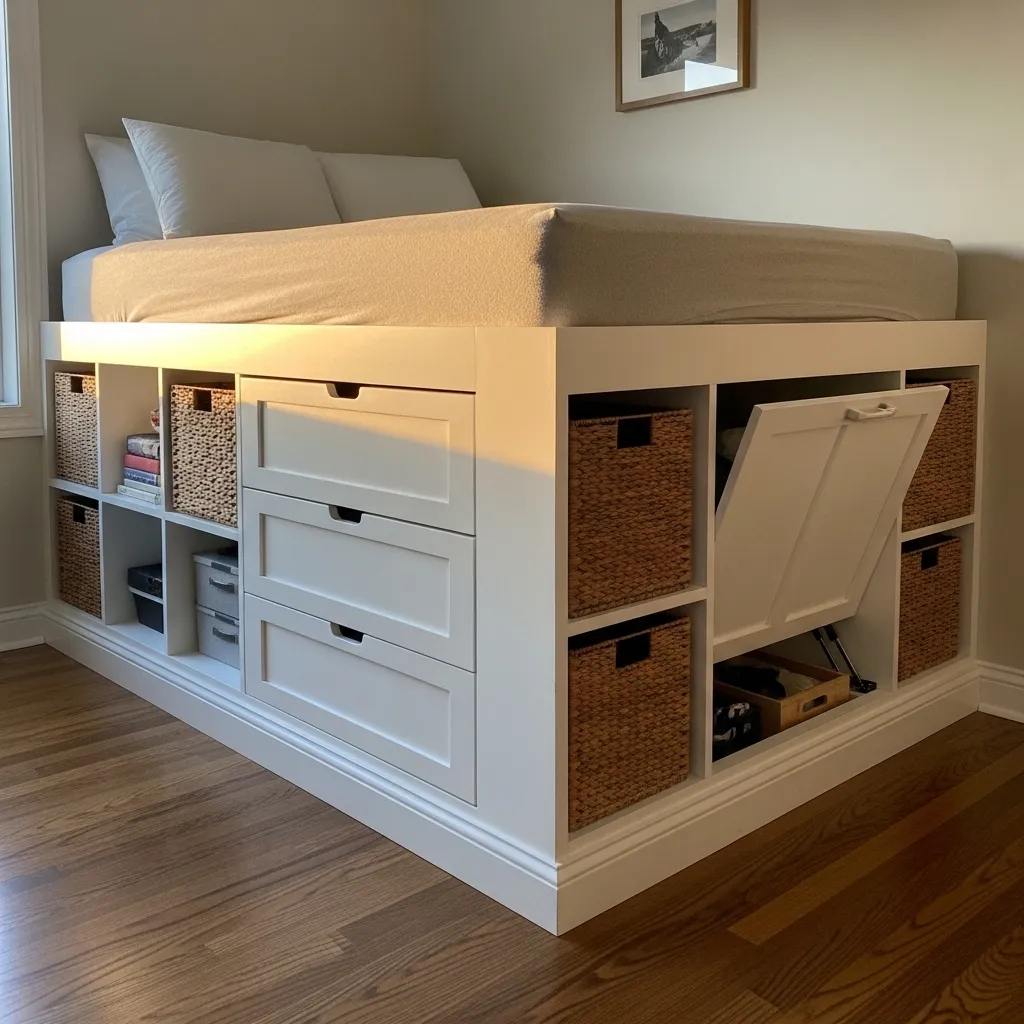
A bed platform with storage beneath — either custom-built or assembled from modular components — is the tiny bedroom organizational solution that creates the most substantial storage volume from the floor space the bed occupies regardless. The bed is the largest floor-plan occupant in any bedroom, typically taking up between thirty and forty percent of the total floor area, and that floor footprint exists whether the space beneath the bed is used for storage or left empty. Building storage into that footprint converts dead floor space into the room’s most significant storage asset without adding any additional furniture or consuming any additional floor area.
The twelve-inch platform height is the specific height that creates the most useful drawer depth — enough to hold folded clothes, bedding, books, and equipment at a practical depth — while remaining comfortable to get in and out of without the bed feeling unusually high. Platforms lower than ten inches create shallow drawers that can only hold flat items; platforms higher than sixteen inches create a bed height that feels awkward and requires a step to mount. The twelve-inch sweet spot creates deep, genuinely useful drawers at a comfortable bed height that most people find preferable to standard frame height.
8. Use Wall-Mounted Storage to Clear the Floor
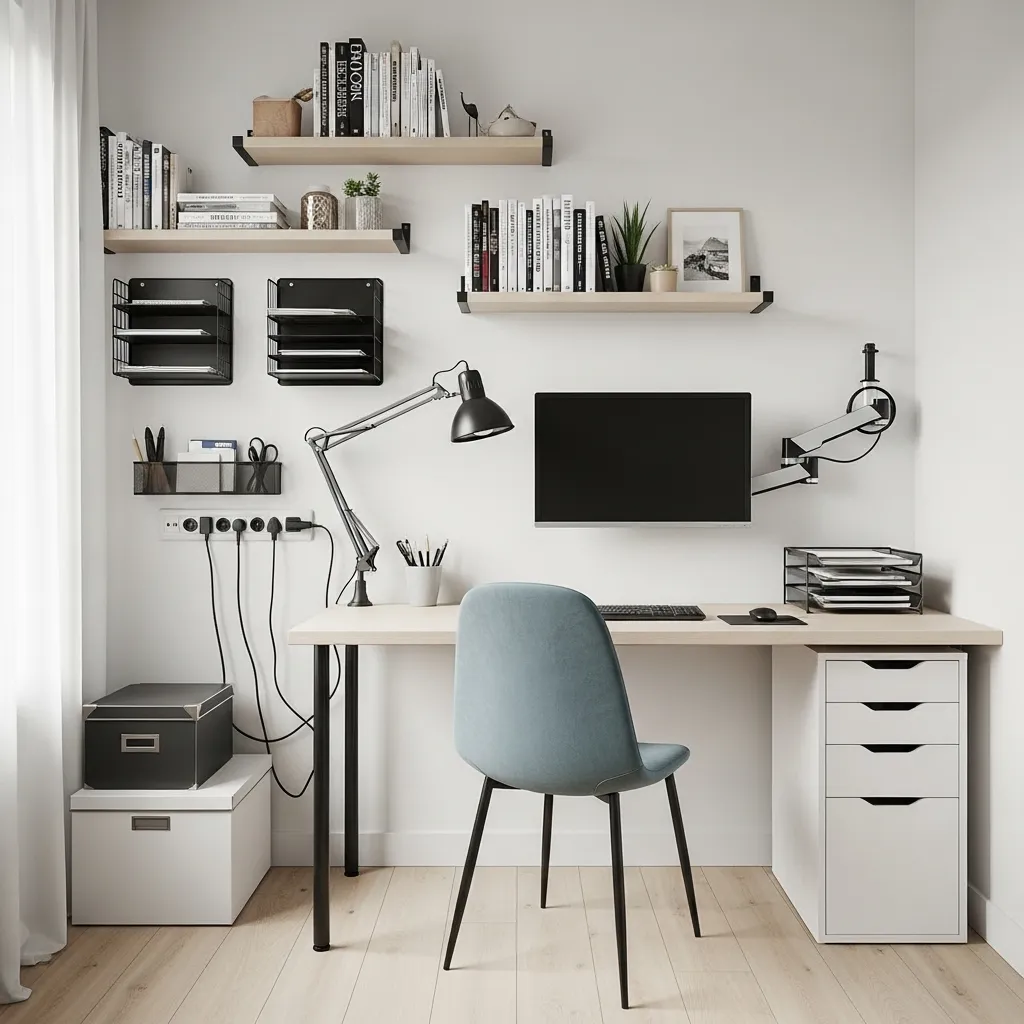
Wall-mounted storage — shelving, filing, lighting, equipment, and organization systems fixed to the wall rather than sitting on the floor or desk — is the organizational approach that creates the maximum floor clearance in a tiny room, and floor clearance is the specific spatial quality that most contributes to a tiny room feeling spacious. Every piece of freestanding storage furniture that stands on the floor consumes floor space and contributes to the visual compression of the room; every storage element that’s mounted on the wall provides equivalent storage capacity while returning the floor beneath it to the room’s open floor plan.
The wall-mounted monitor arm is the specific desk accessory with the highest impact on desk surface organization — it removes the monitor stand from the desk surface, freeing an area of approximately six inches by ten inches (the footprint of a typical monitor stand) that can be used for working rather than supporting equipment, while positioning the monitor at the precise height and distance for ergonomic working. Combined with wall-mounted desk lighting on an articulated arm (removing the desk lamp from the desk surface), a wall-mounted power strip (removing the floor power strip from the floor), and wall-mounted filing (removing the filing tray from the desk), a wall-mounted approach to office equipment can almost entirely clear a desk surface while maintaining all the equipment and organization that a fully equipped desk provides.
9. The One-In-One-Out Rule Applied Consistently
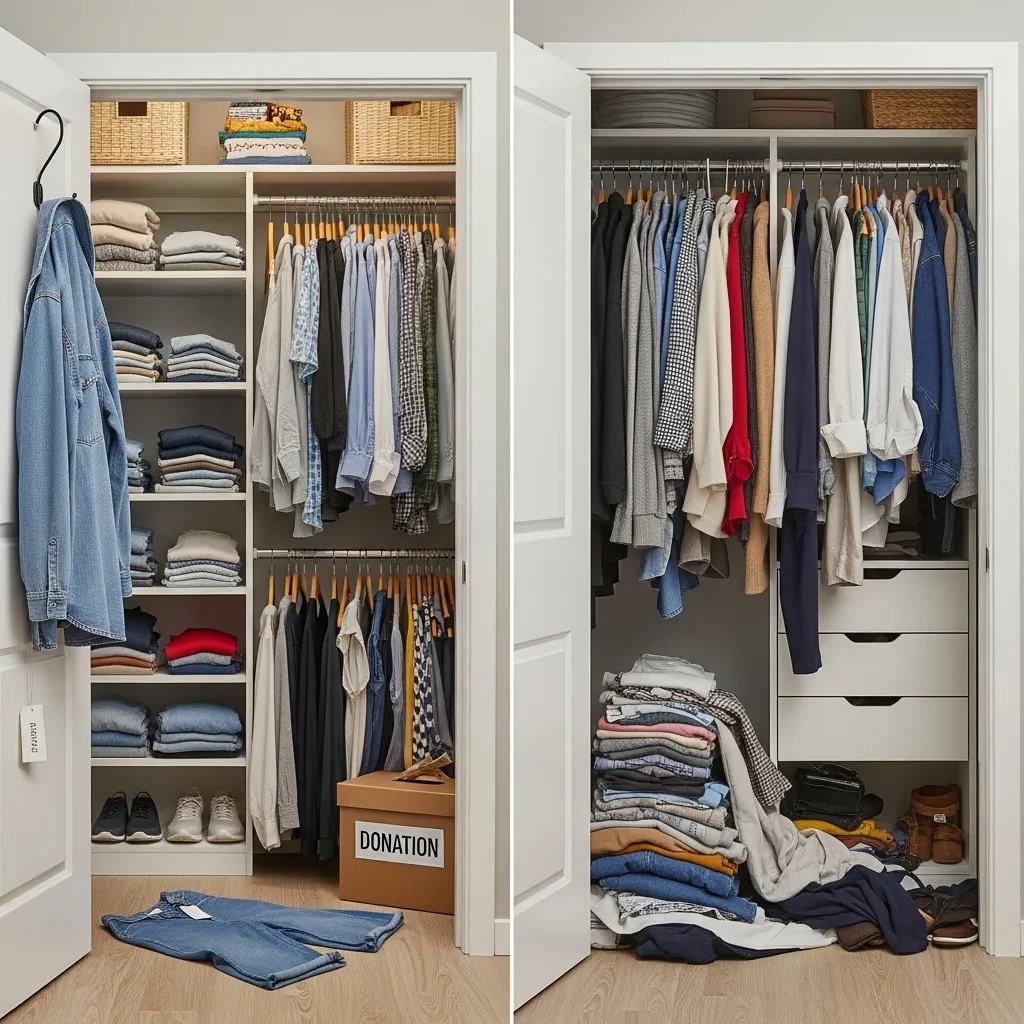
The one-in-one-out rule — the commitment that every new item brought into a tiny room is accompanied by one item leaving it — is the organizational practice that most directly addresses the most fundamental tiny room organization problem: that organization systems can only function within their designed capacity, and that capacity is finite. The most perfectly designed organizational system for a tiny room holds a specific quantity of objects well; add more objects than the system was designed for and the system fails, not because the system was wrong but because the room’s actual capacity has been exceeded. The one-in-one-out rule maintains the room within its organizational capacity indefinitely rather than allowing gradual accumulation to overwhelm any system eventually.
The practical implementation of the one-in-one-out rule requires a physical mechanism — a designated donation box, a specific departure point for items leaving the room — that makes the exit of one item as concrete and as immediate as the entry of another. The rule fails when it exists as an intention without a system — the new item comes in, the old item is identified for departure but remains in the room pending action, and the room gradually accumulates the margin between items identified for departure and items actually departed. A physical donation box in the closet or storage area, filled as items are identified for departure and emptied regularly, makes the one-in-one-out rule a practical reality rather than an organizational aspiration.
10. Install a Pegboard or Grid Wall System
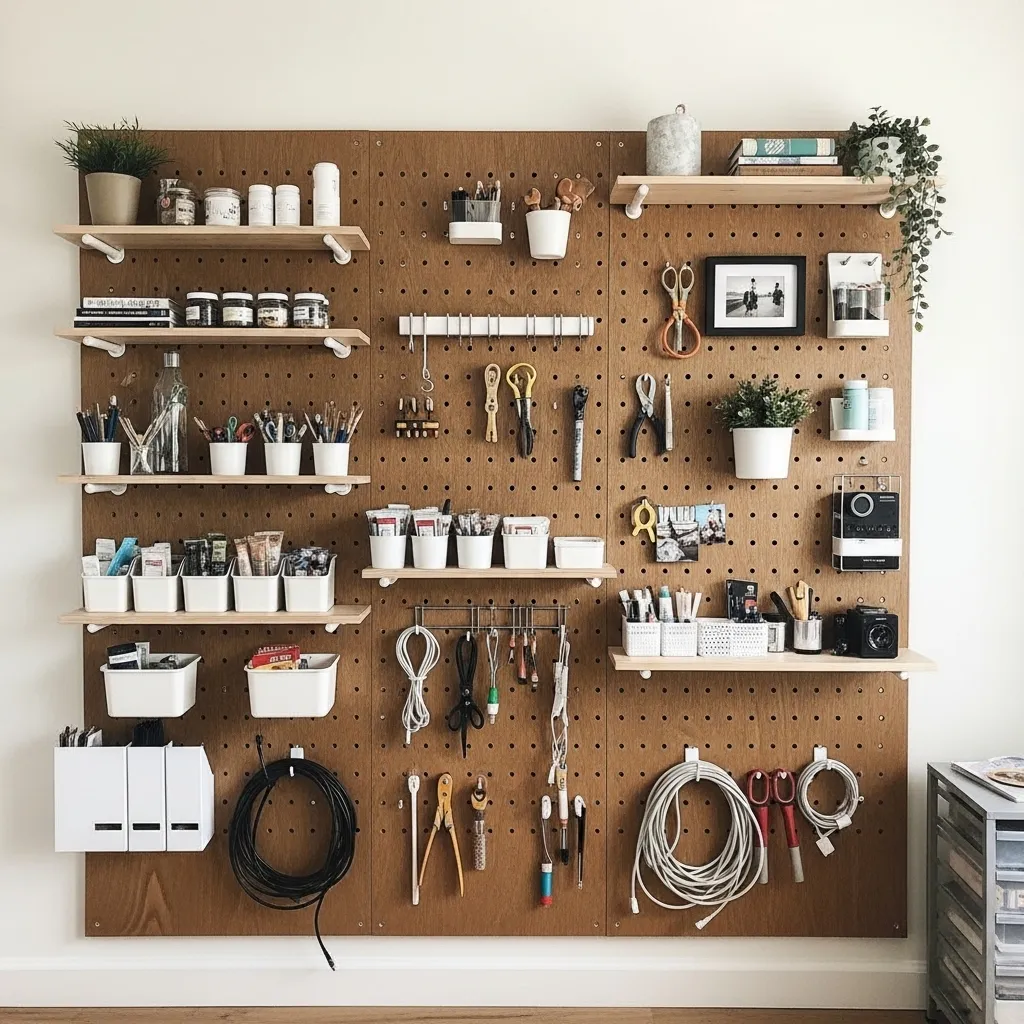
A pegboard or grid wall system is the tiny room organizational tool with the highest flexibility and the lowest commitment — every element of the organization can be repositioned, replaced, or removed as needs change, which makes the pegboard wall specifically valuable in rooms whose organizational requirements evolve over time or whose users’ needs change regularly. Unlike fixed shelving, which requires demolition to reconfigure, a pegboard system can be completely reorganized in an afternoon with no tools beyond the hooks and brackets that hold each element.
The natural wood pegboard — as opposed to the standard white painted or raw metal industrial pegboard — is the specific version that creates an organizational wall with genuine aesthetic quality rather than a functional system installed at the expense of the room’s visual atmosphere. A warm wood pegboard with consistent containers and deliberate organization creates a wall that reads as a designed system rather than a corkboard aesthetic, and in a tiny room where every wall is closely seen, the visual quality of the organizational system is as important as its functional capacity.
11. Create a Dedicated Home for Every Category of Item
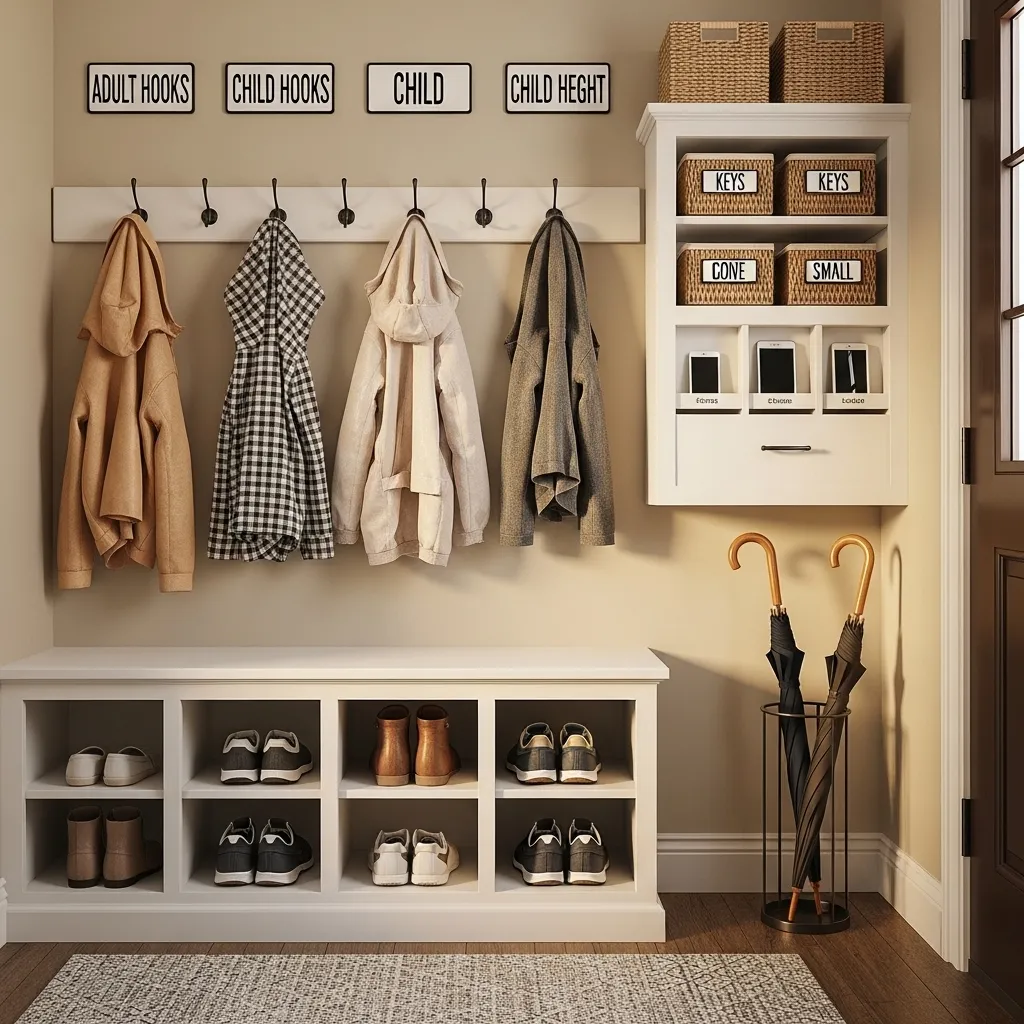
Creating a dedicated home for every category of item in a tiny room — every category of clothing, every category of tool, every category of paper, every category of equipment — is the organizational principle that makes the difference between an organizational system that maintains itself and one that requires constant re-establishment. When every item has a specific home, returning items to their home after use is simple and automatic; when items don’t have specific homes, the decision of where to put things requires active thought that often results in items being placed wherever is convenient rather than wherever is organized.
The labeled system — where the specific home of each category of item is labeled clearly enough that anyone in the household can find and return items without asking — is the specific implementation that makes dedicated homes function as a household system rather than as the private organizational knowledge of one person. A labeled basket for each family member’s small items in the entryway means that every family member knows where their items belong and can return them independently; an unlabeled system where only one person knows the organization requires that person to be both the user and the maintainer of the system, which is not sustainable in any household of more than one person.
12. Use the Space Under and Over Everything
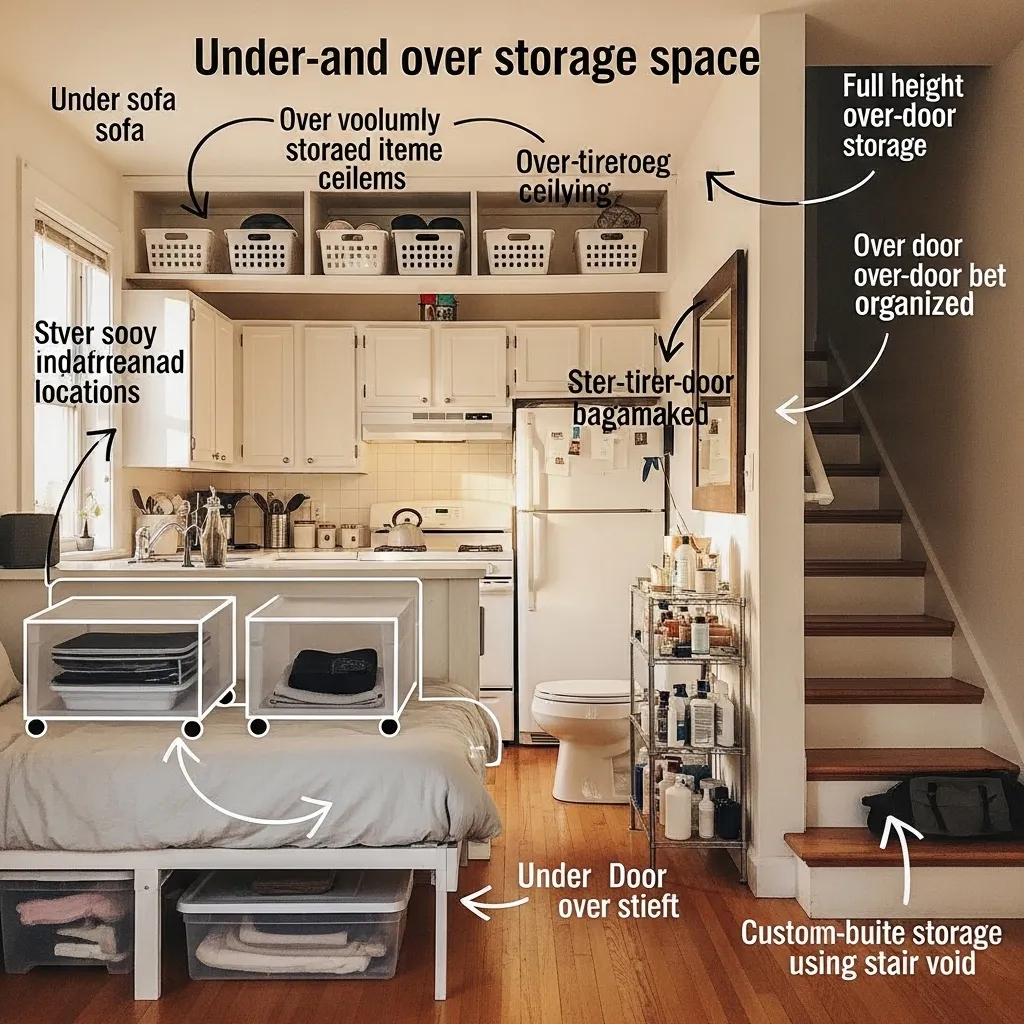
The under-and-over principle — using the space beneath furniture, above cabinets, over doors, and in every overhead void that standard furniture configuration leaves unused — finds significant additional storage capacity in spaces that most small room dwellers leave entirely empty. In a small apartment, the under-sofa space, the over-cabinet space, and the over-door space together can provide the equivalent storage of an additional large chest of drawers — without adding any footprint to the floor plan, without reducing any functional space, and without compromising the visual quality of the room if the storage is done with consistent, appropriately sized containers.
Under-sofa storage specifically is the most consistently overlooked storage volume in a small living room — the space beneath a sofa with legs raised four to six inches above the floor is typically eight to twelve inches deep, extends the full length and width of the sofa, and is easily accessible through the open sides. Slim rolling storage boxes designed for under-bed use work equally well under sofas, and the volume they provide — a full sofa length at twelve inches depth — is substantial enough to hold seasonal items, extra bedding, or any category of items used infrequently enough that the retrieval process of sliding the box out is acceptable.
13. The Weekly Reset Habit
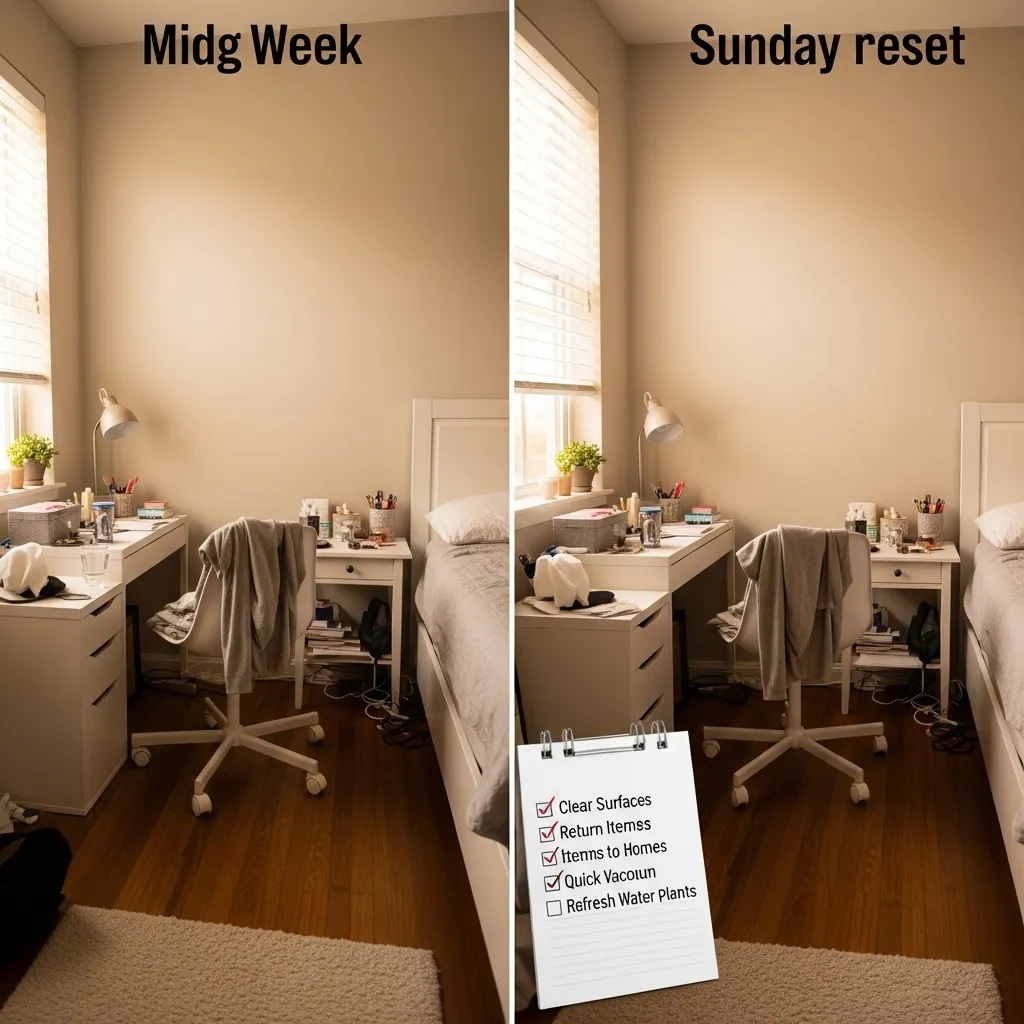
A weekly reset habit — a regular, scheduled time to return every item in a tiny room to its dedicated home, clear every surface, and restore the organizational system to its designed state — is the maintenance practice that makes organizational systems sustainable over time rather than gradually collapsing under the weight of weekly accumulation. The best organizational system in a tiny room will show the effects of a week’s use by the end of that week — items will have drifted from their homes, surfaces will have accumulated things that belong elsewhere, the floor will have items on it that should be stored. The weekly reset returns the system to its designed state, preventing the gradual accumulation that eventually makes the system feel overwhelmed.
The specific value of a weekly reset rather than attempting to maintain perfect organization continuously is that it accepts the reality of daily life — that things move around, that items get placed temporarily rather than definitively, that the organizational system is a resting state rather than a constant state — while preventing the accumulation of those temporary placements from becoming permanent disorder. A tiny room can absorb one week of lived-in accumulation and be restored to organizational calm in thirty minutes of weekly effort; the same room without a weekly reset accumulates that thirty minutes of disorder across every day until the organizational system has completely failed and restoration requires not thirty minutes but several hours.
14. Transparent Storage for Visibility
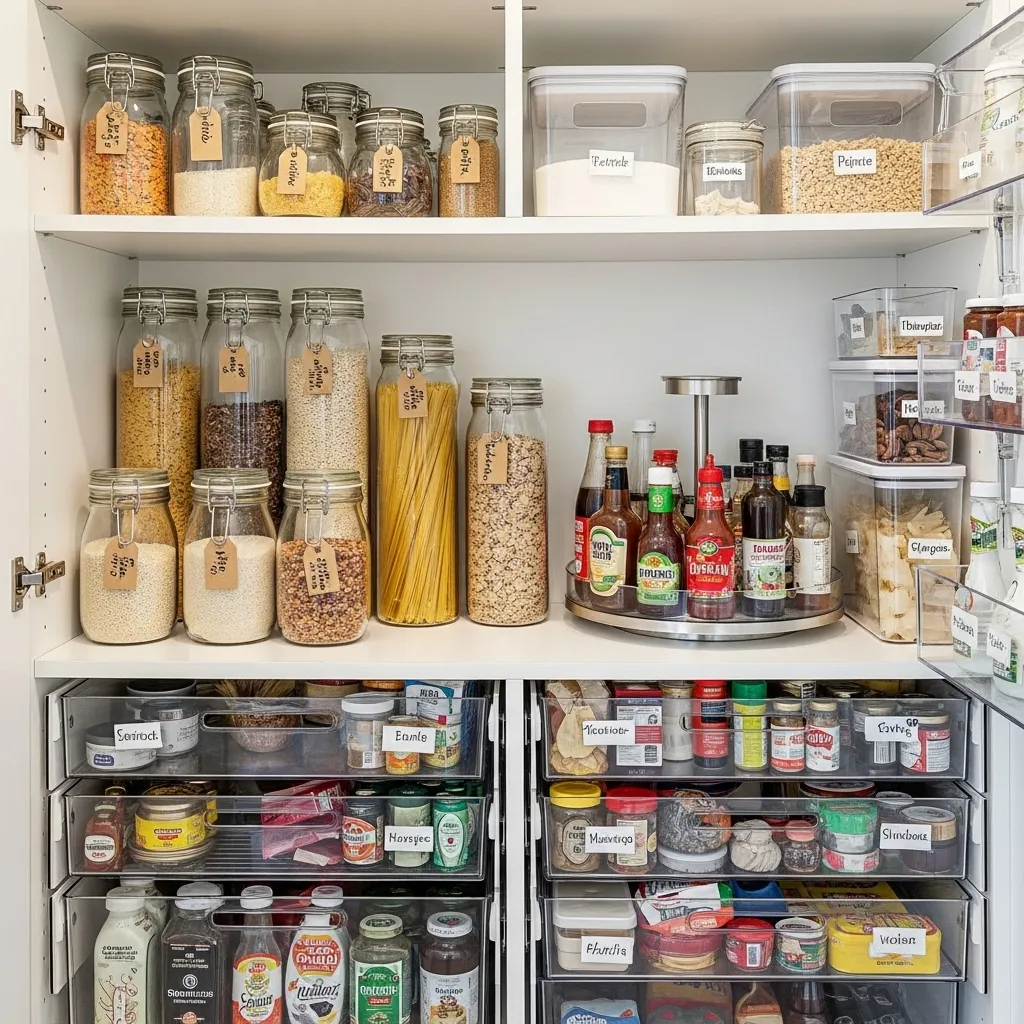
Transparent storage — clear containers, glass jars, see-through bins — is the tiny room organizational approach that eliminates the primary source of friction in most organizational systems: not knowing where things are. In an opaque container system, every retrieval requires either a labeling system detailed enough to identify contents or a searching process that means opening multiple containers to find a specific item. In a transparent container system, the contents of every container are visible at a glance, making retrieval immediate and requiring no labeling beyond the most basic category identification.
The visual calm of a uniform transparent storage system — where all the containers are the same clear material in a consistent range of sizes — creates a storage environment that reads as organized and intentional rather than accumulated, because the visual unity of the transparent containers overrides the visual variety of the different items stored within them. A shelf of twelve matching glass jars containing twelve different food items reads as an organized pantry; the same shelf with twelve different retail packages of the same twelve items reads as accumulated shopping. The container is the visual unit the eye reads, not the contents, and consistent containers create visual unity regardless of the variety of items stored within them.
15. Design the Room for the Life You Actually Live, Not the Life You’re Planning to Live
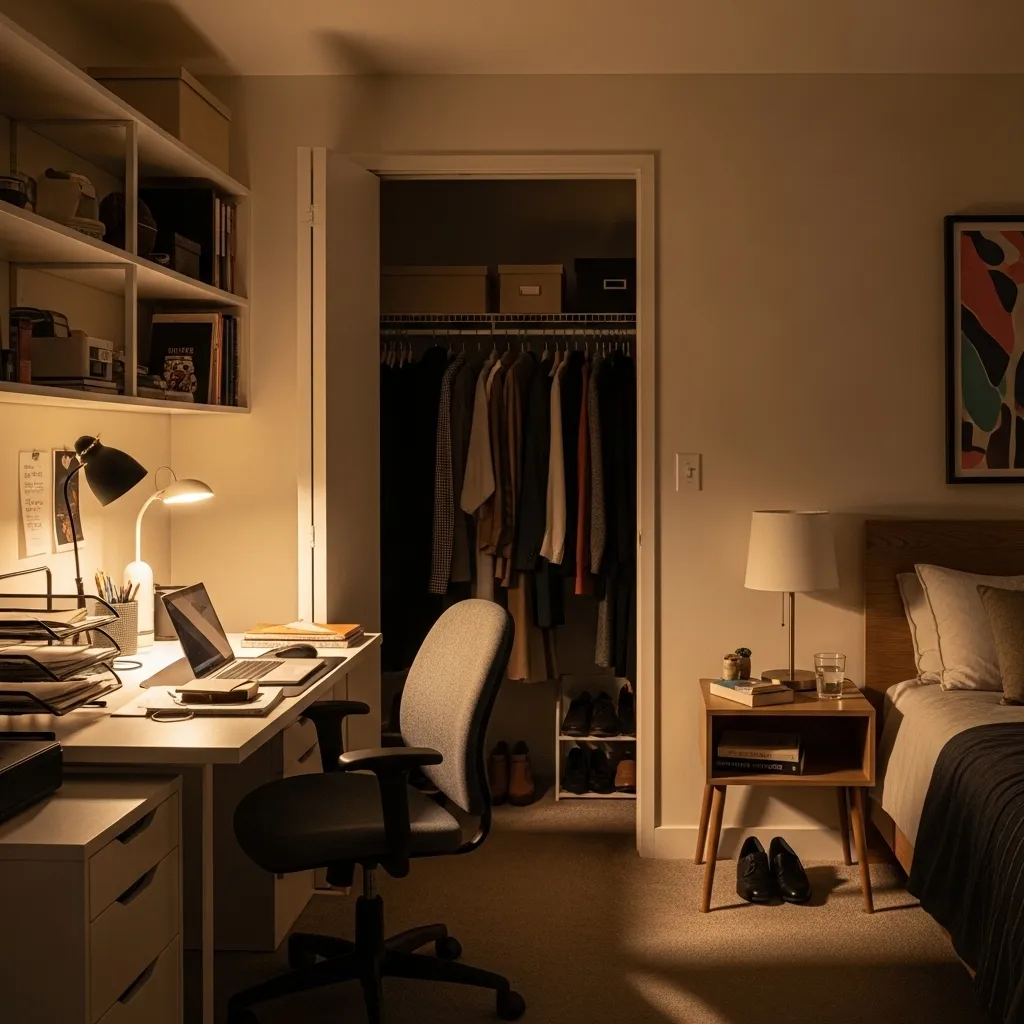
Designing a tiny room’s organization specifically for the life you actually live — your real daily routine, your actual frequency of use for different categories of items, your genuine functional requirements — rather than for the life you’re planning to live or the person you’re intending to become is the organizational principle that most directly determines whether an organizational system actually functions in practice or merely looks good in the planning stage. The organizational system that allocates equal storage space to formal and casual clothing regardless of how often each is actually worn, that creates a full home office setup for a person who works from home three days per week and spends two days elsewhere, that maintains a full kitchen equipment for elaborate cooking in a tiny kitchen where daily cooking is simple and occasional — these are systems designed for an aspirational life rather than the actual one, and they consistently fail because the spaces they allocate don’t correspond to actual frequency of use.
The genuinely functional tiny room organizational system allocates space in direct proportion to actual frequency of use — the most-used items in the most accessible locations, the less-used items in less accessible locations, the rarely-used items in the least accessible storage or removed from the room entirely. This principle requires honesty about how you actually live — what you actually cook, what you actually wear, what you actually do in this room on a typical day — rather than how you’d like to live in an ideal version of your life. The organizational system built around actual use patterns will function effortlessly because the things you need every day are immediately at hand; the organizational system built around aspirational use patterns will create daily friction because the things you actually need are stored among the things you plan to use but don’t.