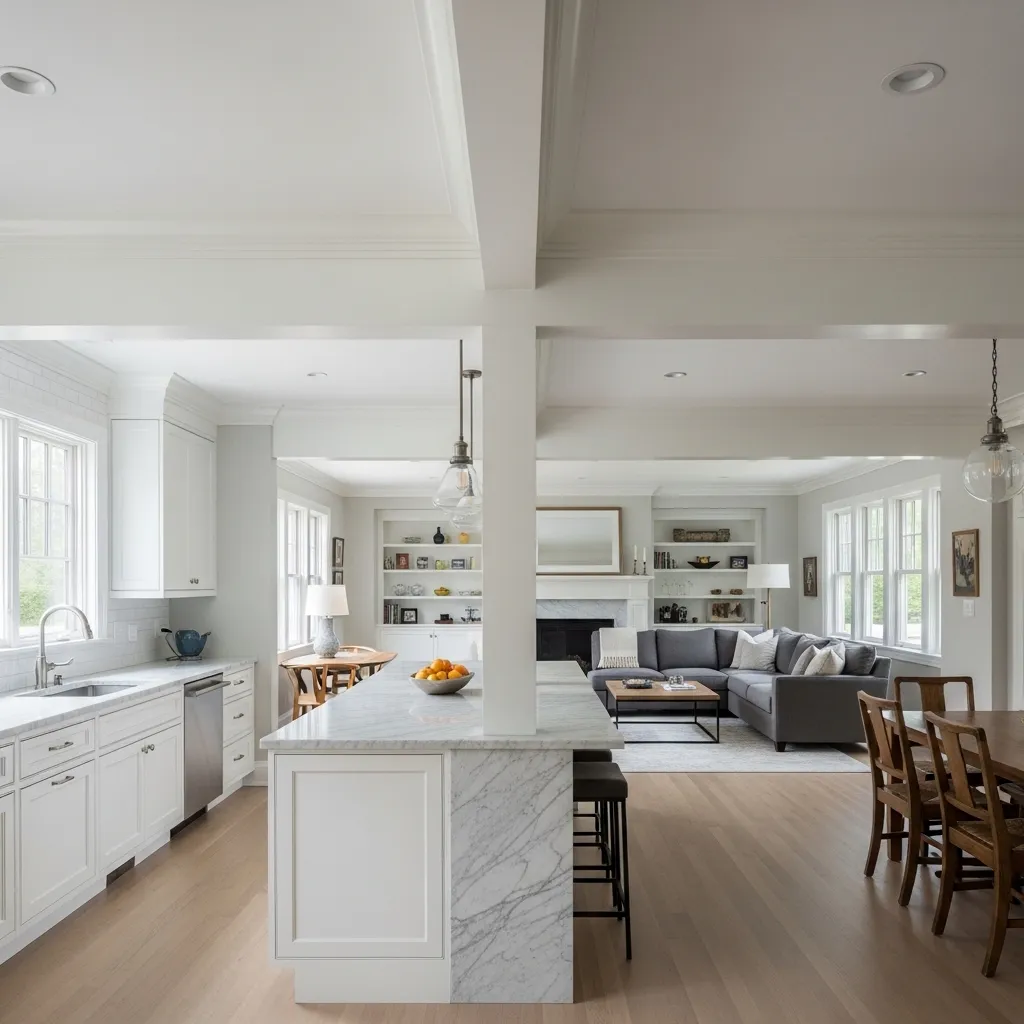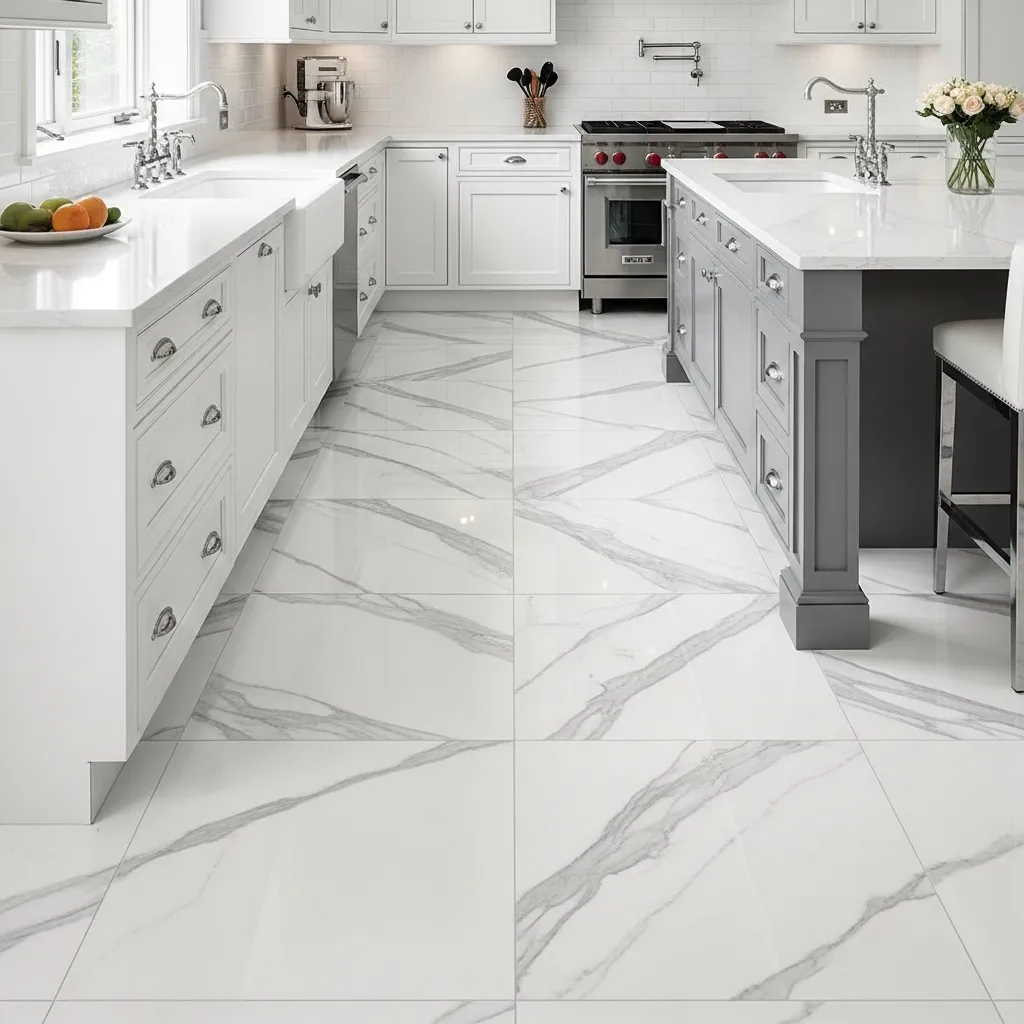
18 Black and White Kitchen Ideas for 2026 That Prove the Most Classic Combination Is Also the Most Endlessly Reinventable
If you’ve been drawn to the black and white kitchen but worried that it’s either too stark to live with daily, too trendy to commit to for a decade-long renovation investment, or too limited as a palette to create the warmth and personality that a kitchen — the most social and most used room in most homes — genuinely needs, this roundup is going to address all three of those concerns directly and thoroughly. Because the black and white kitchen done well in 2026 is none of those things — it’s not stark, it’s not a trend, and it’s not limited. What the best black and white kitchens of this year demonstrate consistently is that the combination of black and white is not a minimal color palette but a maximum contrast palette, one that creates the strongest possible visual foundation for any material, texture, or personality layer you introduce on top of it, and that the warmth and character of a black and white kitchen comes entirely from the quality and variety of those material and texture choices rather than from the introduction of a third color. The eighteen ideas here cover the full spectrum of what black and white kitchen design looks like in 2026 — from the most classically elegant interpretation through the most boldly contemporary, from the most warmly rustic through the most architecturally precise, from the most pattern-forward through the most material-led.
The black and white kitchen has a longer and more distinguished history in domestic design than almost any other color combination — from the black-and-white checkered floors of Georgian and Victorian kitchens through the crisp black hardware and white cabinetry of mid-century American kitchen design through the monochromatic drama of 1980s postmodern kitchen design, the combination has continuously reinvented itself while maintaining its fundamental visual logic: maximum contrast, maximum clarity, maximum graphic impact. What changes in each period is not the combination itself but the materials, the proportions, the surfaces, and the accents used to express it, and the 2026 version of the black and white kitchen is specifically defined by the introduction of warm, textured, natural materials within the black and white framework — the rough-surfaced handmade tile, the warm grain of natural wood, the organic variation of natural stone, the aged warmth of unlacquered brass — that prevent the high contrast of the palette from reading as cold or clinical and that create kitchens of genuine material richness within a visually disciplined framework.
What I find most interesting about designing a black and white kitchen is that the palette’s apparent limitation is actually its greatest strength — when you remove color variation as a design tool, you’re forced to create interest and warmth through material variation, textural contrast, and the quality of individual surfaces rather than through the easier route of color. A kitchen with multiple colors can create visual interest relatively easily by varying those colors; a black and white kitchen has to earn every bit of its visual interest through the quality of its black surfaces, the character of its white surfaces, the texture of the backsplash, the warmth of the countertop, and the precision of the hardware. This discipline produces kitchens of extraordinary material quality and visual coherence that multi-color kitchens rarely achieve, because the constraint of the palette forces each material decision to be genuinely excellent.
1. Classic White Shaker and Matte Black Hardware
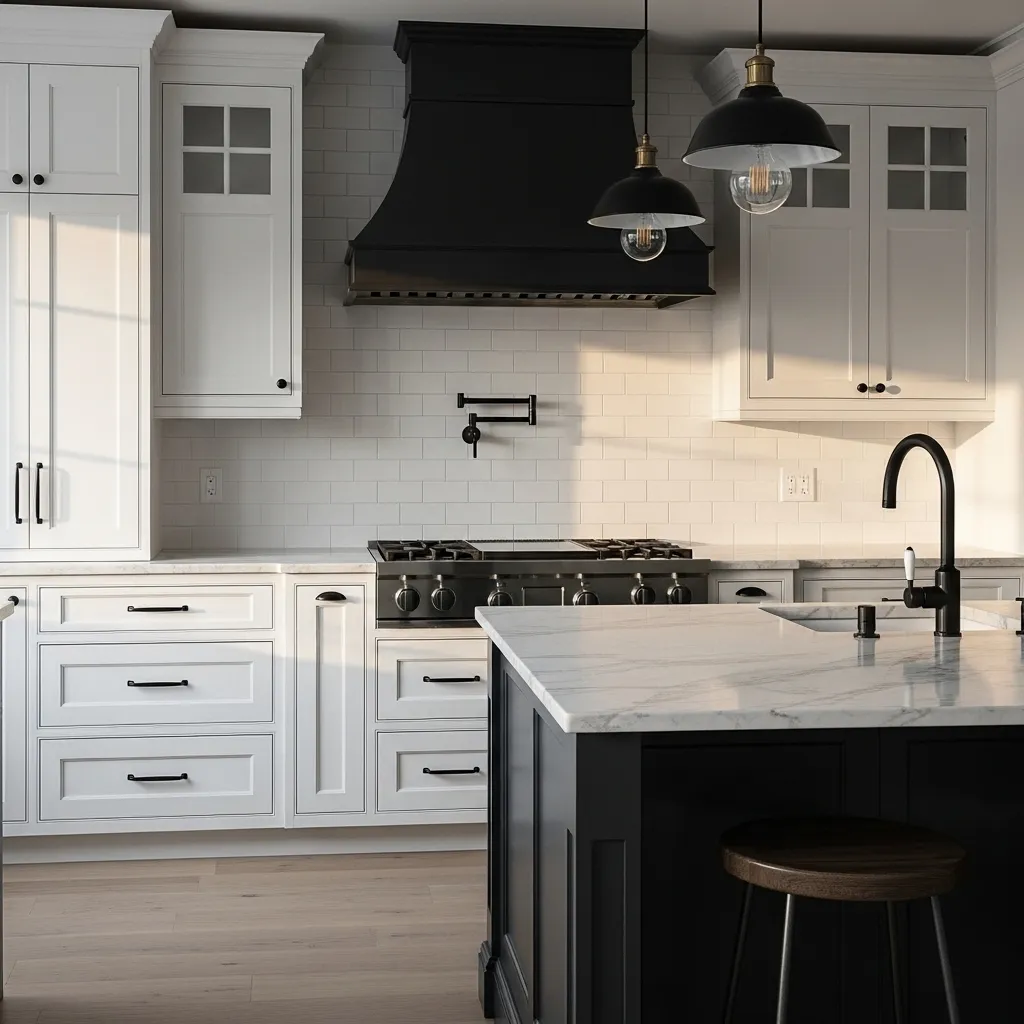
Classic white shaker cabinetry with consistent matte black hardware is the foundational black and white kitchen configuration — the one that has defined the aesthetic’s most enduring and most widely loved expression because it achieves the combination’s essential visual logic (white dominates, black punctuates) with the greatest possible clarity and the greatest possible architectural elegance. The shaker profile adds the shadow depth that flat panel cabinetry lacks, creating cabinet doors that are interesting at close range as well as from across the room, and the consistency of the matte black hardware throughout — not one hardware style in some places and another elsewhere, but the same matte black in every functional metal position in the kitchen — creates a visual thread that connects every element of the kitchen into a single coherent composition.
The matte finish of the black hardware is the specific quality that most determines whether the black-and-white kitchen reads as warm and contemporary or cold and industrial — matte black absorbs light rather than reflecting it, creating hardware that appears as a warm, deep presence rather than a hard, reflective one. Polished black hardware would create a different effect — more dramatic, more jewelry-like — but matte black is the finish that works most consistently across the widest range of kitchen styles and material combinations within the black and white palette.
2. Dramatic Black Cabinetry With White Marble
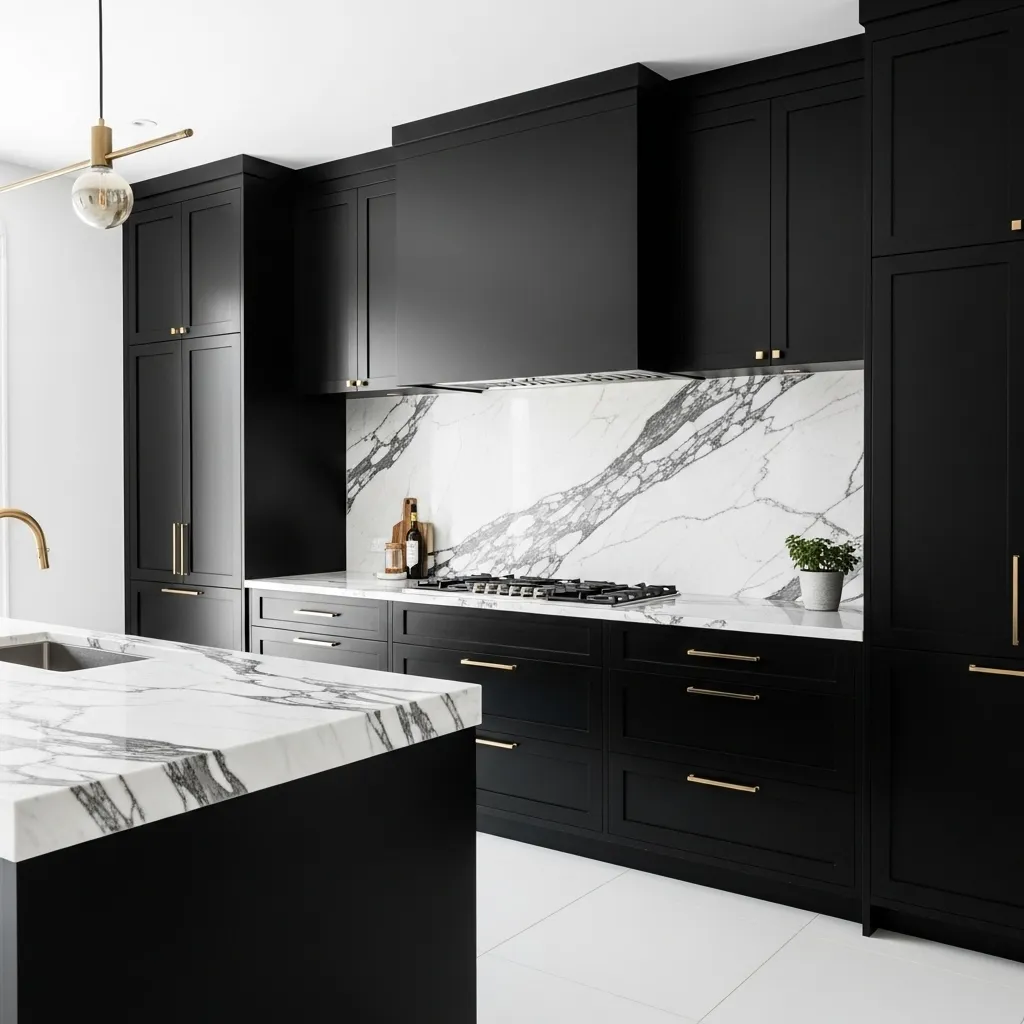
All-black cabinetry with white marble countertops and backsplash inverts the conventional black-and-white kitchen proportion — where the standard configuration has white dominating and black punctuating, this configuration has black dominating and white providing the dramatic light relief — and the inversion creates a kitchen of far greater drama and far greater visual impact than the conventional proportion achieves. The white marble against all-black cabinetry appears almost luminously bright, as though the stone is generating its own light, and the bold veining of Statuario marble becomes dramatically more visible against black than it would against lighter cabinetry.
The handleless flat panel profile is specifically important in an all-black kitchen because it prevents the hardware from creating a visual interruption in the continuous black surface — any hardware on all-black cabinetry, regardless of its finish, creates a regular pattern of punctuation marks across the cabinet faces that the continuous black surface doesn’t need and that the dramatic marble countertop is already providing. The handleless approach creates the uninterrupted matte black surface that makes the white marble appear as a single brilliant horizontal plane rather than a countertop interrupted by hardware reflections.
3. Black and White Checkered Floor — The Heritage Expression
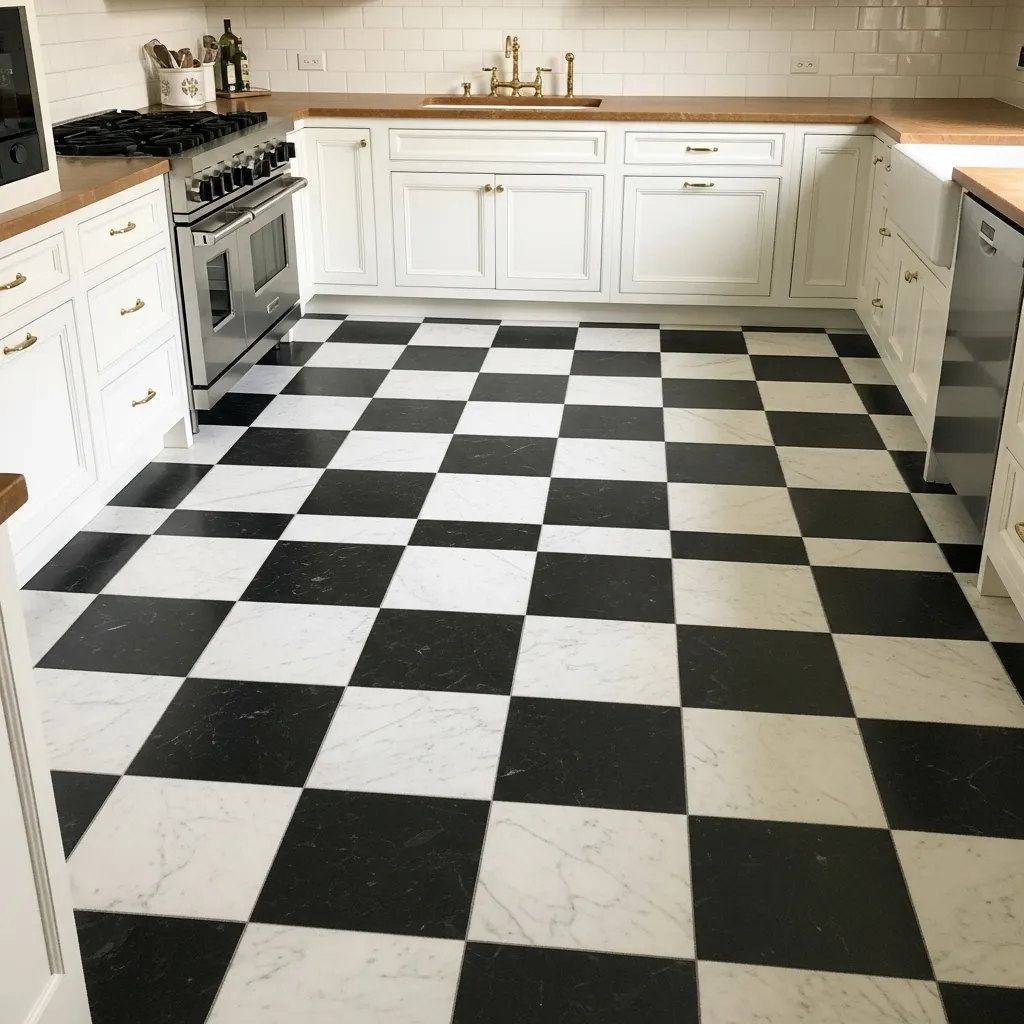
A black and white checkered floor in a kitchen is the design decision that most directly connects contemporary kitchen design to the centuries-long tradition of black and white floor tiles in European domestic and public architecture — from the marble-floored palaces and churches of Renaissance Italy through the Georgian entry halls of English townhouses through the checkerboard floors of American diners and domestic kitchens of the early twentieth century. Using this floor in a contemporary kitchen is not historical pastiche but genuine connection to one of the most consistently beautiful and most enduringly relevant floor patterns in Western architectural history.
The scale of the check is the proportion decision that most determines how the floor reads in context — very small checks (four inches or less) create a pattern that reads as texture from normal kitchen viewing distances, where the individual tiles are too small to register as a check pattern, just as a visual richness; medium checks (eight to twelve inches) create a clearly readable pattern at normal viewing distances while remaining in the scale range that most kitchens can accommodate without the pattern becoming overwhelming; large checks (sixteen inches and above) create a bold, confident pattern that makes a strong graphic statement and works best in kitchens with genuinely generous floor area.
4. White Oak Island Against Black Perimeter Cabinetry
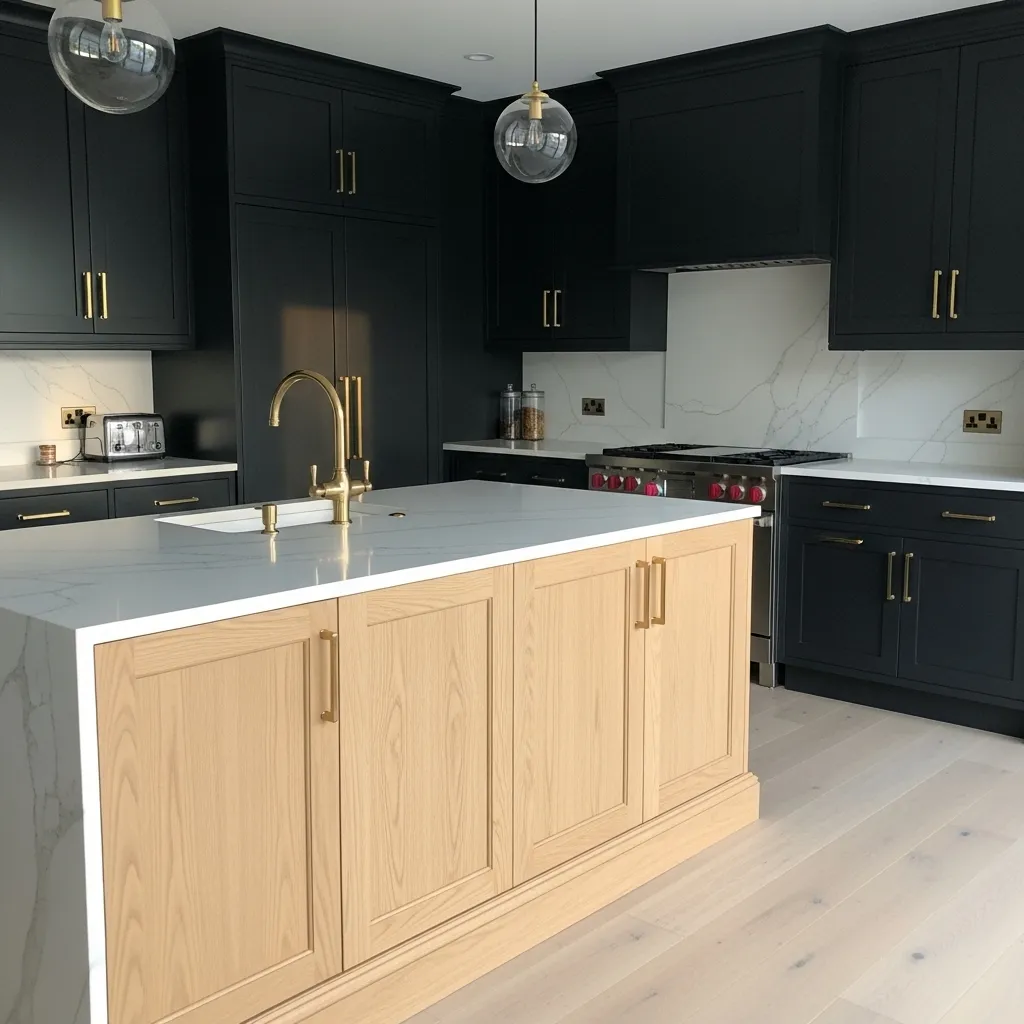
A natural white oak island surrounded by black perimeter cabinetry creates the most visually dynamic and most materially rich interpretation of the black and white kitchen — one where the third element isn’t a third color but a third material quality, the natural warmth of real wood grain introduced as the kitchen’s personality and warmth center within a high-contrast black and white architectural framework. The white oak island becomes the kitchen’s most important design statement precisely because of the dramatic contrast it creates with the black cabinetry around it — the warm grain appears more vivid, more alive, and more specifically beautiful against the matte black backdrop than it would against white or grey cabinetry.
The consistency of the white countertop across both the black perimeter cabinetry and the white oak island is the unifying element that prevents the three-material kitchen from reading as three separate design ideas rather than one coherent composition — the same white quartzite running continuously across all surfaces ties the black cabinetry and the white oak island together into a single kitchen story, the countertop functioning as the connective tissue that relates the dramatically different cabinet materials to each other.
5. Black Zellige Tile Backsplash With White Cabinetry
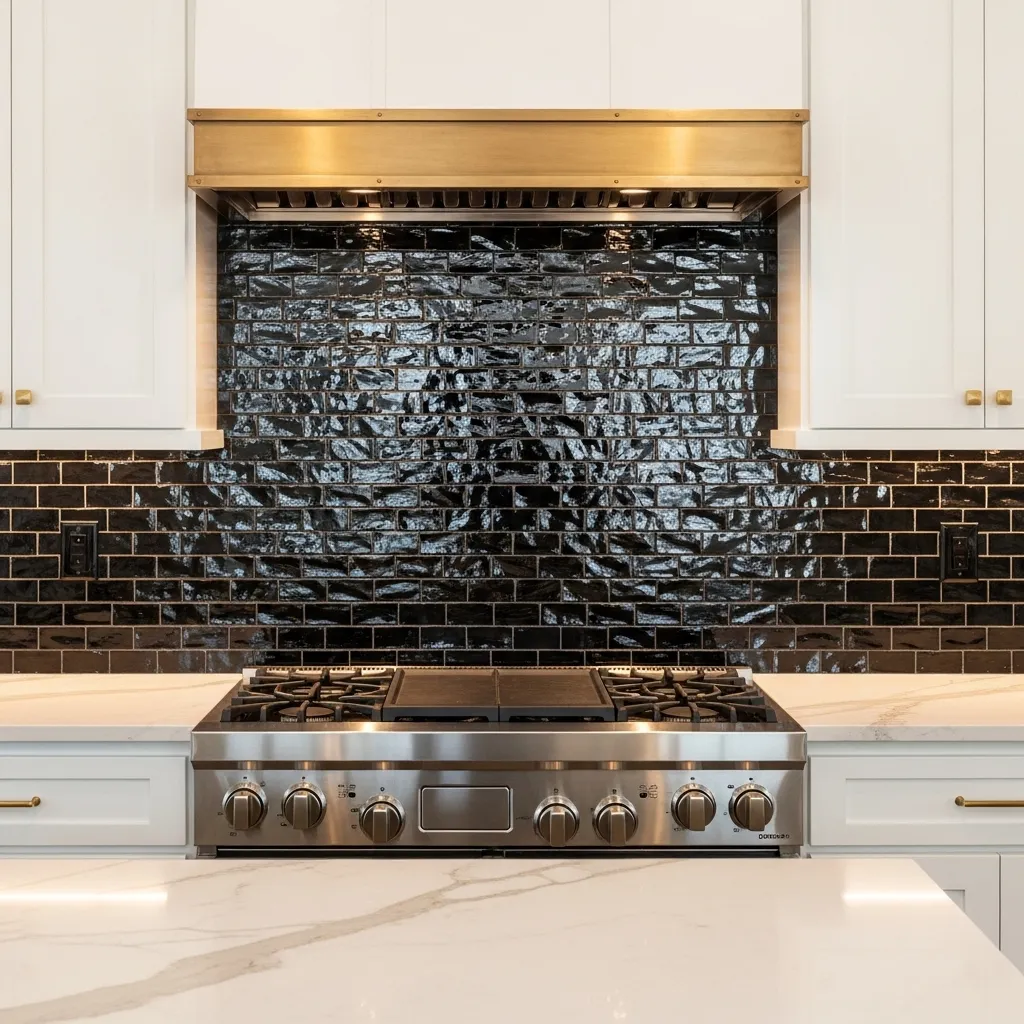
Black zellige tile as a kitchen backsplash creates the most textured and most visually dynamic black surface available in kitchen design — the small-format handmade tiles, each with a slightly different surface angle and a highly reflective black glaze, create a backsplash that’s never quite static, appearing to shift and shimmer as the kitchen lighting changes and as the viewer moves. This quality of light animation distinguishes black zellige from flat black tile or black painted surfaces, which absorb light consistently rather than scattering it into the room.
The combination of black zellige backsplash with white cabinetry creates the black-and-white kitchen’s most textured and most sensory interpretation — the rough, reflective, handmade quality of the zellige against the smooth, matte, precisely made white cabinetry creates a material contrast of extraordinary richness. The zellige’s warmth — despite being black, the handmade ceramic quality of zellige has a warmth that manufactured black materials lack — prevents the high contrast of the black backsplash and white cabinetry from reading as cold, creating a kitchen that’s simultaneously high-contrast and warm.
6. White Cabinetry With Black Concrete Countertops
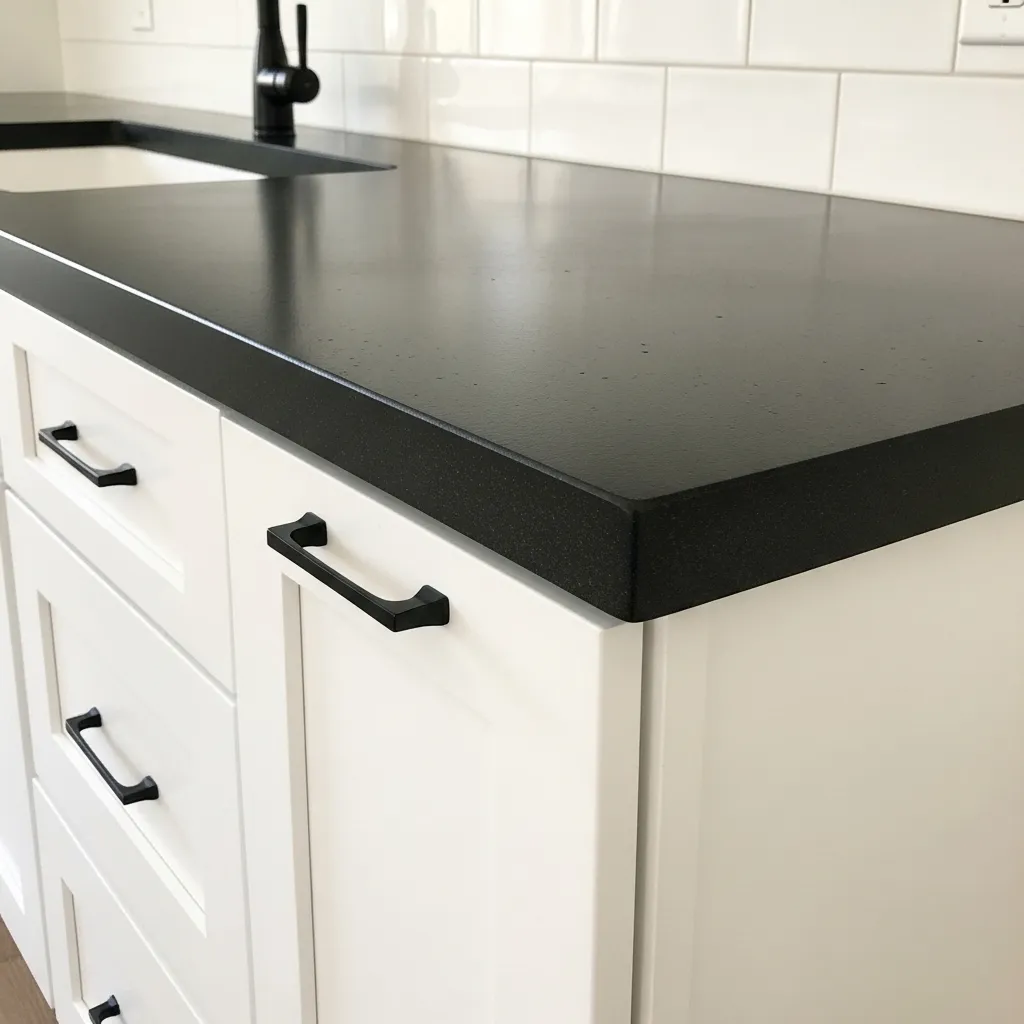
White cabinetry with black concrete countertops creates the most specifically material and most honestly crafted black and white kitchen — the concrete’s warmth, weight, and visible making-process create a black surface with genuine presence and genuine character, while the white cabinetry provides the clean architectural backdrop that allows the concrete’s specific material quality to be fully appreciated. Concrete is not a decorative surface applied to achieve a color; it is a structural material used as a surface, and that material honesty creates a kitchen counter with a quality of truthfulness and permanence that manufactured black surfaces can reference but not replicate.
The warm pigmentation of the black concrete is the specific specification that most determines whether this pairing creates the warm, resolved kitchen of maximum material quality or the cool, slightly industrial kitchen that black concrete without warm undertones produces. Warm-pigmented black concrete — where the warmth counteracts the inherent coolness of portland cement’s grey base — connects to the white cabinetry’s warmth and to the warm handmade tile backsplash in a way that cool-toned black concrete doesn’t, creating a kitchen where every material decision is pulling toward warmth rather than coolness.
7. Bold Black and White Pattern Tile Floor and Backsplash
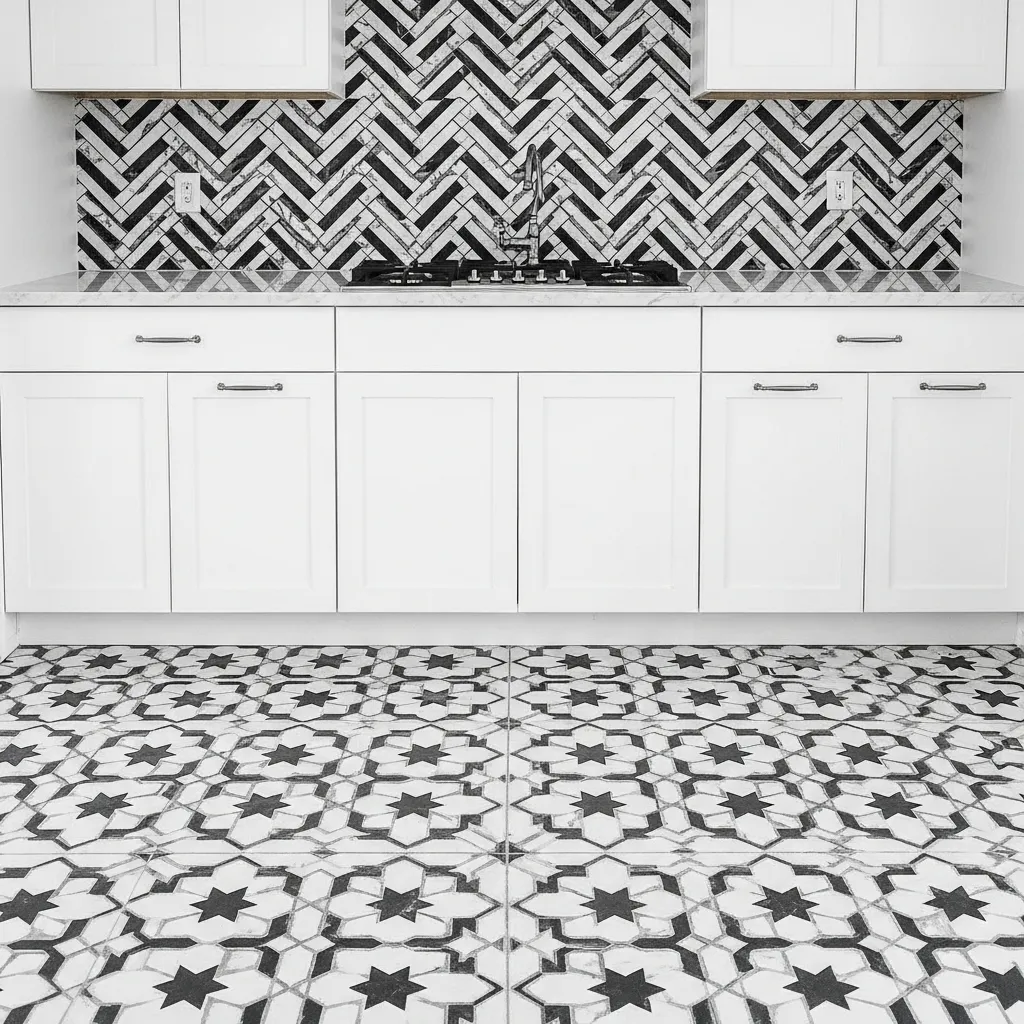
Using bold black and white patterned tile at both floor level and backsplash level — in harmonious but different patterns — creates the most visually complex and most maximalist interpretation of the black and white kitchen, one that uses the palette’s graphic potential to create a kitchen with the visual richness of a beautifully illustrated room rather than the restraint that the palette’s monochromatic nature might suggest. The key to making two different black and white patterns coexist beautifully is the shared palette — both patterns using exactly the same black and exactly the same white — and the clear differentiation in scale that prevents the two patterns from competing at the same visual frequency.
The clean, handleless white cabinetry between the two patterned surfaces is the design decision that makes the dual-pattern approach work rather than creating visual chaos — the white cabinetry provides the visual rest zone, the breathing room between pattern moments, that allows both the floor pattern and the backsplash pattern to be fully experienced as distinct design moments rather than merging into undifferentiated visual noise. This principle — maximum pattern requires maximum simplicity in the adjacent surfaces — is the organizing logic of maximalist pattern design in any context, and the black and white kitchen is the space where it can be most dramatically and most successfully applied.
8. Industrial Black Steel Windows and Doors Within White Kitchen
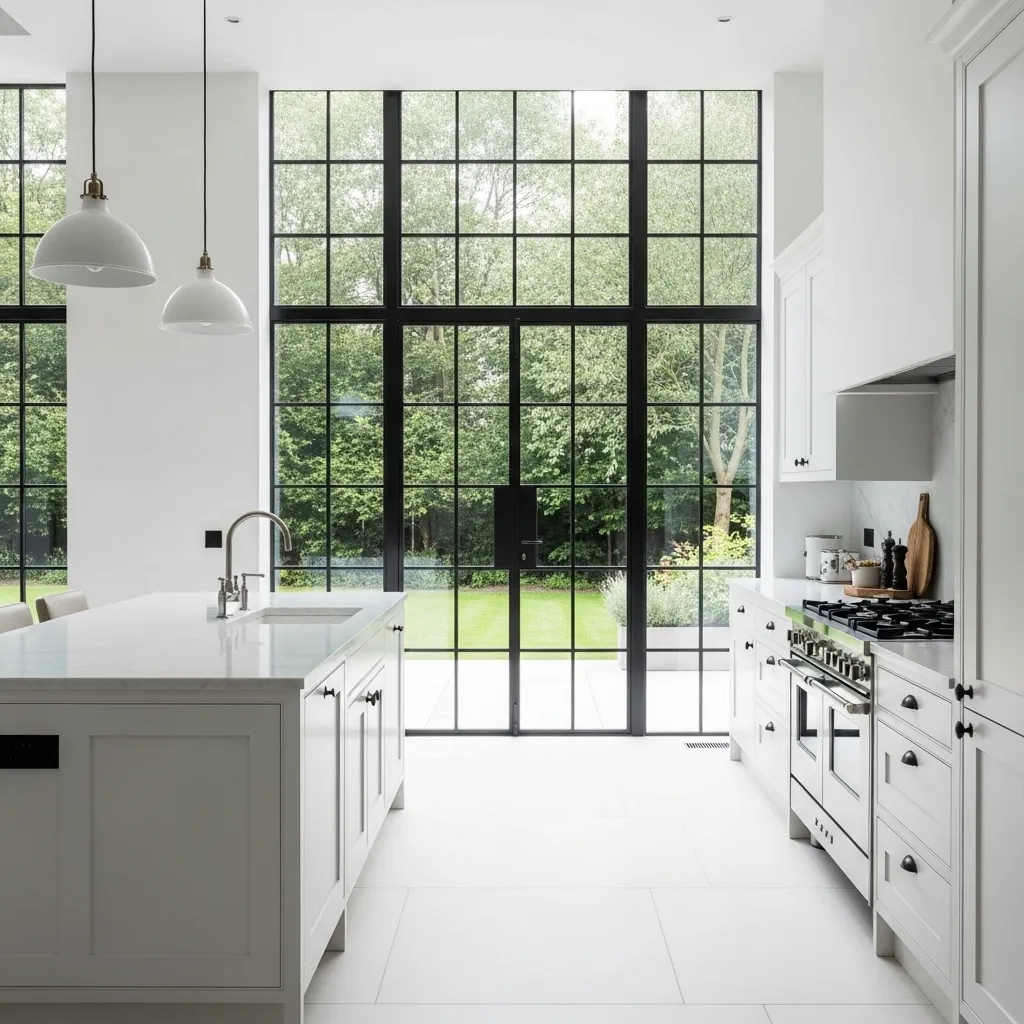
Black steel frame windows and doors as the kitchen’s primary architectural black element — with white cabinetry and white surfaces creating the interior contrast — creates the black and white kitchen’s most architecturally ambitious interpretation, one where the black element is not hardware or tile but structural architecture itself. The black steel frames create a graphic grid of vertical and horizontal elements across the kitchen’s most significant wall, bringing the visual logic of the black and white palette into the architecture of the building rather than limiting it to the decoration and finishes within the room.
The specific beauty of black steel frame windows in a white kitchen is the relationship they create between the kitchen’s interior palette and the garden or exterior view beyond — the black steel frames create a strong graphic grid that creates the most beautiful possible framing of the outdoor view, making the garden appear more vivid and more specifically beautiful through the dark frame than it would through a white or timber frame. This framing effect is the architectural phenomenon that makes black steel windows so valued in contemporary design — they don’t just provide light and view, they transform the view into a series of framed compositions of extraordinary quality.
9. Warm White Limewash Walls With Black Cabinetry
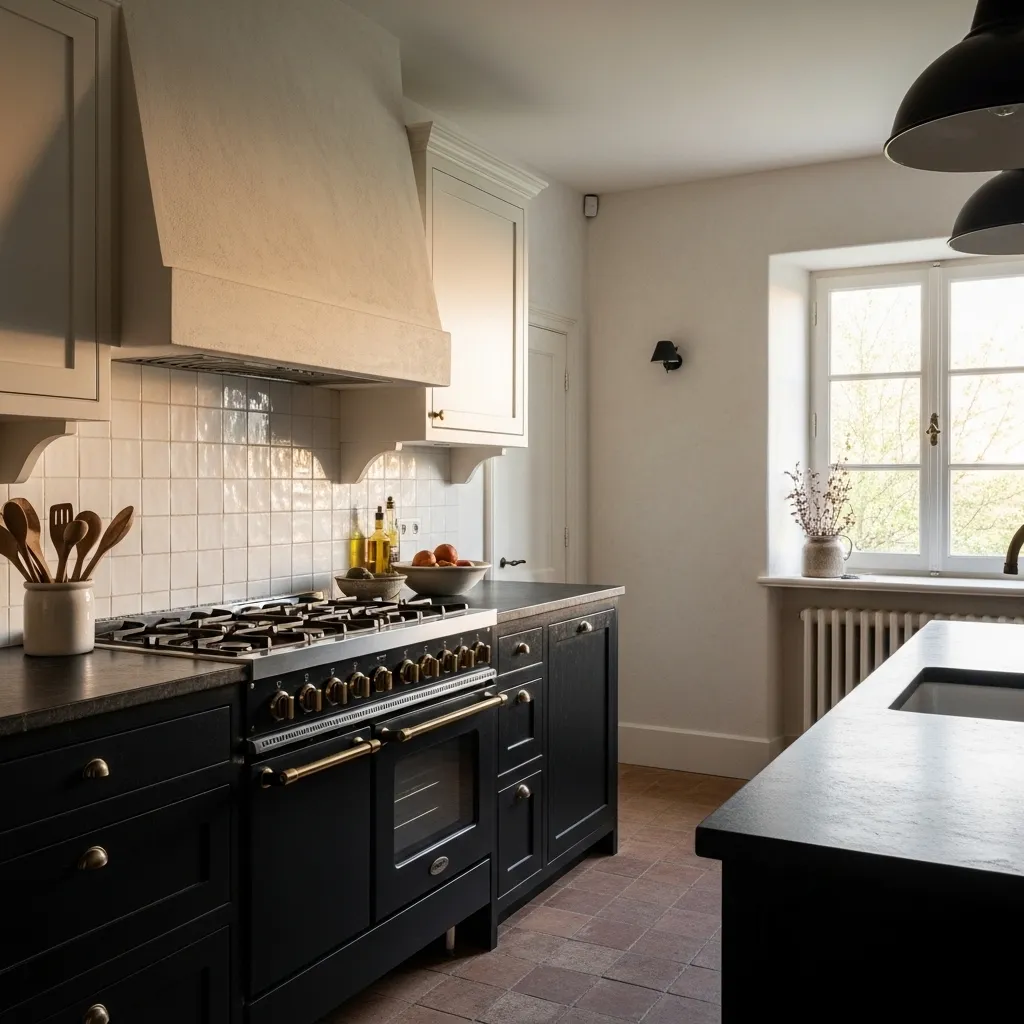
Warm white limewash walls with black cabinetry create the most specifically ancient and most atmospherically warm interpretation of the black and white kitchen — the limewash walls, with their handcrafted surface variation and warm quality, replace the cool flatness of painted walls with a surface of genuine material depth that makes the black cabinetry appear to sit within a warm, living backdrop rather than against a flat neutral one. The tonal variation of limewash — lighter in some areas, slightly warmer in others, always responsive to the changing quality of the light — creates a wall surface that appears almost to breathe, and the black cabinetry within this warm, living backdrop takes on a quality of depth and warmth that the same cabinetry against flat white paint doesn’t possess.
The combination of limewash walls with black cabinetry and terracotta floors creates the specific material story of a Mediterranean farmhouse kitchen updated with contemporary cabinetry — the ancient wall finish and ancient floor material providing the historical and natural warmth that prevents the black cabinetry from reading as cold or contemporary-industrial, while the black cabinetry provides the clean, precise, contemporary architectural element that prevents the limewash and terracotta from reading as purely rustic or purely historical. The tension between these two material registers — ancient and contemporary, natural and precise — is what makes this specific combination so specifically beautiful.
10. White Kitchen With Black Open Shelving
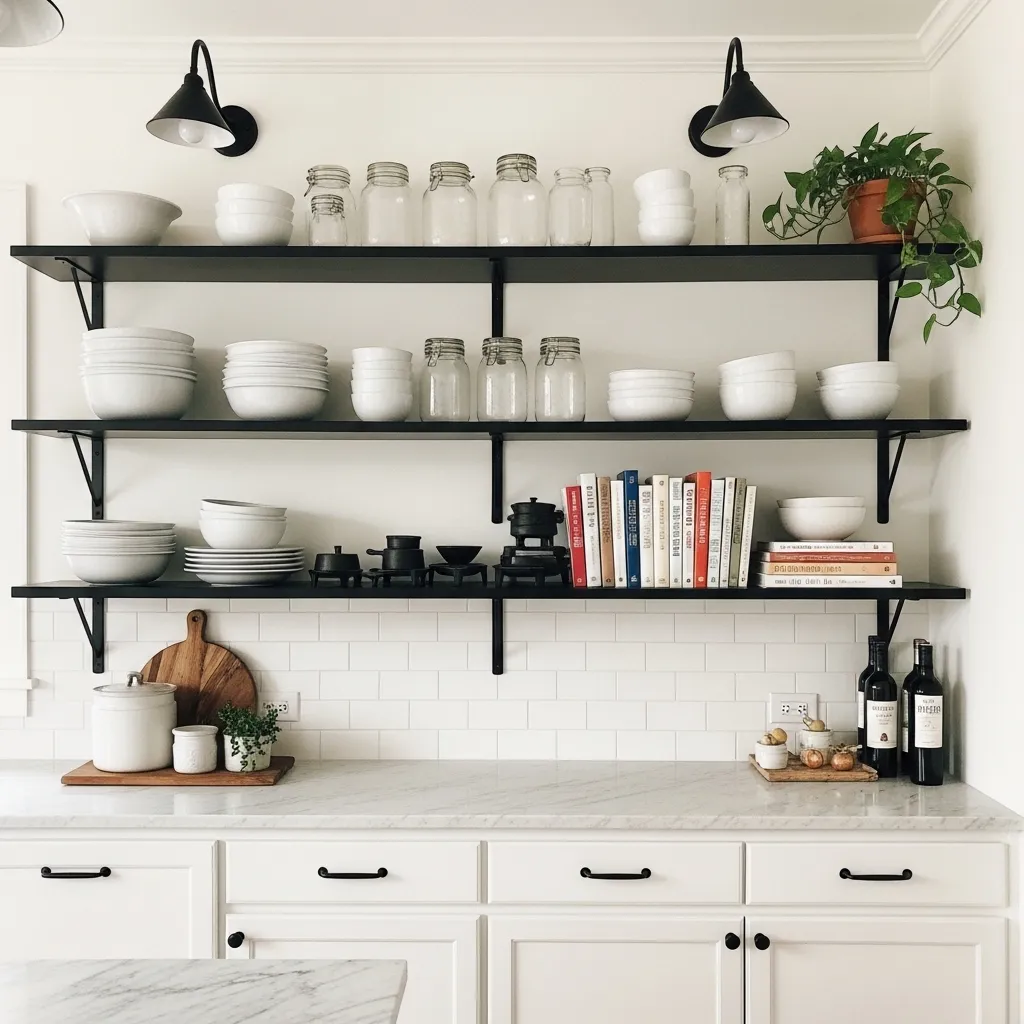
Black powder-coated steel open shelving replacing upper wall cabinetry in a white kitchen creates the most graphic and most clearly black-and-white interpretation of the open shelving kitchen — the slim black steel shelves and brackets against white walls and above white lower cabinetry create a strong graphic composition where the black shelving is clearly visible as a designed architectural element rather than just storage, and the white background makes every object on the shelves appear more vivid and more deliberately chosen than they would against a wood or painted background.
The specific quality of slim steel shelving in a black and white kitchen is its graphic clarity — the slim, precise profile of the steel shelf and bracket creates a clean line drawing on the white wall, a composition of horizontal and vertical black elements that reads as intentional design regardless of what’s displayed on it. The objects displayed on the shelves layer into this graphic composition, adding color, texture, and material warmth within the clean black and white architectural framework of the shelves and wall.
11. Black Range Hood as Statement Feature
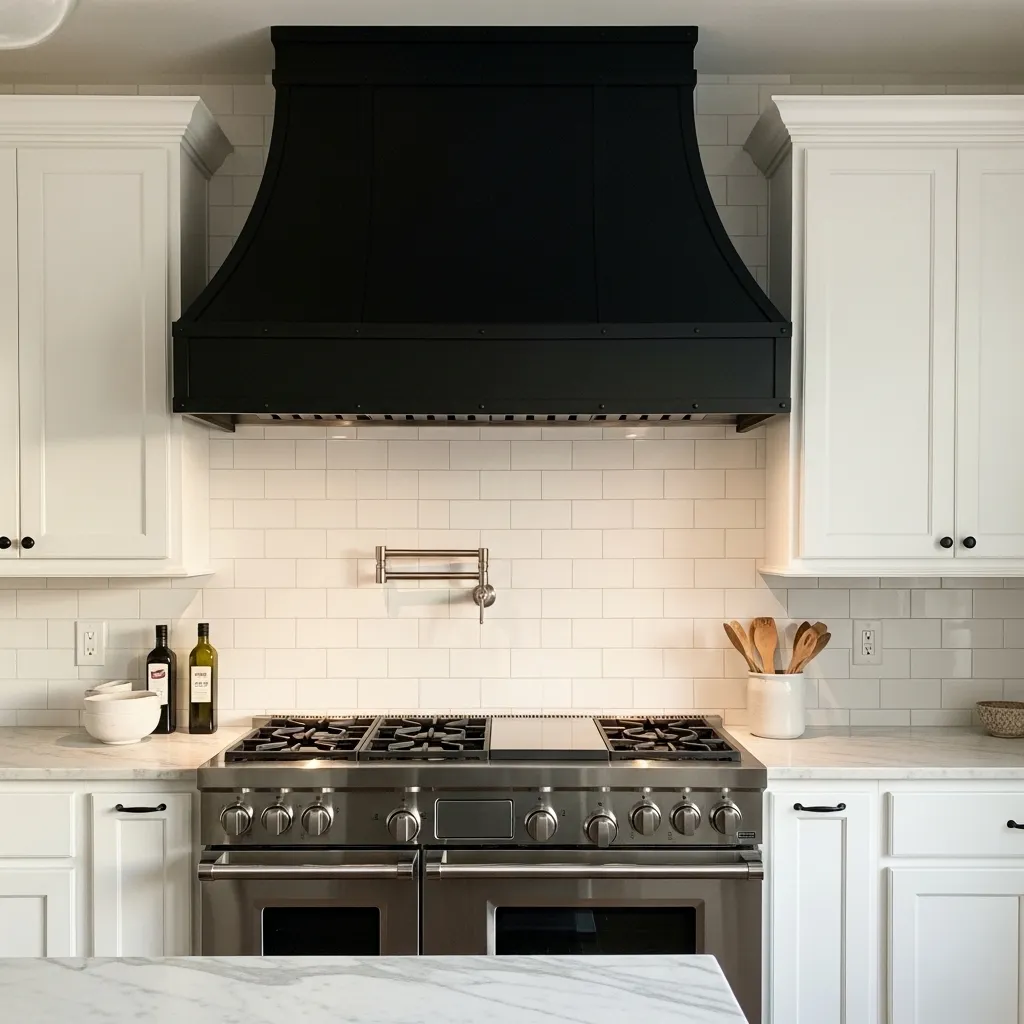
An oversized matte black range hood as the kitchen’s primary design statement — the single most dominant black element in an otherwise white kitchen — creates the black and white kitchen’s most immediately dramatic and most visually authoritative interpretation, because the range hood occupies the most architecturally significant position in the kitchen (the cooking wall, centered, at the dominant visual height) and a black hood in a white kitchen creates maximum contrast at maximum visual prominence. The range hood that’s designed to be seen — oversized, architecturally profiled, in the strongest possible material finish — transforms the kitchen’s cooking wall from a functional zone to a designed focal point of genuine presence.
The specific design of the hood profile is the quality that most determines whether an oversized black range hood reads as a designed object of genuine architectural quality or simply as a large black appliance — clean geometric lines with visible precision, a slightly oversized proportion that communicates confidence rather than function, no visible fasteners or awkward transitions, a matte finish that reads as material quality rather than surface treatment. These design qualities transform the range hood from equipment into architecture, and that transformation is what makes the oversized black hood the most powerful single design element available in a white kitchen.
12. Carrara Marble Throughout — The Luxury Monochrome
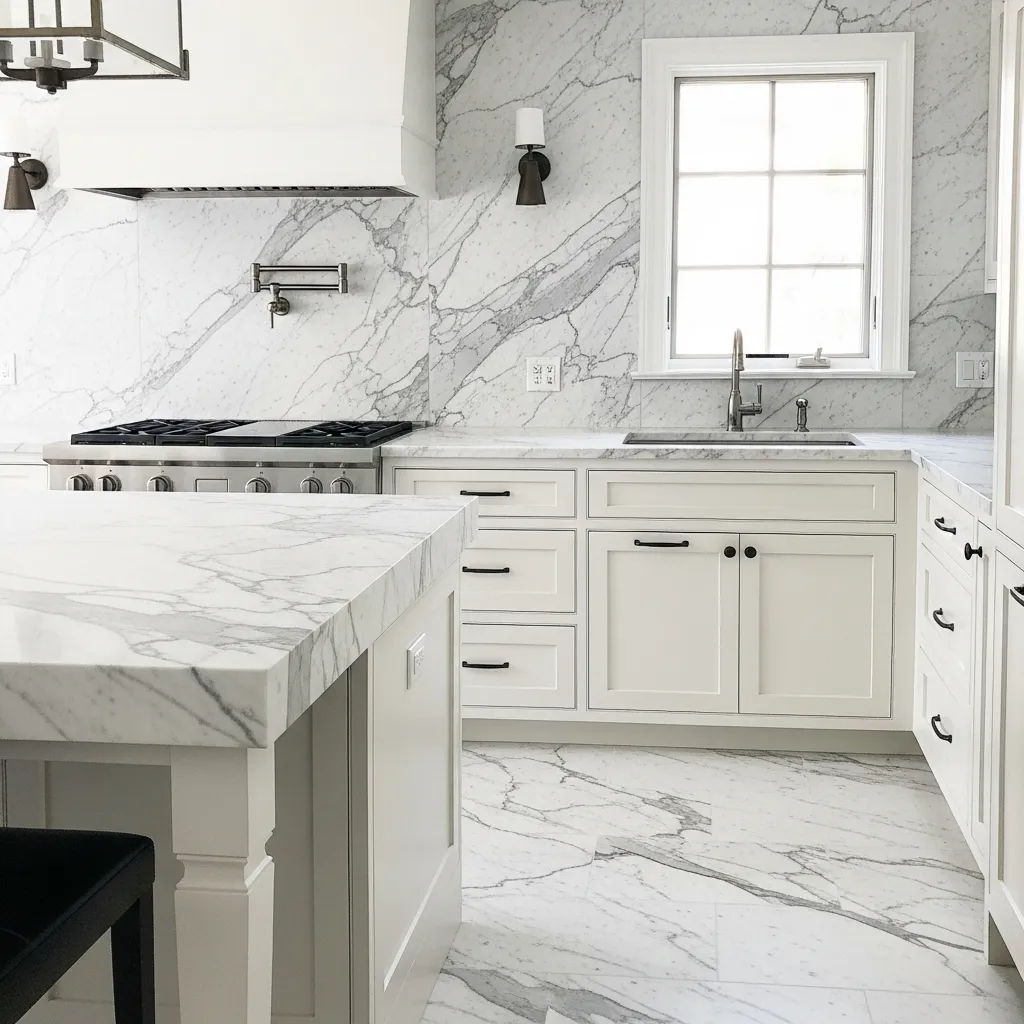
Using Carrara marble throughout — countertops, backsplash, island, floor, and windowsill all in the same white marble with grey veining — creates a black and white kitchen where the palette is expressed entirely through the natural pattern of a single material rather than through the contrast of separate black and white surfaces. The marble’s veining creates the black element; the marble’s white base creates the white element; and the complete material cohesion of a full-marble kitchen creates a luxury of material consistency that the use of multiple different materials, however well coordinated, can’t quite achieve.
The grey veining of Carrara is the specific marble characteristic that makes it the ideal material for a marble-as-black-and-white-palette kitchen — it has enough veining to create clear visual interest and clear black-and-white pattern, while the veining is refined enough that a room fully clad in it reads as beautifully coherent rather than visually overwhelming. A more dramatically veined marble — Calacatta with its bold grey and gold movement, Statuario with its strong contrasting veins — would create a full-kitchen clad result that’s extraordinary but potentially too visually complex for daily living; Carrara’s quieter veining creates the full-marble kitchen that’s most genuinely livable as well as most beautiful.
13. Black Kitchen With White Brick Backsplash
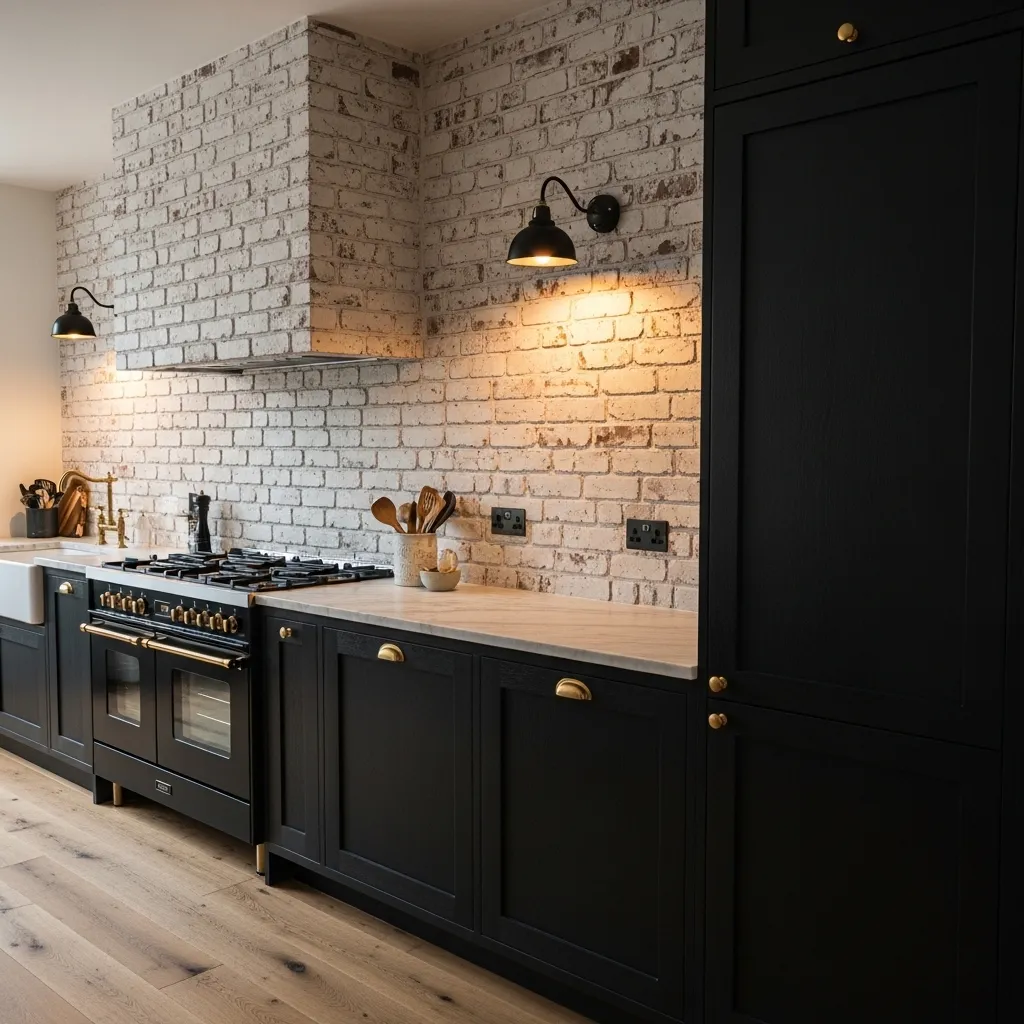
Matte black cabinetry against a white brick backsplash creates the most texturally dramatic material pairing available in black and white kitchen design — the rough, irregular, deeply shadowed surface of brick at full wall height behind the flat, precise, perfectly smooth surface of matte black cabinetry creates a contrast of texture and surface quality that makes both materials appear more distinctive and more characterful than either would in isolation. The white brick’s texture makes the black cabinetry’s precision appear more intentional and more perfectly crafted; the black cabinetry’s smoothness makes the white brick’s irregularity appear more genuinely ancient and more authentically material.
The white brick backsplash specifically — brick that has been painted white or whitewashed rather than left in its natural red-orange tone — is the material that creates the purest black and white kitchen expression within this configuration, because white brick maintains brick’s extraordinary textural quality (the individual brick forms, the mortar joints, the rough surface) while contributing to the black and white palette rather than introducing a third color. The white-painted brick also has a quality of architectural history — it references the painted brick of industrial lofts, of old warehouse buildings, of the specific architectural tradition of painting industrial brick to brighten a space — that gives this kitchen configuration a quality of genuine place and genuine history.
14. Black and White Kitchen With Warm Brass — The Triumvirate
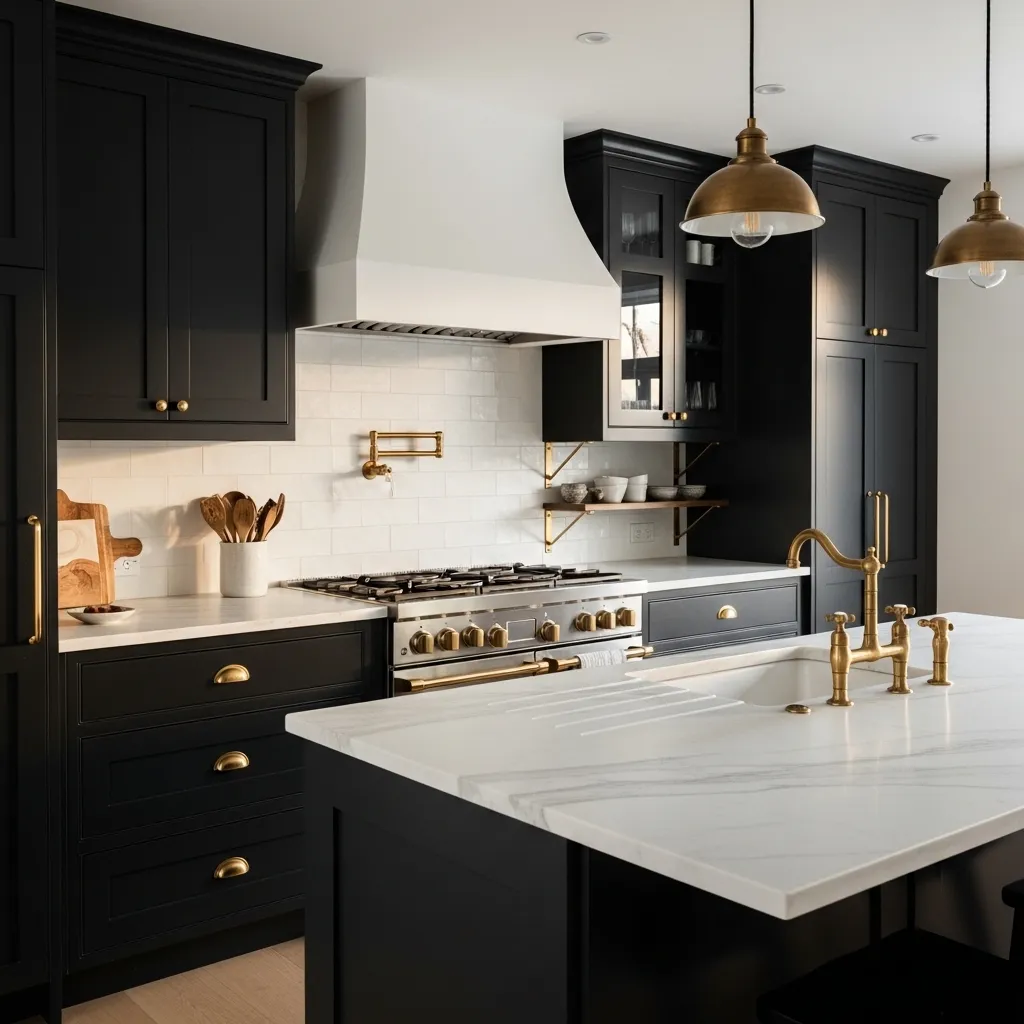
The combination of black cabinetry, white surfaces, and warm unlacquered brass hardware is the triumvirate that most completely solves the black and white kitchen’s potential coldness problem — because while black and white alone create maximum contrast and maximum graphic impact, they can read as cold or clinical without a warm material to mediate between them. Unlacquered brass is the specific warm material that mediates most effectively because its amber-to-honey tone is equidistant in warmth between the cold potential of the white surfaces and the stark potential of the black cabinetry, connecting to both while belonging fully to neither.
The unlacquered quality — the absence of protective lacquer that allows the brass to develop a natural patina — is specifically important to this kitchen’s character because aged brass has a warmth and complexity that new lacquered brass lacks. As unlacquered brass ages in the kitchen environment, it deepens and develops areas of deeper oxidation at the joints and edges and areas of brighter surface where frequent touch keeps the metal polished, creating a hardware surface of genuine character and genuine material beauty that lacquered brass — which maintains its initial tone uniformly — never achieves. In a kitchen where material quality and material honesty are the primary design values, unlacquered brass that tells the story of its use is specifically aligned with the black and white palette’s fundamental commitment to materials in their most genuine and most beautiful form.
15. Monochromatic Black Kitchen — Pure Drama
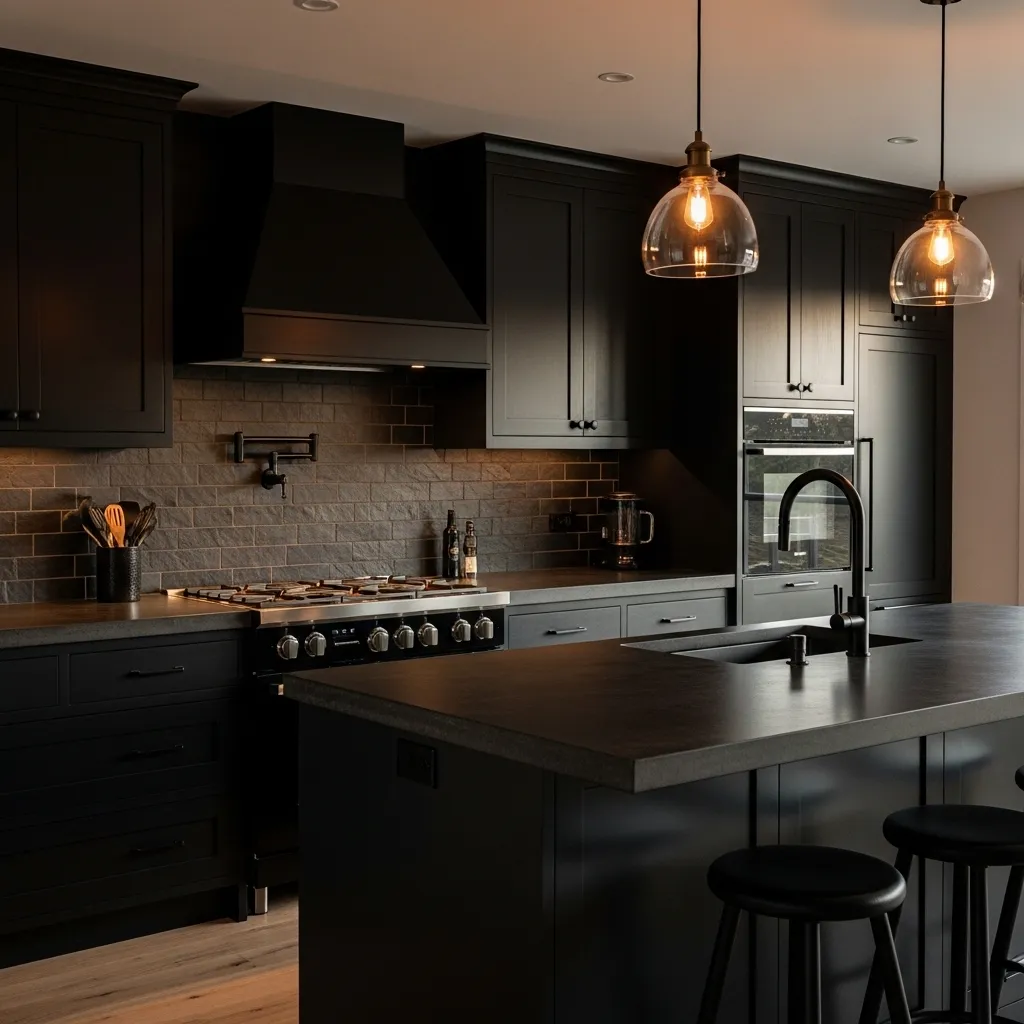
A monochromatic black kitchen — where every surface and every material is in a variation of black rather than in the conventional black-and-white combination — creates the boldest and most dramatic kitchen environment available and represents the most extreme point of the black kitchen aesthetic’s spectrum. The interest in a monochromatic black kitchen comes not from the contrast between black and white but from the contrast between different blacks — the matte black of cabinetry versus the warm dark grey of concrete countertop versus the mineral black of stone backsplash — and the skill of designing it lies in selecting blacks that have enough tonal and textural variation to create visual richness rather than visual monotony.
The two deliberate warm accents — the aged brass pendant lights and the pale oak floor — are the elements that prevent the monochromatic black kitchen from reading as oppressive rather than dramatic. Without any warm light source within the kitchen and without any warm natural material at floor level, a fully black kitchen would feel like a cave regardless of its spatial quality or material excellence. The warm amber light of aged brass pendants and the warm honey of pale oak flooring create the specific contrast that makes the surrounding darkness appear intentional and atmospheric rather than simply dark — they are the light sources that make the darkness beautiful rather than just making the room dark.
16. White Kitchen With Black Ceiling
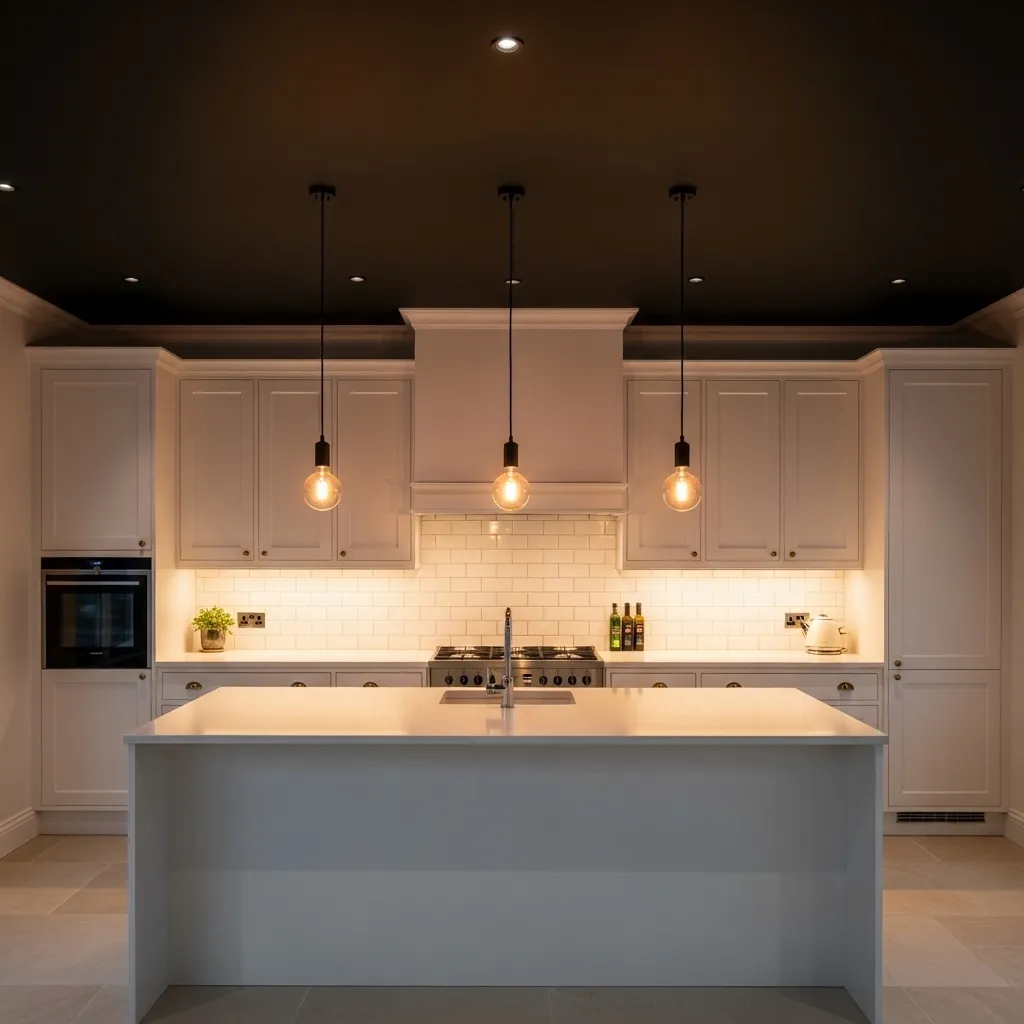
A black ceiling in an otherwise white kitchen creates the most architecturally unexpected and most spatially dramatic interpretation of the black and white kitchen — by placing the black element at the ceiling rather than at the cabinetry or floor, the conventional spatial logic of the kitchen is inverted and the room’s proportions and atmosphere are completely transformed. The black ceiling creates a feeling of intimate enclosure — a sky that has been brought down to human scale — that makes the kitchen feel like a room within a room, a specifically designed space rather than a functional area within a larger house.
The specific spatial effect of a black ceiling in a white room is the appearance of visual compression and intimacy rather than height and openness — but this compression reads as warmth and enclosure rather than smallness when the ceiling black is executed with genuine material quality (matte finish, warm undertone) and when the lighting within the space is warm and well-positioned. Pendant lights hanging from a black ceiling with warm filament bulbs create a quality of ambient light that’s specifically domestic and specifically beautiful — the warm bulbs appear as warm amber stars in the dark ceiling, and their light pools on the white surfaces below create a quality of intimate, focused warmth that overhead recessed lighting in a white ceiling entirely fails to produce.
17. Black and White Kitchen With Natural Stone Island
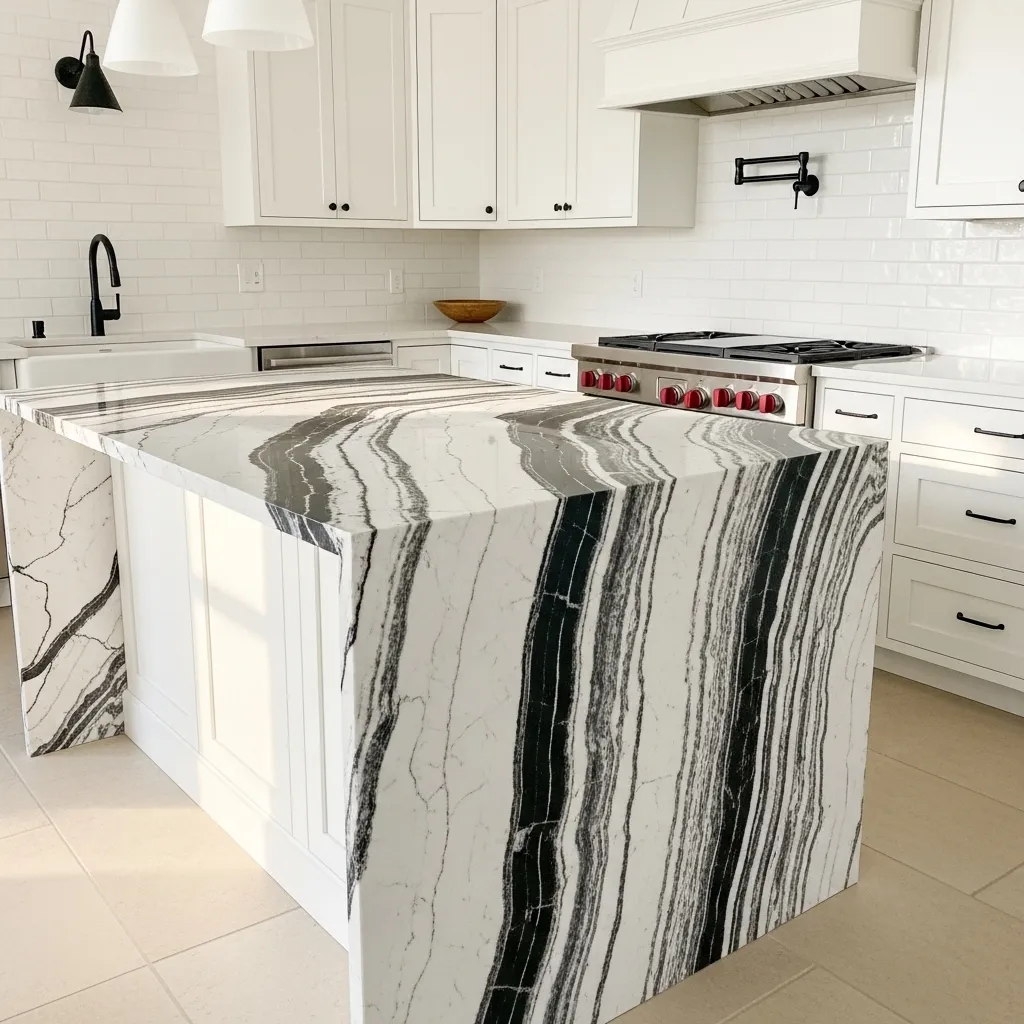
A dramatically veined black and white quartzite or marble island slab — where the stone’s natural veining creates the kitchen’s black element through the pattern of the stone rather than through painted cabinetry or hardware — creates the most materially sophisticated and most luxuriously natural interpretation of the black and white kitchen. The stone’s pattern is not designed but found — selected because this specific slab happened to contain the bold black veining on white background that makes it the kitchen’s primary design statement — and that quality of found rather than designed beauty creates a kitchen with a specific material authenticity that no amount of paint or tile specification can achieve.
The selection of the specific quartzite slab for this application requires the same attention that selecting marble for a book-matched application requires — seeing the actual stone in person, understanding how the veining will read at countertop scale, evaluating whether the bold movement of the veining creates a composition of genuine beauty or simply visual complexity. The right slab has bold, confident veining that reads as a designed composition from across the room while revealing its geological complexity at close range — veining that’s bold enough to create the graphic black and white statement from the kitchen entrance but specific enough in its patterning to reward sustained attention and close inspection.
18. The Full Black and White Kitchen — Every Element Considered
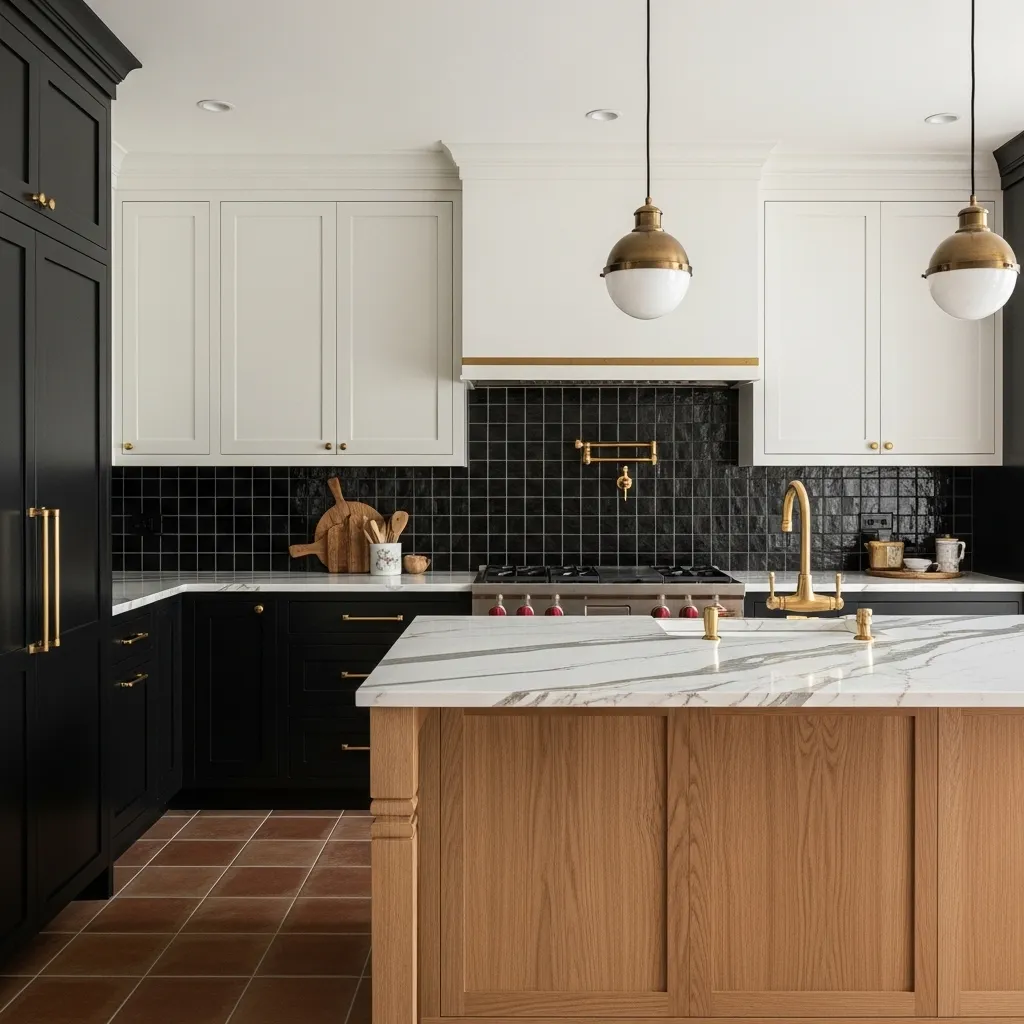
A fully resolved black and white kitchen where every element has been specifically chosen to contribute to either the black element, the white element, the warm brass accent, or the warm natural material warmth — and where no material contradicts those four registers — creates a kitchen of extraordinary completeness and extraordinary visual coherence. The discipline of the palette, applied consistently across every decision from the largest (the cabinetry color) to the smallest (the pendant light finish), creates a kitchen that reads from the first glance as a completely composed, completely intentional design rather than a series of individual decisions that ended up in the same room.
The terracotta floor within a black and white kitchen is the 2026 material decision that most clearly distinguishes current black and white kitchen design from previous interpretations — the terracotta introduces warmth at the room’s most foundational level while remaining consistent with the black and white palette’s commitment to natural, honest materials in their most beautiful form. The warm amber-red of terracotta beneath black and white cabinetry and white marble countertops creates a kitchen that’s simultaneously high-contrast and warm, architecturally precise and organically grounded, contemporary in its palette and ancient in its materials — which is precisely the combination that defines the best black and white kitchen design of 2026.