15 Dining Room Wall Decor Ideas That Transform the Room Where You Gather Into Something Genuinely Extraordinary
If your dining room walls are currently doing one of three things — bearing a single piece of art that feels slightly too small and slightly too alone, hosting a mirror that reflects the table back at you without adding much of interest to what’s being reflected, or simply being walls that you’ve been meaning to do something with since you moved in — this guide covers every significant approach to dining room wall decor that creates genuine visual impact, genuine atmospheric transformation, and the specific quality of a room that makes guests stop when they enter and experience the space before they’ve even sat down. The fifteen ideas here span the complete spectrum of what dining room walls can do: from the most dramatically wallpapered feature wall that turns the dining room into a jewel box, through the oversized single artwork approach that creates a room anchored by genuine visual authority, the floor-to-ceiling gallery wall that creates a room within a room of accumulated beauty, the architectural molding and paint treatment that turns flat drywall into genuine interior architecture, the dramatic lighting-as-wall-decor approach where the sconces and pendants are themselves the visual statement, the full-wall mural that creates the most immersive dining experience possible, the vintage mirror collection that multiplies light and visual complexity simultaneously, the textured wall treatment in plaster or limewash that makes the wall surface itself the decor, the built-in banquette with upholstered wall above it that creates a complete dining destination, the dramatic dark painted ceiling combined with lighter walls that inverts conventional spatial expectation, the wainscoting and wallpaper combination that creates full architectural completeness, the oversized botanical or nature photography that brings the outdoor world inside at dramatic scale, the sculptural wall installation in ceramic or metal that turns the dining room wall into a three-dimensional art experience, the full-wall wine storage that creates both functional and visual abundance, and the conversation wall of meaningful personal objects that creates the dining room’s most intimate and most specifically personal visual moment.
The dining room wall is the most underutilized design opportunity in most homes — in a room where people sit for extended periods facing the walls rather than the floor or the ceiling, where there is no television competing for visual attention, where the purpose of the gathering is conversation and pleasure rather than activity, the walls have a significance and a duration of viewing that walls in other rooms don’t quite achieve. You look at your dining room walls for the full length of every meal you eat there, for the full duration of every dinner party, for the whole span of every holiday gathering — which means over a year of regular use you spend more concentrated, unhurried time looking at your dining room walls than at almost any other surface in your home. Given that duration of viewing and that quality of unhurried attention, the dining room wall deserves more genuine design investment and more genuine creative ambition than the single small painting and the unused mirror that most dining rooms receive.
What makes dining room wall decor genuinely extraordinary — what separates the dining rooms that guests photograph and remember from the ones that provide a pleasant neutral backdrop for the food and the company — is the quality of commitment to a specific visual idea rather than the quality of restraint. Dining room walls that are beautiful are beautiful because they’ve committed to something specific: a specific color drama, a specific artwork at a specific scale, a specific wallpaper pattern at the full scale of the room, a specific collection of objects in a specific arrangement that creates a complete visual world. The beautiful dining room wall is the one that chose an idea and pursued it completely rather than hedging toward a safe, underdeveloped version of it.
1. Full-Wall Dramatic Wallpaper — The Jewel Box Dining Room
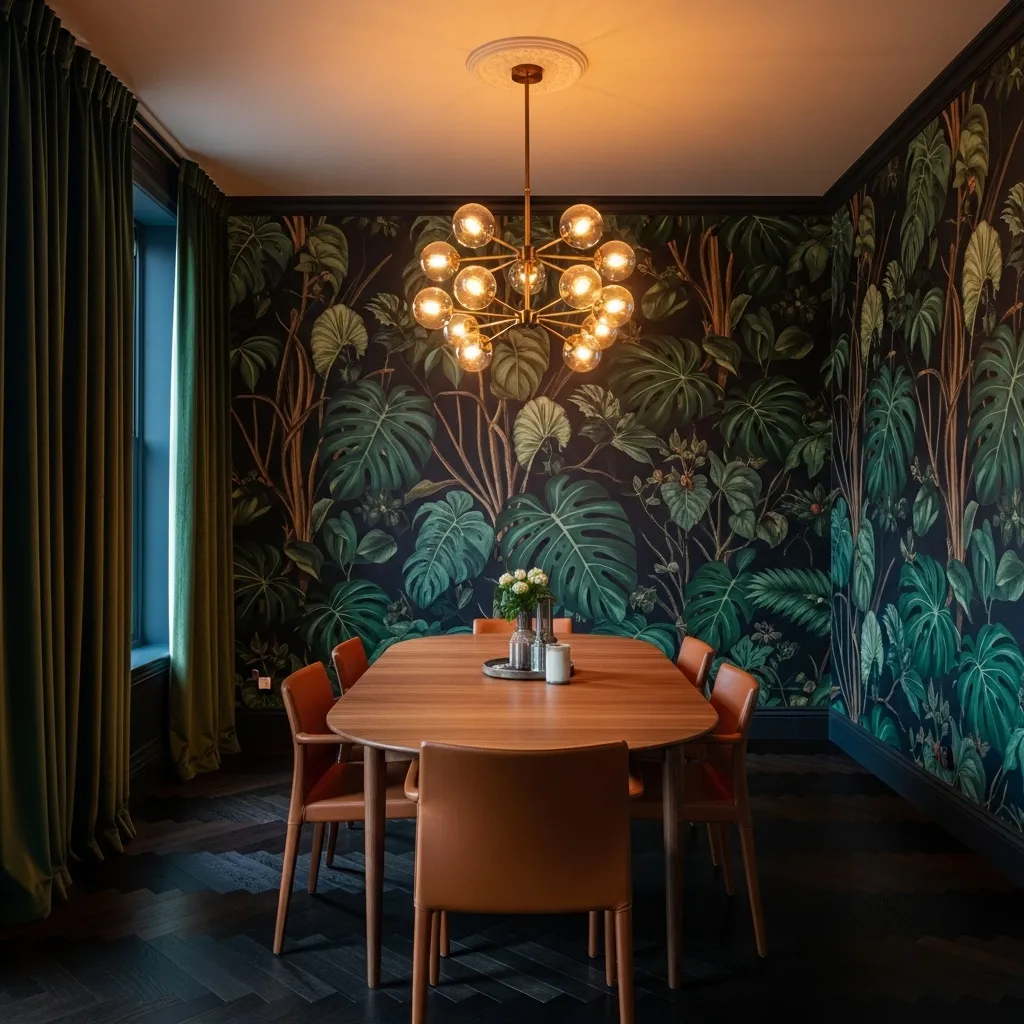
Full-wall dramatic wallpaper — covering all four walls of the dining room in a large-scale, richly colored pattern — creates the most transformative and most completely immersive dining room experience available, turning the dining room from a room that contains a table and chairs into a specific environment of atmospheric richness that makes dining there genuinely extraordinary. The dining room is specifically the best room in the house for bold wallpaper precisely because of the dinner party dynamic — your guests are enclosed by the walls for hours, looking at them from every angle and at every moment of relaxation and conversation, and a wallpapered dining room provides a visual world worthy of that sustained, unhurried attention.
The large-scale botanical pattern is the wallpaper choice that most consistently creates the jewel box dining room of genuine drama and genuine beauty — oversized tropical leaves at near-life-size scale create the specific quality of immersive enclosure, of dining within a canopy, that smaller-scale botanical patterns approach but never fully achieve. The pattern’s scale means each wall segment contains only one or two full pattern repeats, creating large areas of single continuous pattern rather than the uniform repeat of a small-scale design, and this larger scale creates drama and visual movement that smaller patterns at the same color intensity wouldn’t.
2. The Oversized Single Artwork — Visual Authority and Confidence
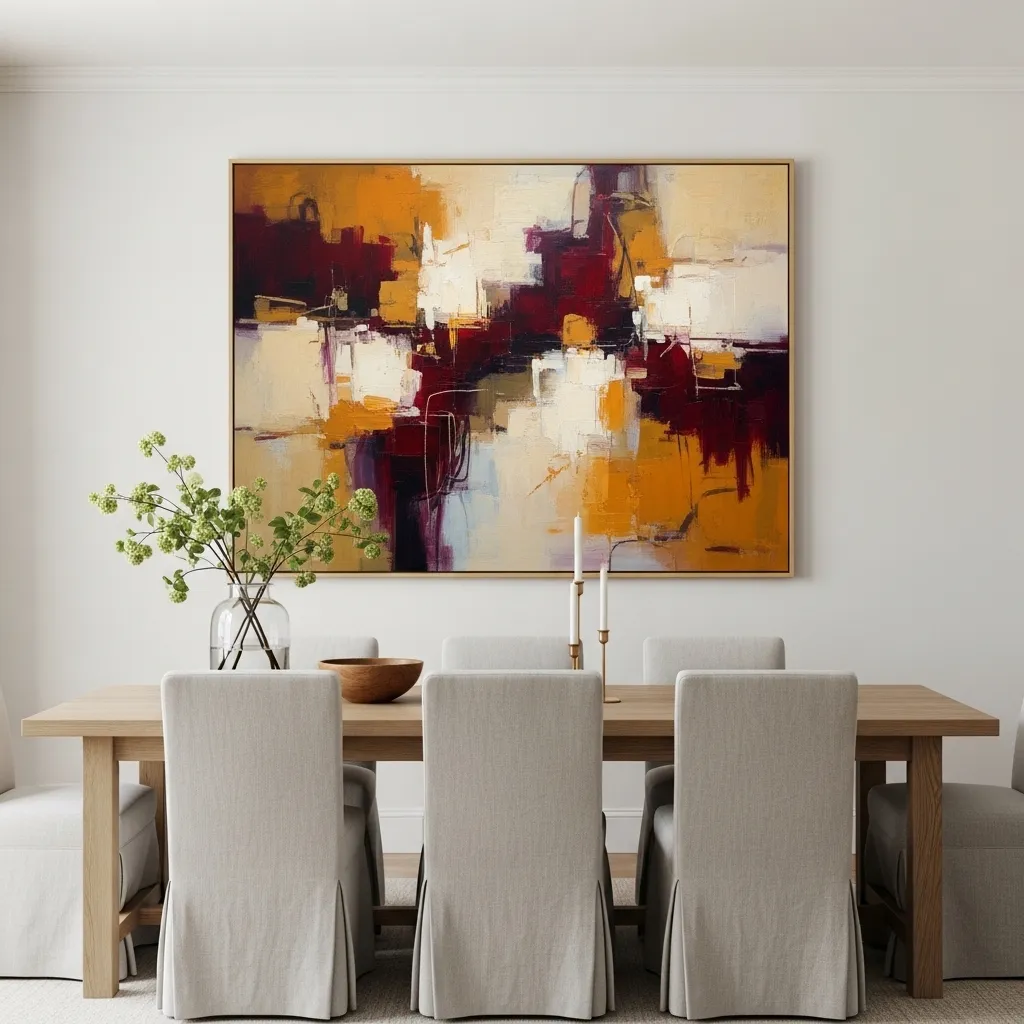
A single oversized artwork — genuinely large, in the range of four to six feet in its smaller dimension — is the dining room wall decor approach that creates the most immediate and most unambiguous statement of design confidence, because an oversized artwork hung alone on a wall communicates that the person who put it there is completely certain of its quality and completely willing to let it stand without support. The undersized artwork hung alone on a large wall communicates uncertainty; the oversized artwork hung alone on an appropriate wall communicates conviction, and that conviction creates a dining room of genuine visual authority that smaller, safer choices don’t achieve.
The abstract painting at the right scale is specifically appropriate for the dining room’s wall decor function because abstract art rewards the kind of sustained, unhurried viewing that dining creates — unlike figurative or narrative art that can be fully read in a single moment of attention, abstract art creates an ongoing visual experience that reveals different qualities at different times of day, in different lighting conditions, from different viewing positions around the table. Each guest at each position sees the painting slightly differently, which creates a shared visual experience that remains interesting across the full duration of the meal.
3. Floor-to-Ceiling Gallery Wall — A Room of Accumulated Beauty
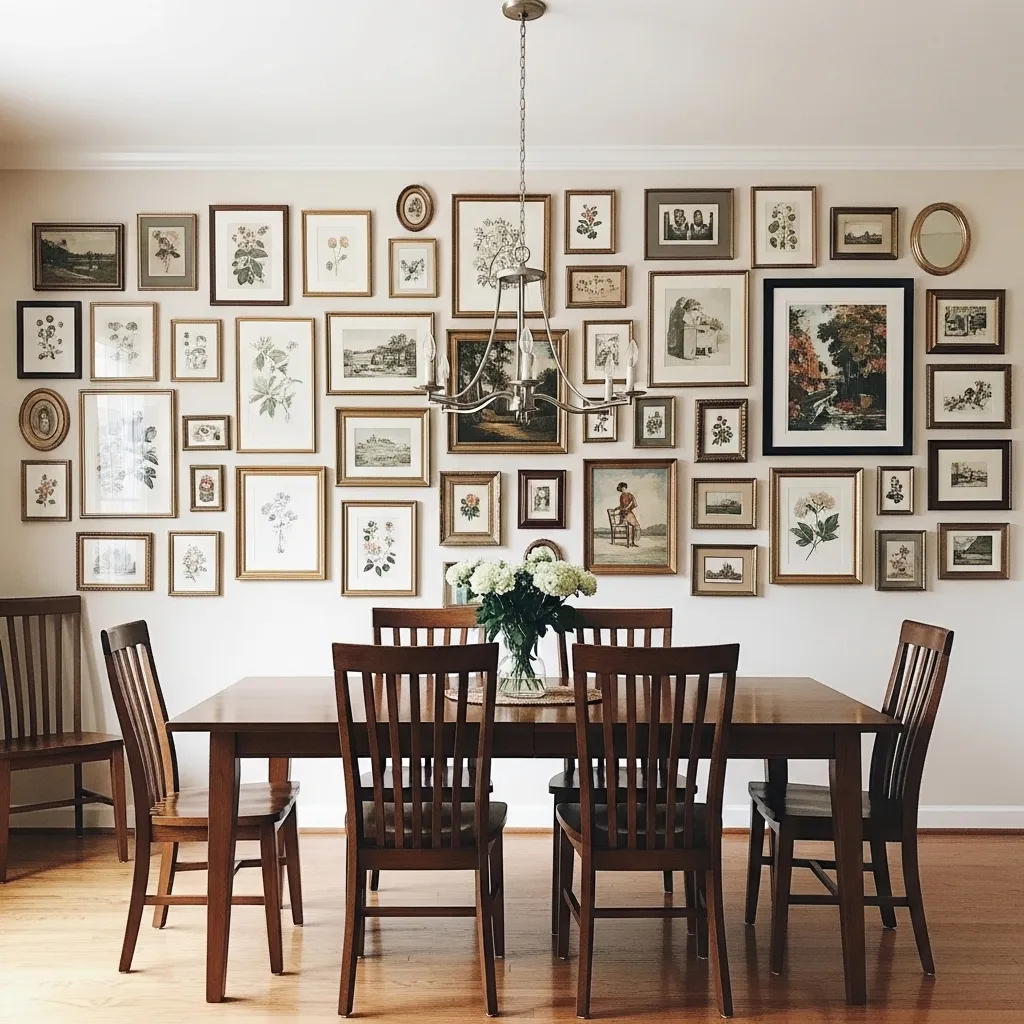
A floor-to-ceiling gallery wall covering the complete primary dining room wall — from baseboard to crown molding, from corner to corner — creates the dining room with the most densely personal and most visually complex wall treatment available, a room where the walls themselves become a complete visual world assembled from years of collecting and choosing and receiving artwork. The density of the floor-to-ceiling approach — the gallery extending all the way to the baseboard and all the way to the crown molding rather than occupying the conventional picture-hanging zone between three and six feet — is what creates the specific quality of a room surrounded by art rather than a room with art hung on it.
The floor-to-ceiling gallery wall specifically creates the dining room wall treatment most suited to long dinner party evenings because its density and variety provide essentially unlimited visual interest — there is always something new to notice in a gallery of thirty or forty pieces, always a detail that rewards closer inspection, always a combination of adjacent pieces that creates an unexpected relationship worth considering. Guests seated at different positions around the table have different sections of the gallery in their primary sightline, creating different and complementary visual experiences that become a genuine subject of conversation.
4. Architectural Molding Treatment — Wall as Interior Architecture
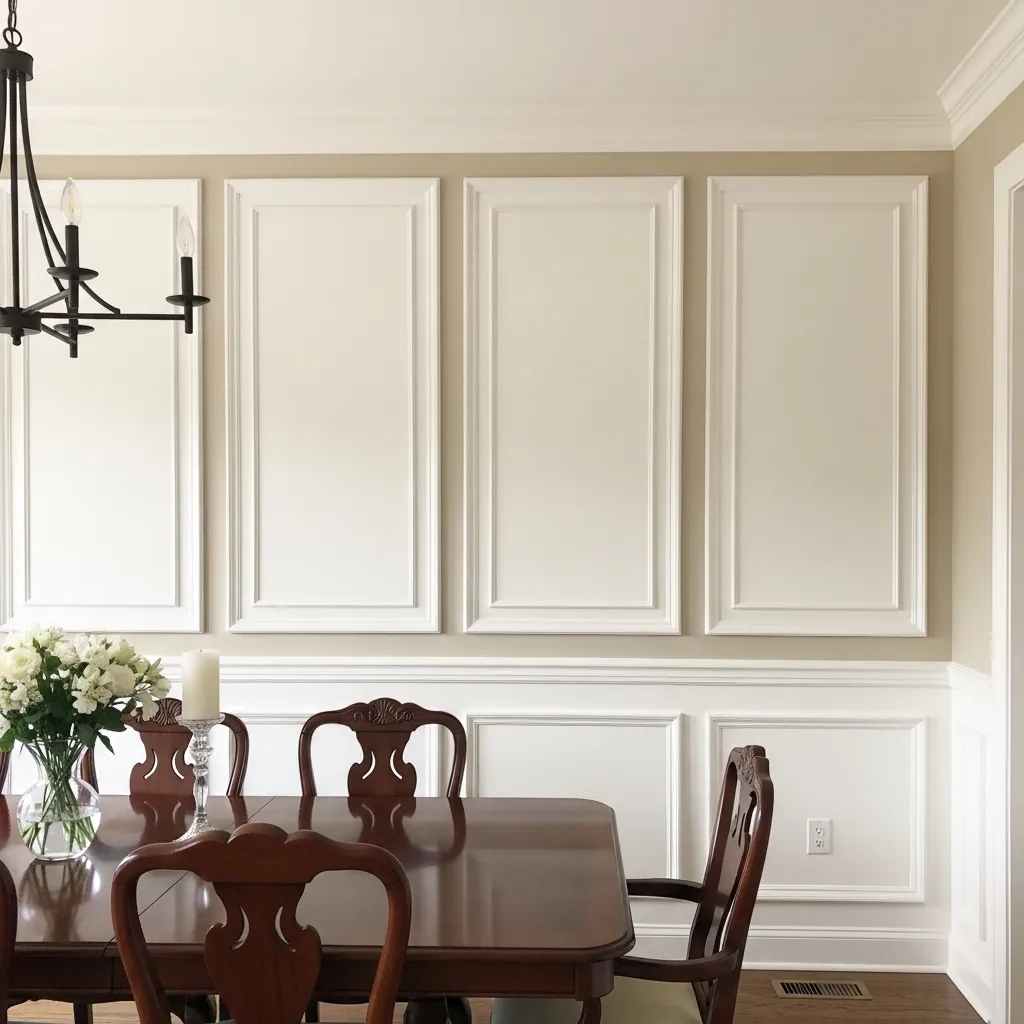
An architectural molding treatment — applied panel moldings creating a series of proportioned rectangles on the dining room walls — creates the most genuinely architectural dining room wall treatment available through purely decorative means, transforming flat walls into surfaces with the depth, shadow, and formal geometry of genuine architectural detailing. The panel moldings create depth through the shadow lines between the molding profile and the wall surface — in natural light these shadow lines read as actual physical recesses, creating walls that appear to have been designed with architectural intention rather than simply painted and furnished.
The proportion of the panels is the specific design decision that most determines whether the molding treatment reads as genuinely architectural or as applied decoration — panels proportioned according to classical principles (approximately 1:1.4 ratio, roughly the golden rectangle proportion) create the specific quality of architectural rightness that well-proportioned classical rooms consistently achieve. Panels that are too wide read as horizontal and squat; panels that are too narrow read as tall and cramped; panels at the golden rectangle proportion read as natural and resolved, as though the proportions have always been exactly right.
5. Dramatic Wall Sconces as the Primary Visual Statement
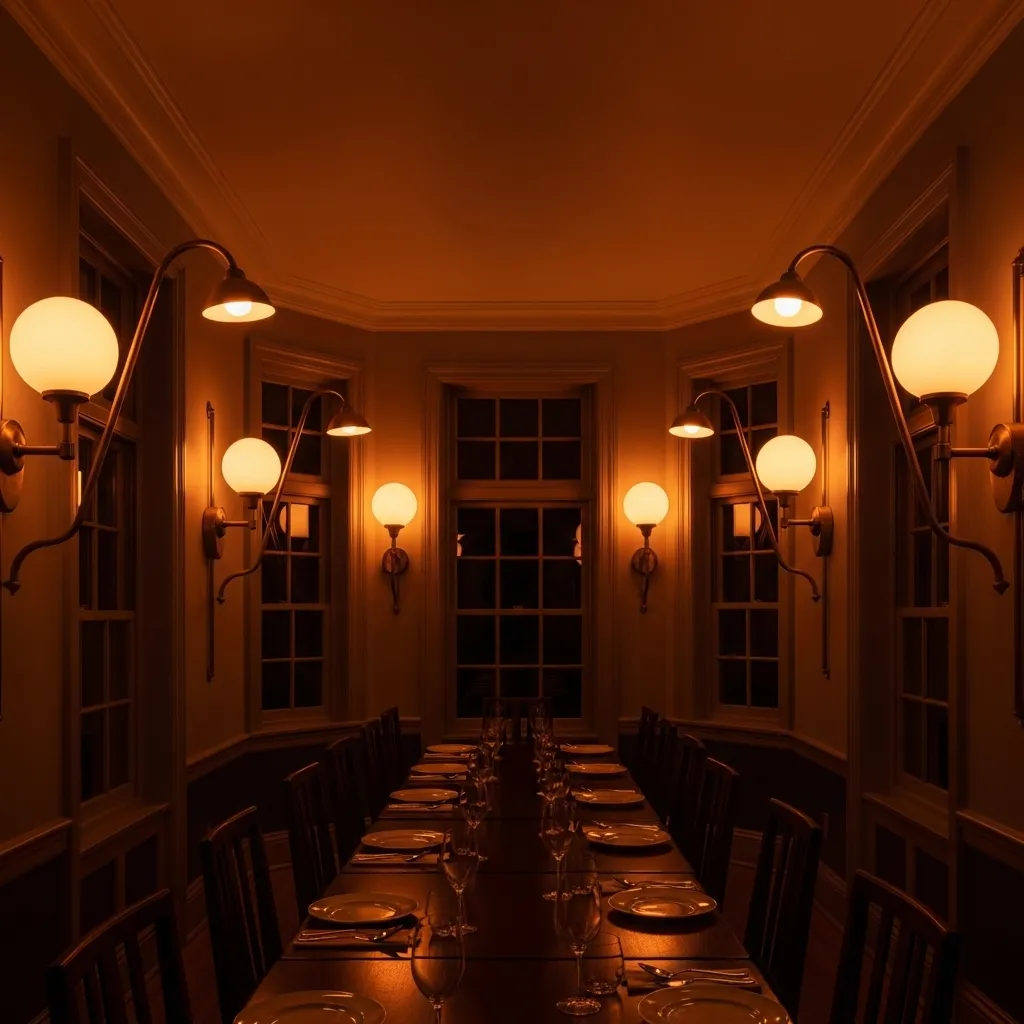
Wall sconces as the primary visual statement and primary light source in a dining room — with no overhead fixture, all the room’s light coming from sconces positioned at eye level around the walls — creates the most specifically beautiful and most atmospherically intimate dining environment available in residential lighting design. Dining by sconce light rather than overhead light creates a quality of horizontal illumination — light coming from the same height as the human face — that creates the most flattering possible light for the people at the table and the most beautiful possible atmosphere for the dining experience.
The sconce as visual statement rather than merely functional fixture requires choosing sconces of genuine architectural quality and appropriate scale — large, sculptural, with the specific presence of a designed object rather than a purchased accessory. A sconce approximately twenty-four to thirty inches tall with a substantial arm and a genuinely beautiful shade or globe in the right material (opal glass, hand-blown glass, perforated metal, linen shade) creates a wall object of genuine visual interest that’s worth looking at in its own right rather than simply as a source of light. A series of these sconces arranged with architectural regularity around a dining room creates the room’s primary visual rhythm and primary atmospheric experience simultaneously.
6. Full-Wall Mural — The Most Immersive Dining Experience
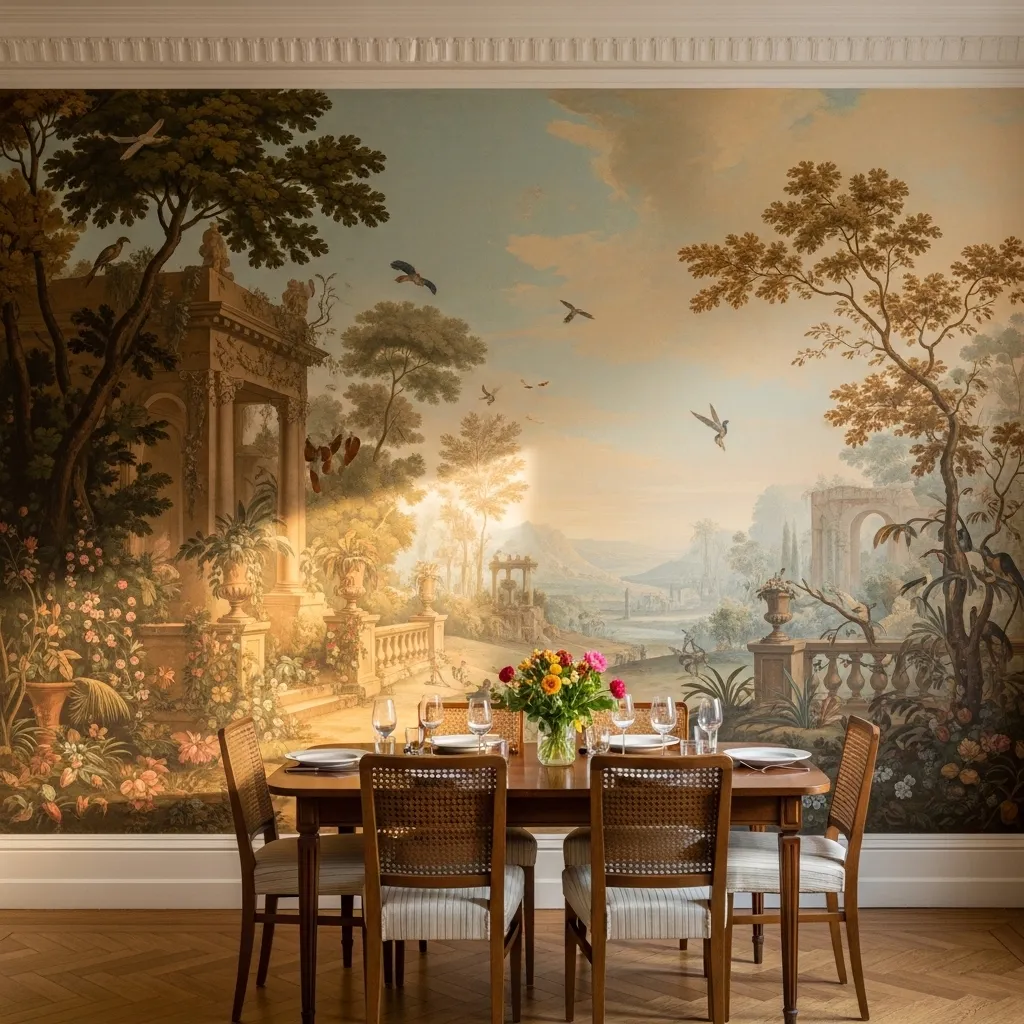
A full-wall dining room mural — whether hand-painted by an artist or professionally printed from an original artwork — creates the most completely immersive and most singular dining room wall treatment available, a room where one wall has been transformed into a complete visual world of extraordinary scale and atmospheric depth. The dining room is specifically the ideal room for a mural because the mural’s full impact requires sustained, unhurried viewing from a fixed position — exactly the conditions that a dining room creates, where guests sit for extended periods with the mural wall in their primary sightline.
The eighteenth-century French scenic wallpaper tradition — the panoramic landscape murals of manufacturers like Zuber and Dufour, depicting exotic landscapes from China, America, and the Mediterranean in continuous panoramic scenes that wrapped around entire rooms — is the specific visual tradition that creates the most beautiful and most atmospheric dining room murals, because the panoramic landscape creates a dining experience of being present in a landscape rather than facing a decorated wall. The slightly faded, warm palette of antique scenic wallpaper is the color quality that makes contemporary scenic murals feel genuinely beautiful rather than aggressively new — the warmth and softness of the faded palette creates a visual quality that reads as aged and beautiful rather than recently installed.
7. Vintage Mirror Collection — Light, Depth, and Visual Complexity
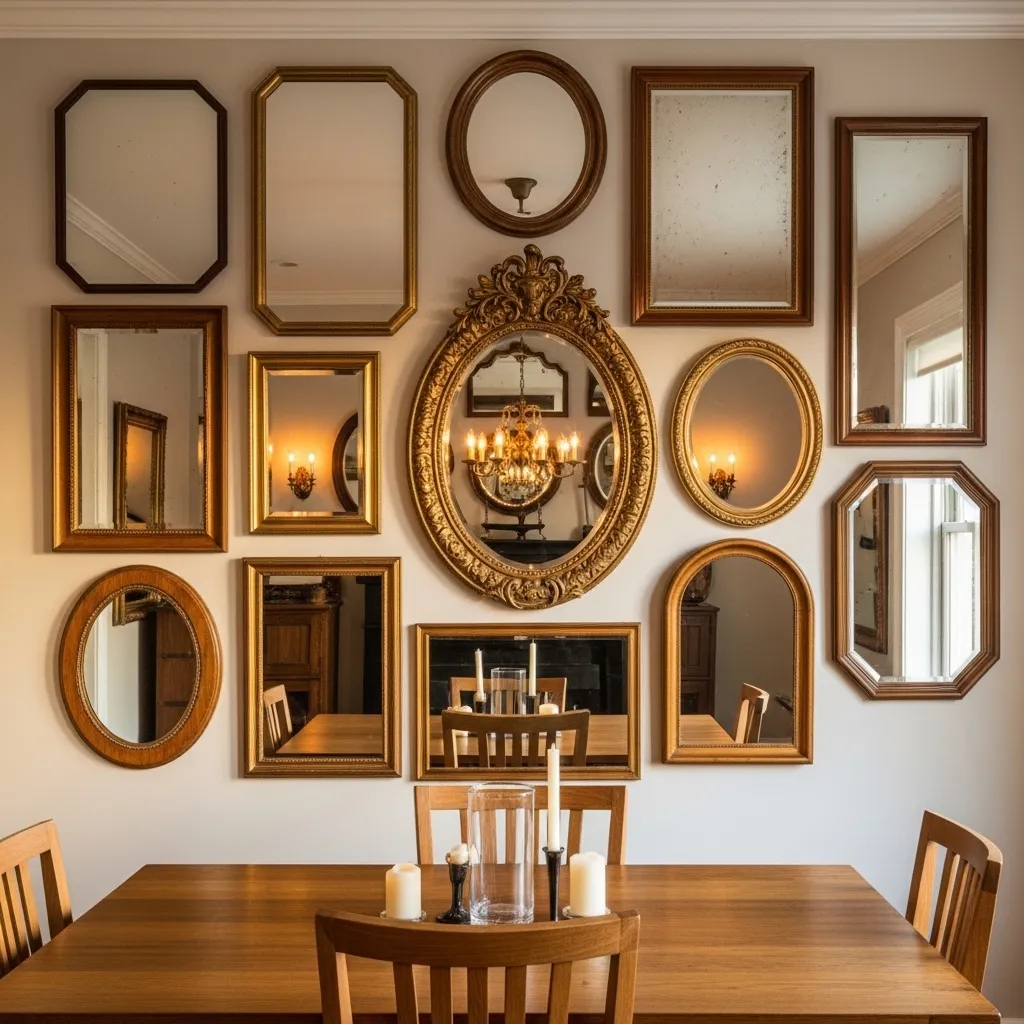
A collection of vintage and antique mirrors in varying shapes, sizes, and periods covering the dining room wall creates the wall treatment with the most dramatically light-enhancing effect — because multiple mirrors at different heights and angles reflect the room’s light sources from multiple directions simultaneously, creating a wall that appears to generate light rather than simply reflect it. The warm candlelight of a dinner party reflected in fifteen mirrors of different sizes and orientations creates a quality of ambient warm illumination that genuinely transforms the dining experience, making the room appear to glow from every surface simultaneously.
The variety of frame styles in a vintage mirror collection is the quality that creates genuine visual richness rather than a merely reflective wall — a collection of mirrors all in the same period and style creates a unified but potentially monotonous reflective surface, while a collection assembled from multiple periods (the gilded Victorian oval beside the simple Federal rectangle beside the Arts and Crafts copper mirror beside the mid-century beveled piece) creates a wall of genuine historical variety and genuine visual interest. The frames themselves, independent of their reflective function, create a wall of decorative objects of diverse aesthetic quality.
8. Limewash or Plaster Texture — The Wall as the Decor
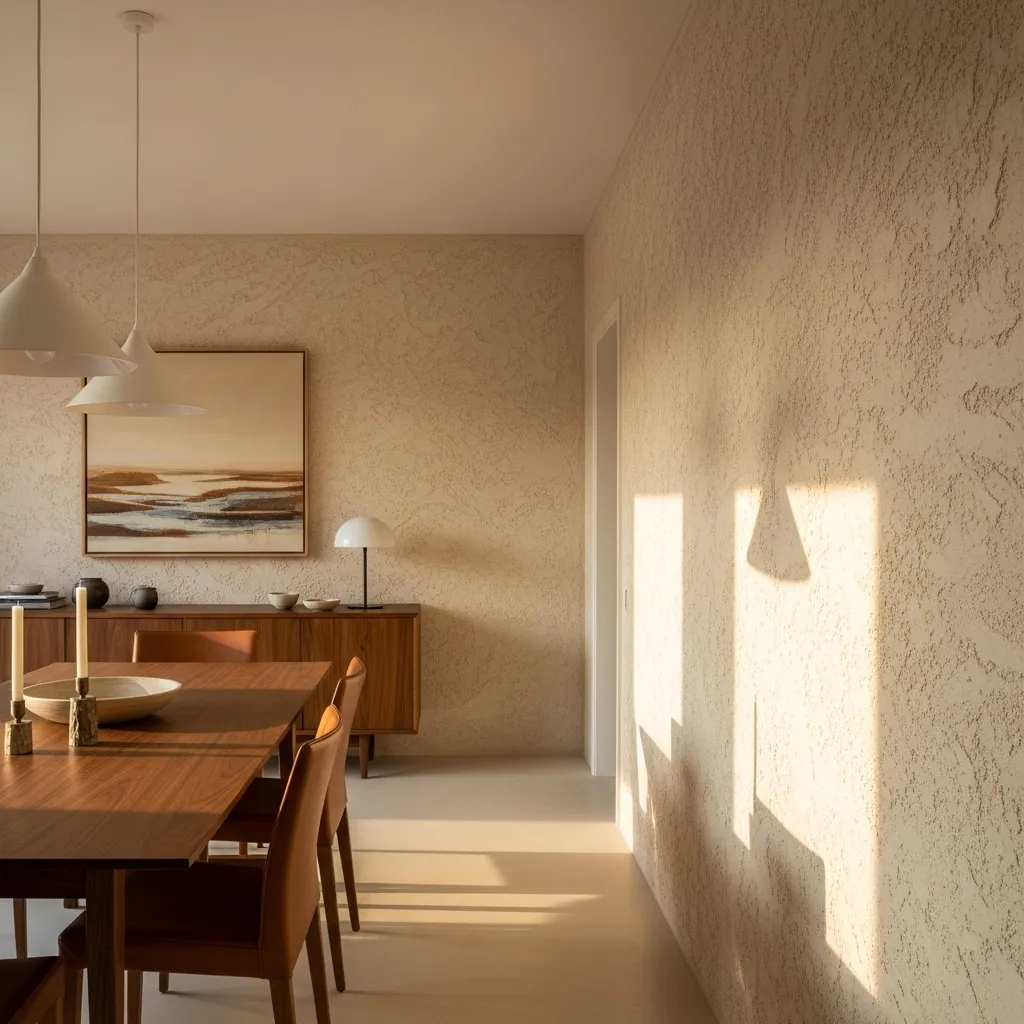
Limewash or hand-troweled Italian plaster as the dining room’s primary wall treatment — where the texture and quality of the wall surface itself is the decor rather than something applied to the wall surface — creates the most materially sophisticated and most architecturally serious dining room wall available, one that communicates design intelligence and material investment through the quality of the surface rather than through what hangs on it. A dining room with genuinely beautiful hand-troweled plaster walls needs nothing on them — the plaster is the wall decor, and adding art or mirrors to plaster of sufficient quality is adding complexity where the simplicity of the beautiful surface is the more powerful statement.
The specific quality of Italian lime plaster that makes it the most beautiful of all dining room wall treatments is its light-responsiveness — the surface catches and holds light differently depending on the direction and intensity of the light source, appearing warm and slightly golden in afternoon sunlight, cooler and more textured in north light, warm and almost luminous in candlelight. This quality of light-responsiveness means the dining room walls change character with the time of day and the quality of light, creating a wall surface that’s genuinely different in the morning, the afternoon, the evening, and the warm candlelight of a dinner party — and that variety of appearance across the day creates a dining room wall of continuous interest and continuous beauty.
9. Wainscoting and Wallpaper — Complete Architectural Resolution
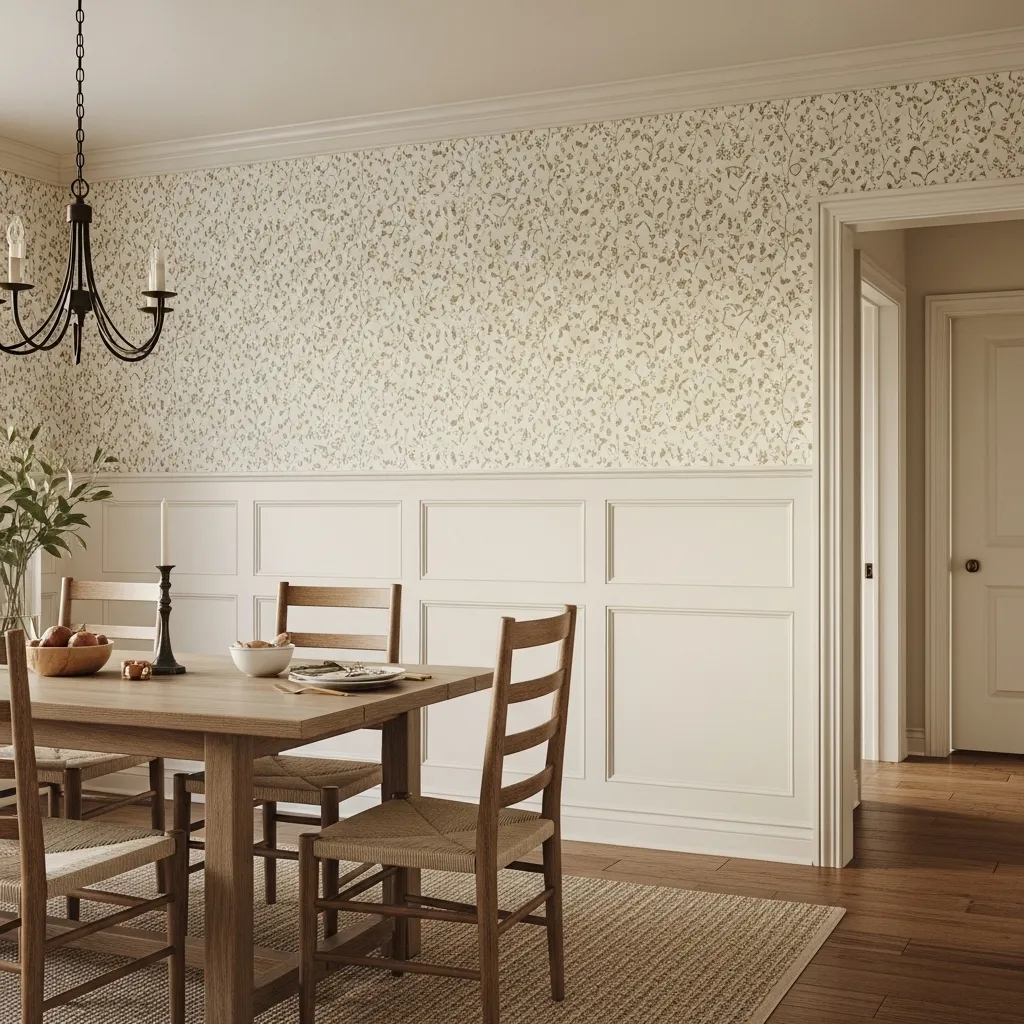
A wainscoting and wallpaper combination in the dining room creates the most complete and most architecturally resolved wall treatment available — the wainscoting provides the practical, durable lower wall zone that dining rooms require (protecting the wall from chair backs and everyday dining activity) while the wallpaper above provides the visual richness and decorative character that makes the dining room specifically beautiful. Together they create a wall that’s fully considered at every height and every zone, with the cap rail creating a clear architectural transition between the practical lower zone and the decorative upper zone.
The proportional relationship between the wainscoting height and the wallpaper zone is the specific design decision that most determines the room’s character — wainscoting at chair-rail height (approximately thirty-two to thirty-six inches) creates a lower zone that’s appropriately subordinate to the wallpaper above; wainscoting at mid-wall height (approximately forty-eight inches) creates a more dramatic lower zone that gives the room a more architectural, more formal quality. The taller the wainscoting, the more formal and more architectural the room’s character; the standard chair-rail height creates the most versatile and most universally appropriate proportion.
10. Oversized Nature Photography — The Outdoor World at Dining Scale
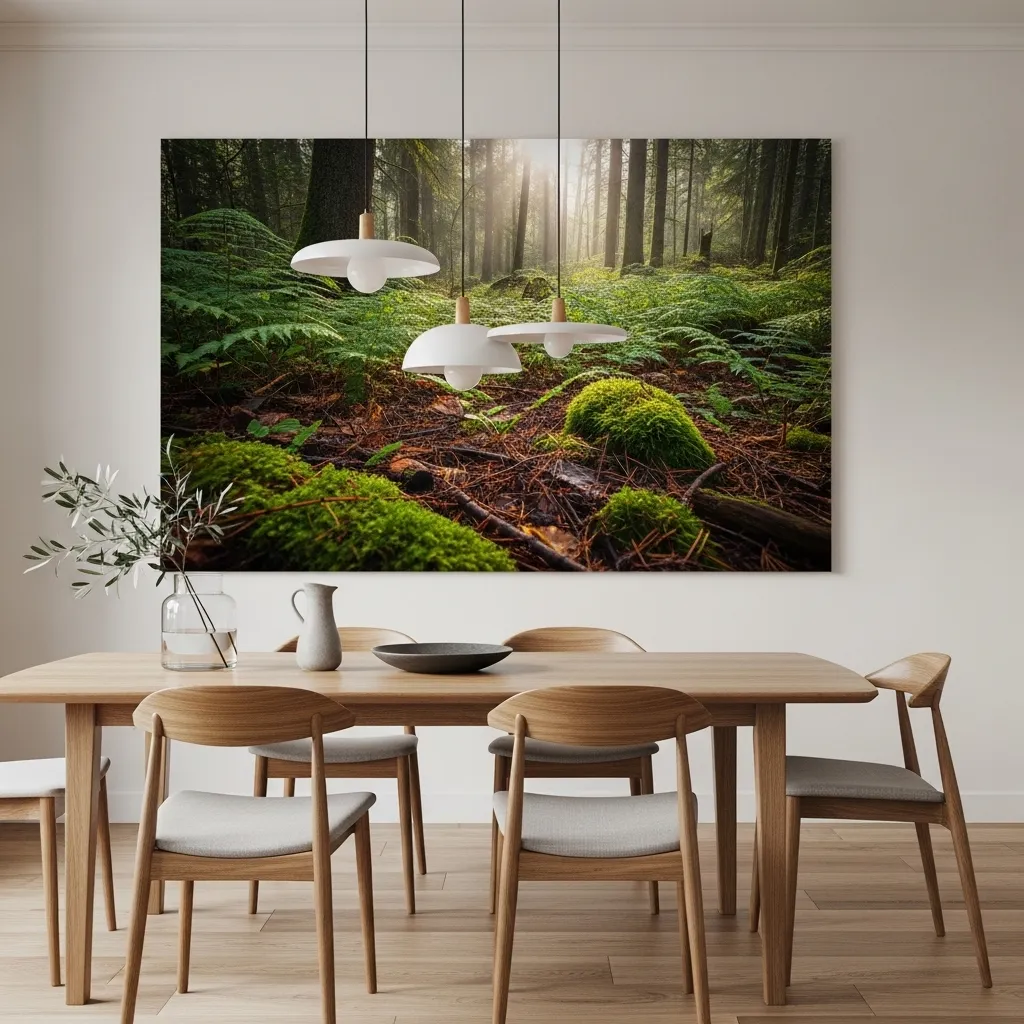
An oversized nature photograph at genuine monumental scale — forty-eight inches or larger in its smaller dimension — creates the dining room wall treatment with the most immediate and most visceral quality of presence, because large-scale photography has a quality of visual reality and sensory immediacy that painted art, however beautiful, doesn’t quite achieve. At near-life scale, a nature photograph of a forest floor or a coastal landscape or a mountain vista creates the specific sensation of proximity to the natural world — the sensation that the natural world is immediately present rather than represented — that transforms the dining experience from a meal in a decorated room to a meal at the edge of a forest or a coast or a mountain landscape.
The specific nature subjects that create the most beautiful and most immersive dining room photographs are those that have strong depth cues at large scale — forest floors receding into shade, coastal scenes with waves and sky, meadow landscapes with grasses in the foreground and horizon in the distance. These subjects create the impression of spatial depth that makes large-scale photography genuinely immersive rather than merely large, and that depth quality specifically suits the dining room context where guests are looking at the wall from a fixed distance with sustained attention.
11. Three-Dimensional Sculptural Wall Installation
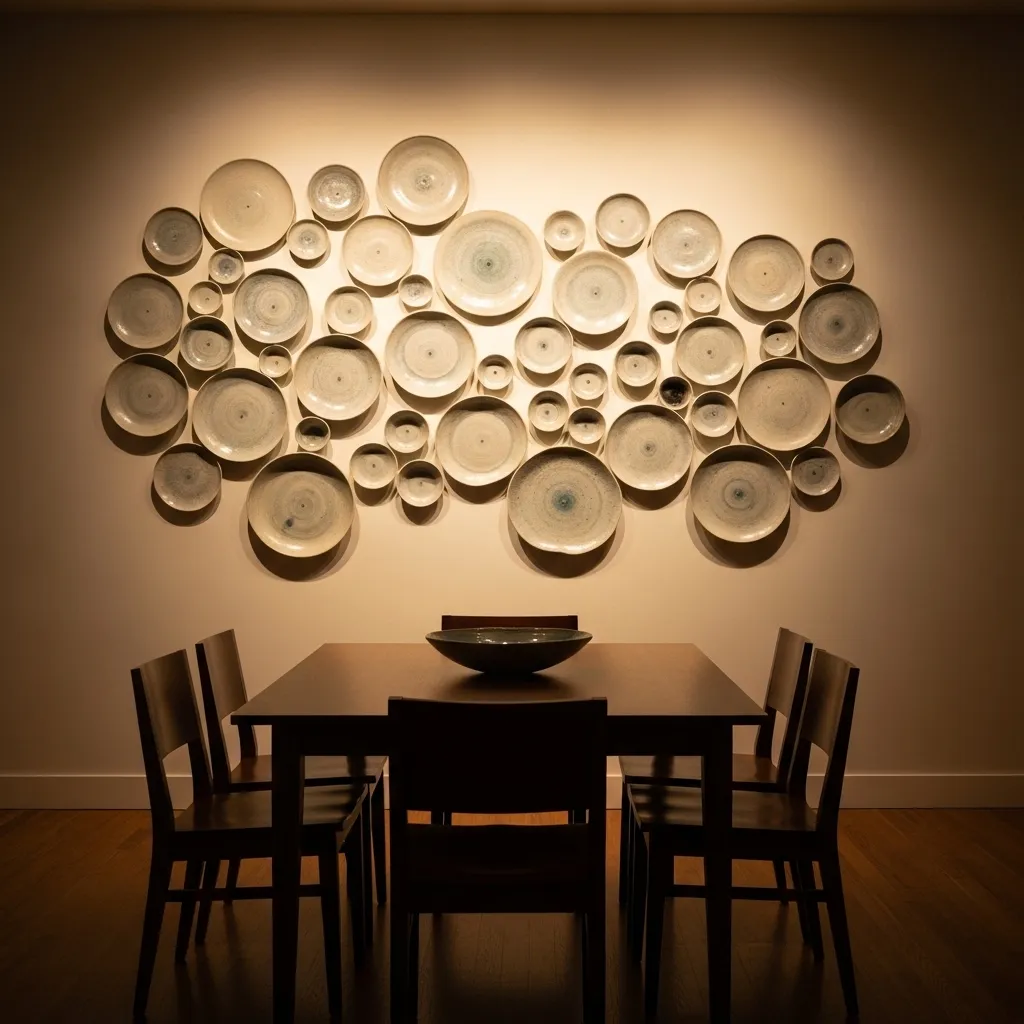
A three-dimensional sculptural wall installation — ceramic pieces, metal sculptures, wooden forms, or any material arranged on the dining room wall as a three-dimensional art experience — creates the wall treatment with the most genuinely sculptural quality and the most dramatic use of light and shadow available in dining room wall decor. Unlike flat art, which exists in the same plane as the wall and depends on its imagery for visual impact, a three-dimensional wall installation creates actual depth, actual shadow, and actual spatial presence that changes character with the direction and quality of the light falling on it.
The hand-thrown ceramic installation is the specific form that most beautifully combines the three-dimensional sculptural quality with the warm, organic material character that creates dining room warmth — each individual piece is both a craft object of specific beauty and a component of a larger composition of spatial depth and visual complexity. The variation in glaze across the individual pieces creates a surface that reads as a single composed work from across the dining room and as a collection of individual craft objects at close range — a visual experience that rewards both the distant view and the close inspection that a dinner party creates.
12. Full-Wall Wine Storage — Functional Beauty at Room Scale
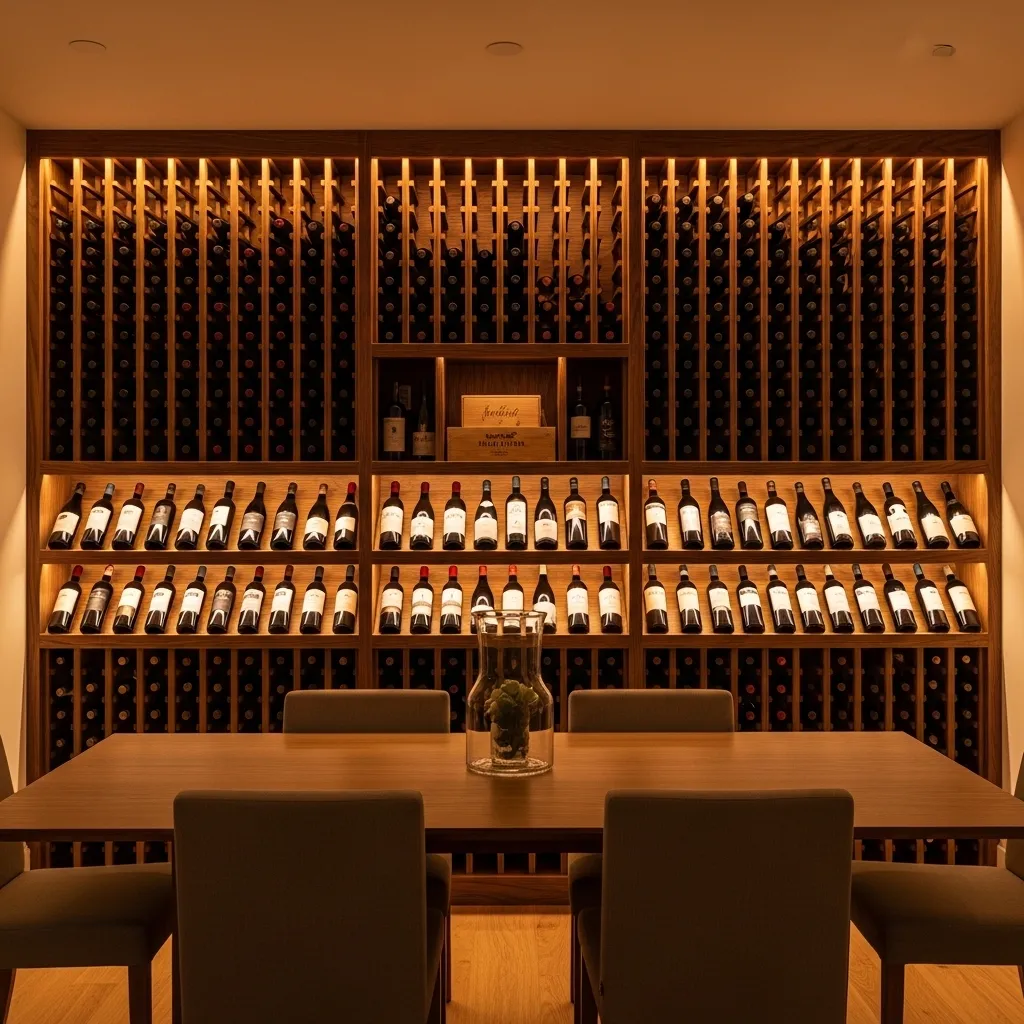
Image Prompt: A spectacular dining room photographed in warm ambient light, where one full wall has been dedicated to floor-to-ceiling wine storage — a custom built-in wine rack in warm oak or dark walnut that fills the complete wall from baseboard to ceiling with individual bottle compartments, each holding one bottle on its side with the label facing outward. The wall of wine bottles — their labels creating a mosaic of paper color and typography, their bottle ends creating a regular pattern of dark glass circles — creates a room of extraordinary visual abundance and genuine functional beauty. The wine storage is clearly organized — reds in one section, whites in another, with a small section of vintage or special bottles highlighted — but the organization doesn’t interrupt the visual abundance of the full wall of bottles. The dining table positioned in front of the wine wall is simple and beautiful. The lighting illuminates the wine wall from below, creating a warm glow through the bottle glass. The camera shoots from mid-height, slightly wide, capturing the full wine wall and its abundance.
A full-wall wine storage installation in the dining room creates the most dramatically functional and most specifically convivial dining room wall treatment — a wall that is simultaneously a design statement of extraordinary visual abundance and the complete wine collection of a genuine wine lover, where the beauty of the wall comes directly from the functionality of what it contains rather than from decoration applied to conceal or supplement a functional purpose. The wall of wine bottles creates a dining room that announces its specific purpose and its specific pleasures immediately upon entry — this is a room where eating and drinking well are taken seriously, and the wall of wine is the most direct possible expression of that seriousness.
The visual quality of a full wall of wine bottles is genuinely beautiful in a way that’s separate from and additional to its functional value — the mosaic of different labels creates a complex, varied surface of paper and typography and image that’s constantly changing as bottles are consumed and replaced, the dark glass of the bottle ends creates a regular geometric pattern of circles against the wood of the rack, and the warm backlighting through the bottle glass creates a warm, amber glow that makes the wine wall appear to generate its own warmth. These are visual qualities of genuine architectural beauty that few other wall treatments create.
13. Dark Dramatic Painted Ceiling — The Unexpected Transformation
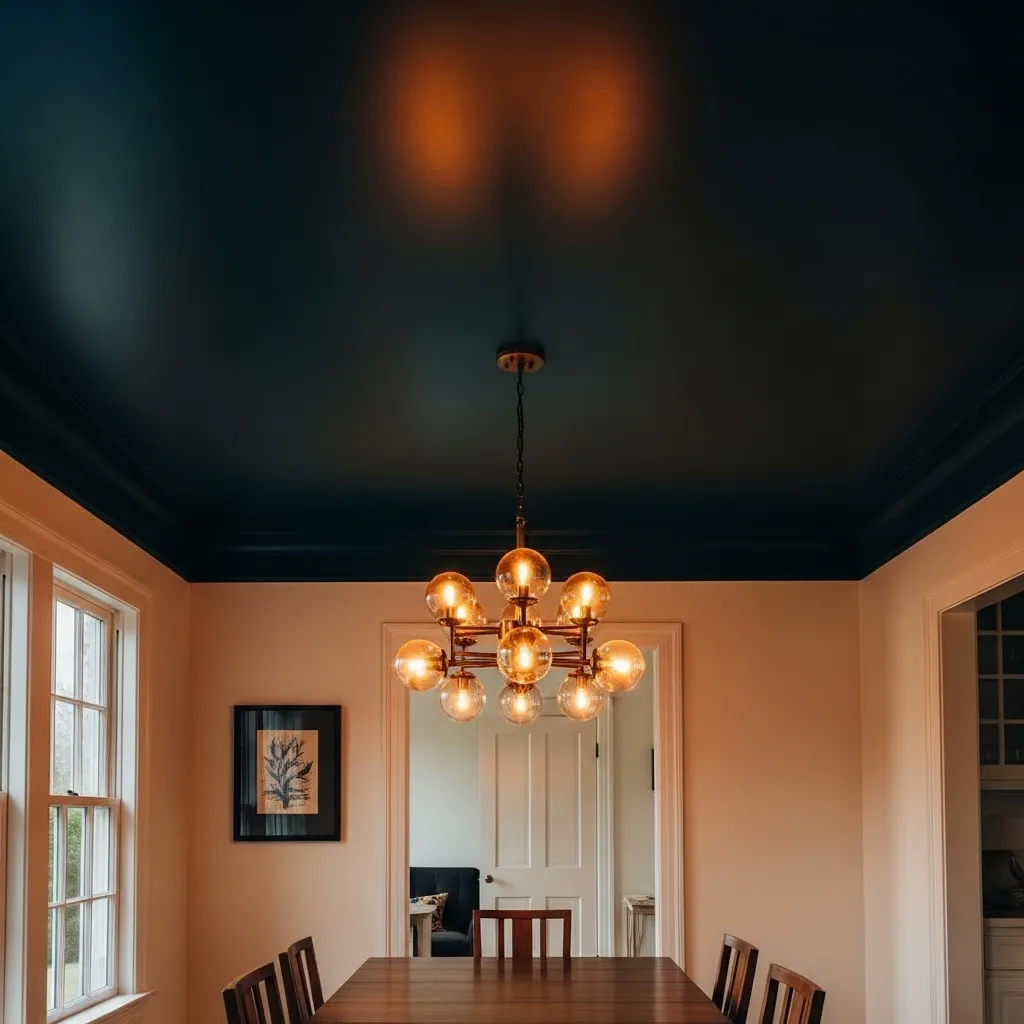
A dramatically dark painted ceiling — in deep navy, forest green, or rich burgundy — creates the most unexpected and most specifically atmospheric dining room transformation available through paint alone, because it inverts the conventional spatial logic of domestic rooms (light above, dark below) and creates the specific quality of an intimate, enveloping enclosure that makes the dining experience feel special and specifically different from eating in any other room in the house. The dark ceiling brings the room’s upper limit visually closer, creating a quality of intimate enclosure rather than airy openness, and that enclosure creates the specific quality of a cave or a canopy — the ancient human preference for shelter from above during meals.
The elimination of the crown molding boundary — painting the crown molding the same deep color as the ceiling rather than in the conventional lighter wall color — is the specific detail that creates the most dramatic and most complete ceiling treatment, making the dark ceiling appear to flow down the wall rather than ending abruptly at the ceiling plane. This treatment makes the dark ceiling feel enveloping rather than merely painted, creating the quality of being inside the dark color rather than having the dark color above you.
14. Upholstered Wall Behind the Banquette — Complete Dining Destination
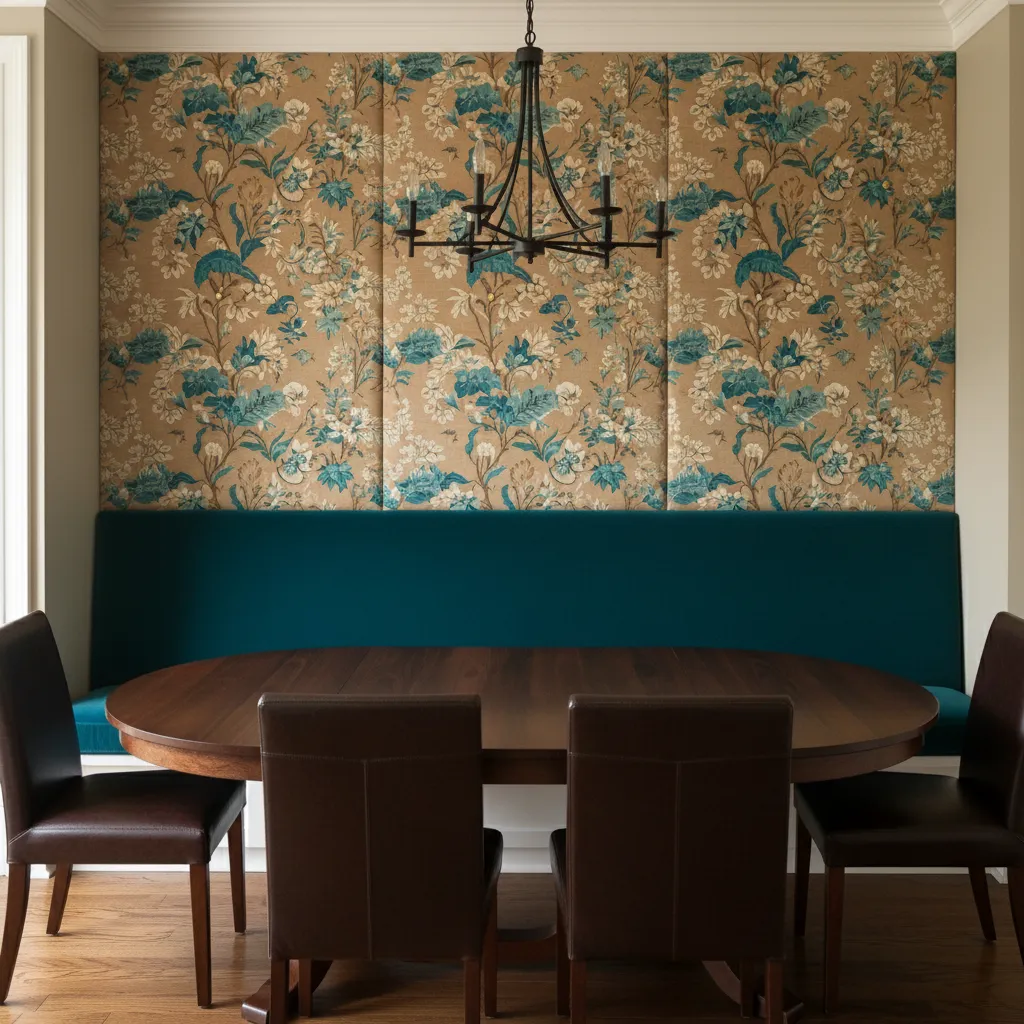
A built-in banquette with an upholstered wall above it creates the most complete and most enveloping dining destination available — a zone within the dining room that’s defined by its own textiles, its own warmth, and its own quality of cushioned comfort that makes the dining position feel specifically chosen and specifically designed rather than merely where the chairs happen to be. The banquette and upholstered wall together create a dining zone that reads as a complete architectural feature rather than a piece of furniture placed in a room, and that architectural completeness creates the sense of destination that makes the best restaurant banquettes so specifically desirable.
The upholstered wall above the banquette creates acoustic benefits as well as visual ones — the fabric-covered padded wall absorbs sound, creating a dining zone that’s quieter and more intimate than the hard-walled alternatives. In a dining room that hosts dinner parties, this acoustic quality is genuinely significant — a banquette zone where conversation is naturally more intimate and more clearly audible creates a specific quality of dining experience that makes guests prefer the banquette position to the chair position, and that preference for the designed zone is the evidence of successful dining room wall decor.
15. The Conversation Wall — Personal Objects as Visual Identity
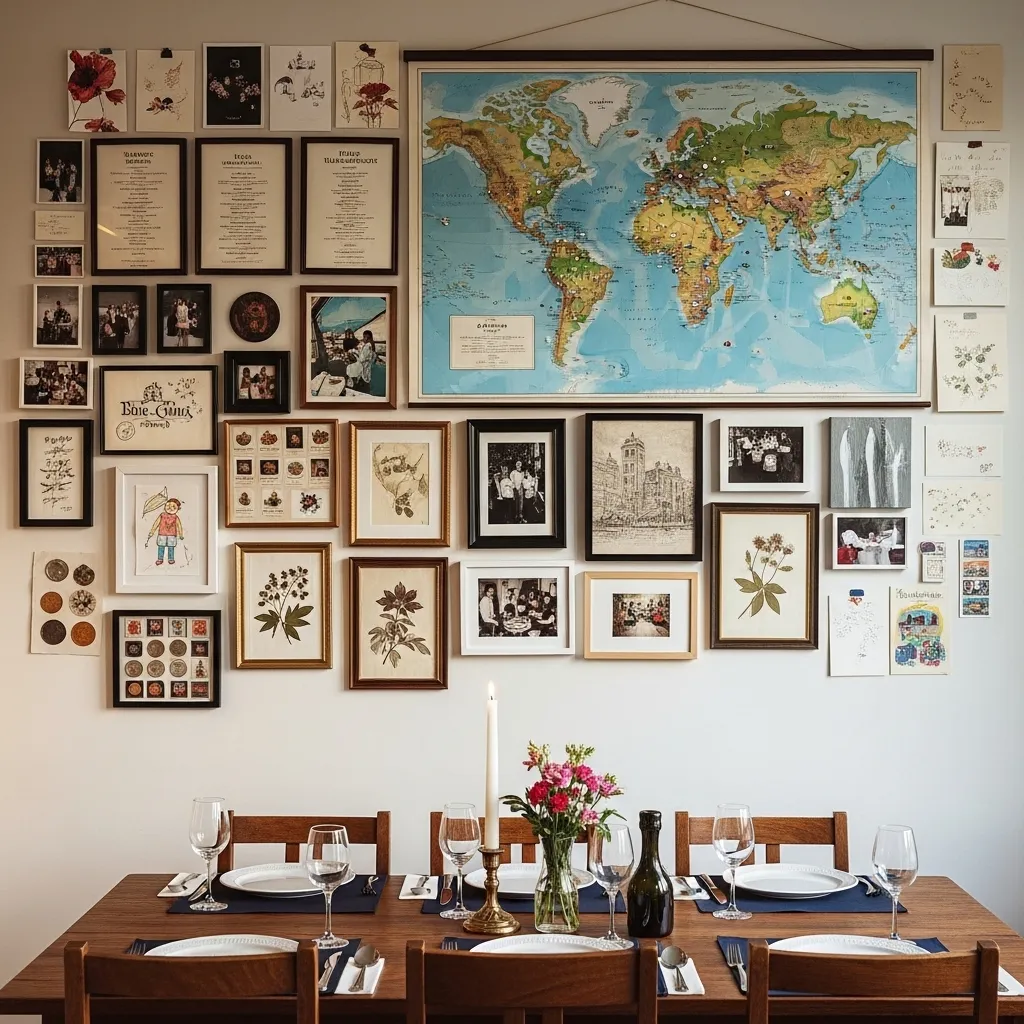
A conversation wall — a dining room wall covered in personally meaningful objects that each carry a specific story worth telling at dinner — is the dining room wall decor that creates the most genuinely social and most specifically conversational dining experience, because the wall itself becomes a subject of conversation rather than a backdrop for it. Guests at the table who can read the world map’s pins, who can ask about the framed menus, who can inquire about the drawings and the pressed botanicals and the foreign stamps, are guests who have been given a complete autobiography of their host in visual form — a gift that creates the best kind of dinner party conversation, the kind that starts from genuine curiosity about a specific person’s specific life.
The difference between a conversation wall and a random accumulation of personal objects is the quality of visual organization and the quality of framing — the conversation wall uses consistent framing (similar frame styles, a limited palette of frame materials) to create visual cohesion across very different objects, and it uses the same organizational principles as any gallery wall (triangle principle, height variation, negative space between clusters) to create visual composition that reads as designed rather than merely accumulated. The personal quality of the objects provides the content; the gallery wall principles provide the form; and together they create a dining room wall that’s both genuinely beautiful and genuinely meaningful.