15 False Ceiling Design For Living Room in 2026 That Turn the Fifth Wall Into the Most Considered Surface in Your Home
Because a ceiling done right doesn’t just cover the room — it defines it, anchors the furniture below it, controls how light moves through the space, and determines, more than almost anything else, whether a living room feels finished or merely furnished
If you’ve been looking at your living room ceiling and sensing that something is missing — that the room is pleasant enough at eye level but somehow unresolved when you look up — then you’ve already understood the central problem that false ceiling design exists to solve. What follows covers the full range of what a false ceiling can do: the deep geometric satisfaction of a coffered ceiling in painted timber, the dramatic warmth of a layered tray ceiling with recessed LED cove lighting glowing at its edges, the clean architectural authority of a simple dropped panel ceiling in smooth plaster, the way a wooden beam false ceiling can transform a contemporary apartment into something that feels rooted and genuinely warm, the specific luxury of a backlit stretched fabric ceiling that diffuses light like a sky, the understated intelligence of a perimeter cove ceiling that makes a standard room feel twice as tall, and the quietly spectacular effect of a false ceiling that defines the seating zone while leaving the rest of the room at its original height. Some of these are projects for a full renovation; others are achievable with a skilled contractor over a long weekend. All of them treat the ceiling as what it actually is — the largest uninterrupted surface in any room — rather than as an afterthought that gets a coat of white and is promptly forgotten.
I came to false ceilings the way most people who care about interiors eventually do — by standing in a room that had one done exceptionally well and feeling something shift that I couldn’t immediately name. It was a living room in a converted warehouse apartment: the ceiling had been dropped about fourteen inches at the perimeter, with recessed warm-white lighting running along the cove, and the central section left at the original height with three pendant lights hanging from a simple plaster medallion. The effect was that the room appeared to have been carved rather than built — as though the space had been deliberately shaped by someone who understood that ceiling height isn’t just architecture, it’s atmosphere. I spent years after that noticing ceilings in every room I entered, realising how much of a room’s emotional quality originates specifically from what’s happening above your head.
What makes a false ceiling specifically powerful rather than merely decorative is its relationship to light and proportion simultaneously. A ceiling is the primary surface that light touches before it reaches anything else in a room — it determines whether light in the space feels bounced and diffused or directional and dramatic, whether it warms the room from above or carves it into zones of brightness and shadow. The false ceiling gives the designer control over both the ceiling’s geometry and its relationship to light, which is why the best examples feel less like a design feature and more like a fundamental atmospheric decision. Getting a false ceiling right is not about choosing a shape; it is about understanding how that shape will interact with every light source in the room across every hour of the day — and designing it accordingly.
1. The Perimeter Cove Ceiling — The Design That Makes Every Room Feel Taller Than It Is
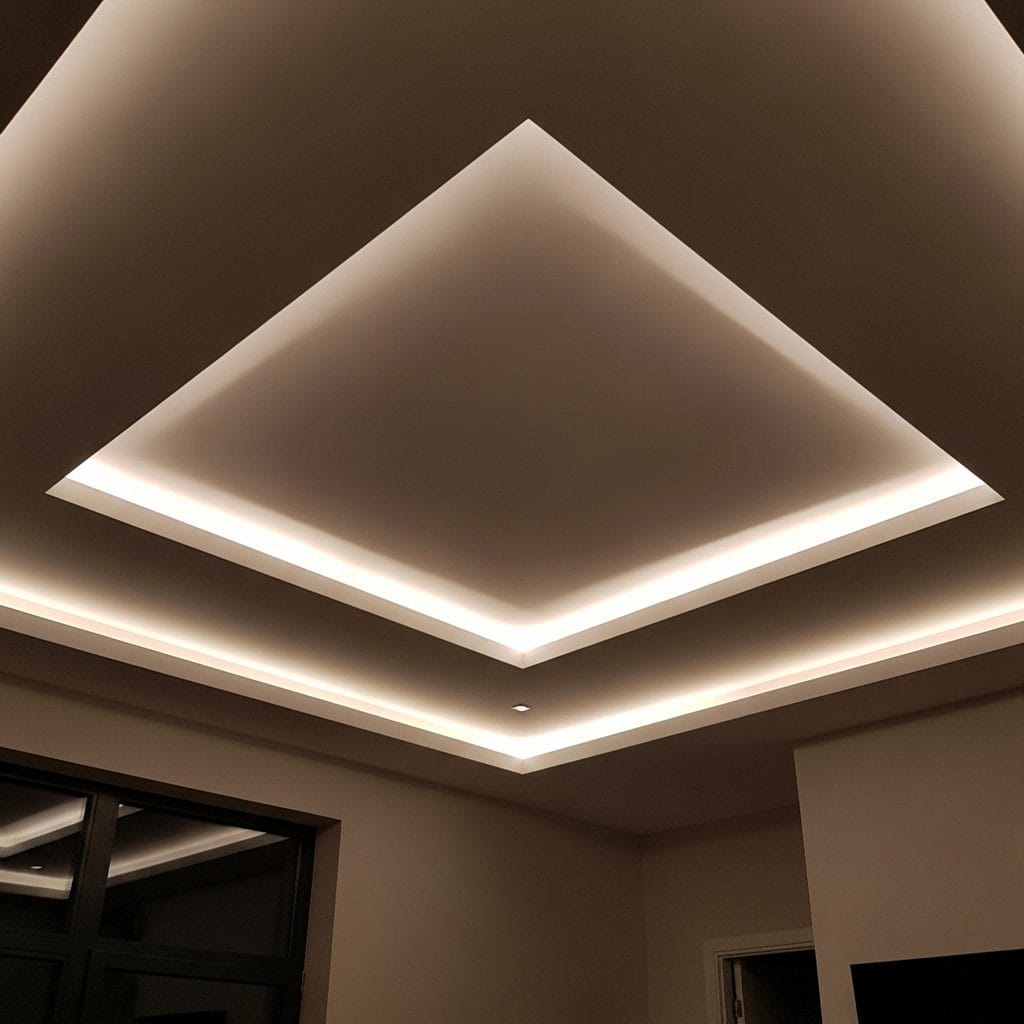
The perimeter cove ceiling is the false ceiling design with the longest reach for its investment — which is specifically its capacity to make a room appear taller than its actual dimensions while simultaneously making it feel warmer and more contained. The mechanism is precise: by dropping the ceiling at the perimeter and concealing LED strip lighting within the resulting cove, you create upward-washing light that illuminates the central ceiling from below, making it appear to float rather than sit. The eye reads the lit central section as the primary ceiling and perceives the darker perimeter drop as shadow rather than structure — which is the perceptual trick that adds apparent height. In rooms where the actual ceiling is a limiting eight or nine feet, this effect can be genuinely transformative.
The specific technical decision that determines whether this ceiling reads as sophisticated or merely serviceable is the colour relationship between the dropped perimeter section and the central ceiling. The most common mistake is painting both the same white, which flattens the effect and removes the visual separation that the design depends on. The version that works is a central ceiling in the lightest warm white available — Farrow & Ball’s All White or Benjamin Moore’s White Dove — and a perimeter drop in a tone two to three shades deeper, a warm greige or pale stone. This tonal shift reinforces the shadow the cove light creates, deepening the apparent depth of the recess and making the floating central ceiling read as genuinely elevated rather than merely lit.
2. The Coffered Ceiling in Painted Timber — The Design That Gives a Room Structural Memory
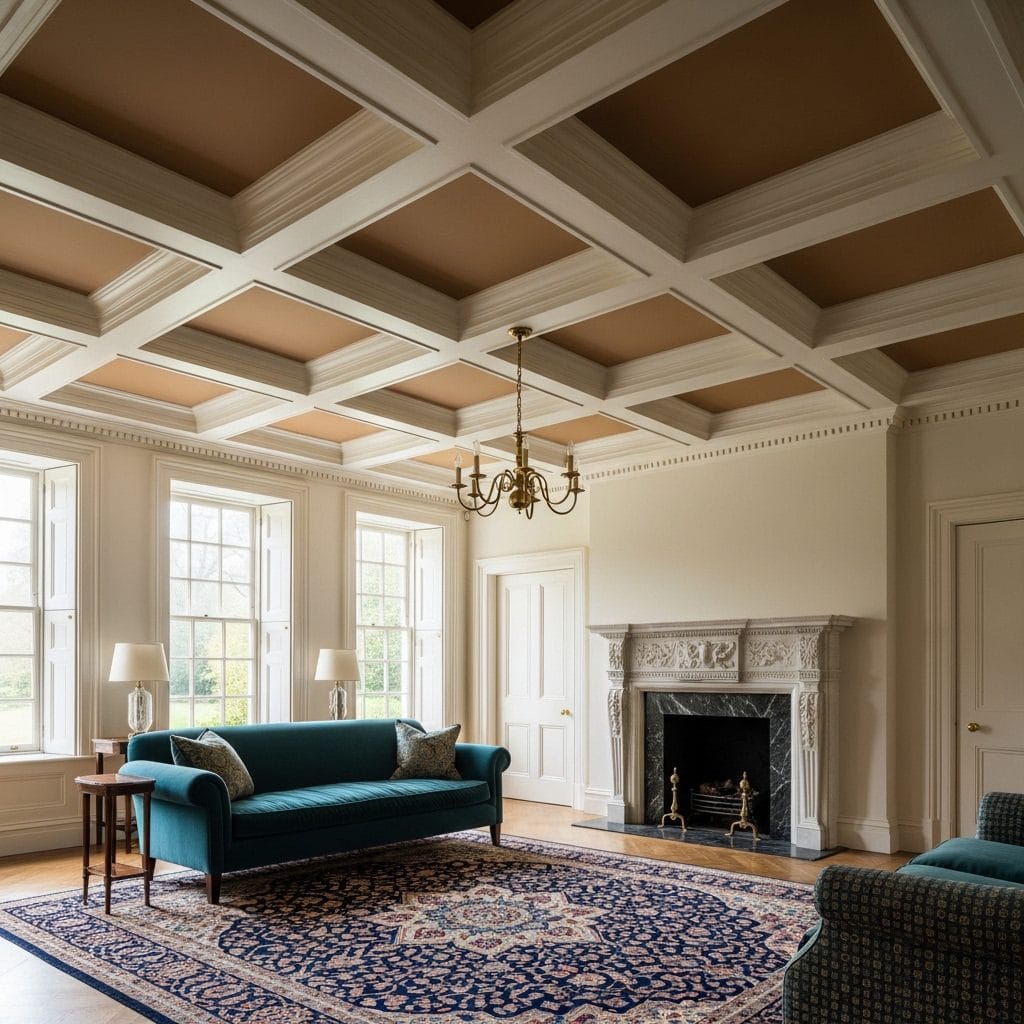
The coffered ceiling in painted timber is the false ceiling design with the deepest historical precedent — appearing in Renaissance palaces, Georgian townhouses, Edwardian drawing rooms, and the grandest Craftsman bungalows — and this accumulated history is precisely the quality it brings to a contemporary living room. A coffered ceiling doesn’t just add visual interest; it adds what might be called structural memory, the sense that the room has been designed at every level with equal care, that the ceiling is as considered as the fireplace and the furniture. The specific grid geometry of the coffers creates a rhythm above the seating area that anchors the furniture below it, pulling the room together around a centre in the way that only a ceiling-level intervention can achieve.
What distinguishes a genuinely successful coffered ceiling from a merely adequate one is the depth of the coffers relative to the beam width. Shallow coffers — less than four inches deep against beams wider than four inches — read as decorative appliqué rather than genuine structure, which undermines the entire point of the design. The version to build is one where the coffer depth is at least equal to and ideally greater than the beam width, so that the shadows within each coffer are genuine and deep, giving the ceiling real three-dimensional quality in changing light. In practice, this means coffers of five to eight inches depth with beams of four to five inches width — proportions that require a ceiling of at least nine feet to avoid feeling oppressive, and that reward rooms of ten feet or more with something genuinely spectacular.
3. The Single-Zone Tray Ceiling — The Design That Defines the Living Room Without Touching the Walls
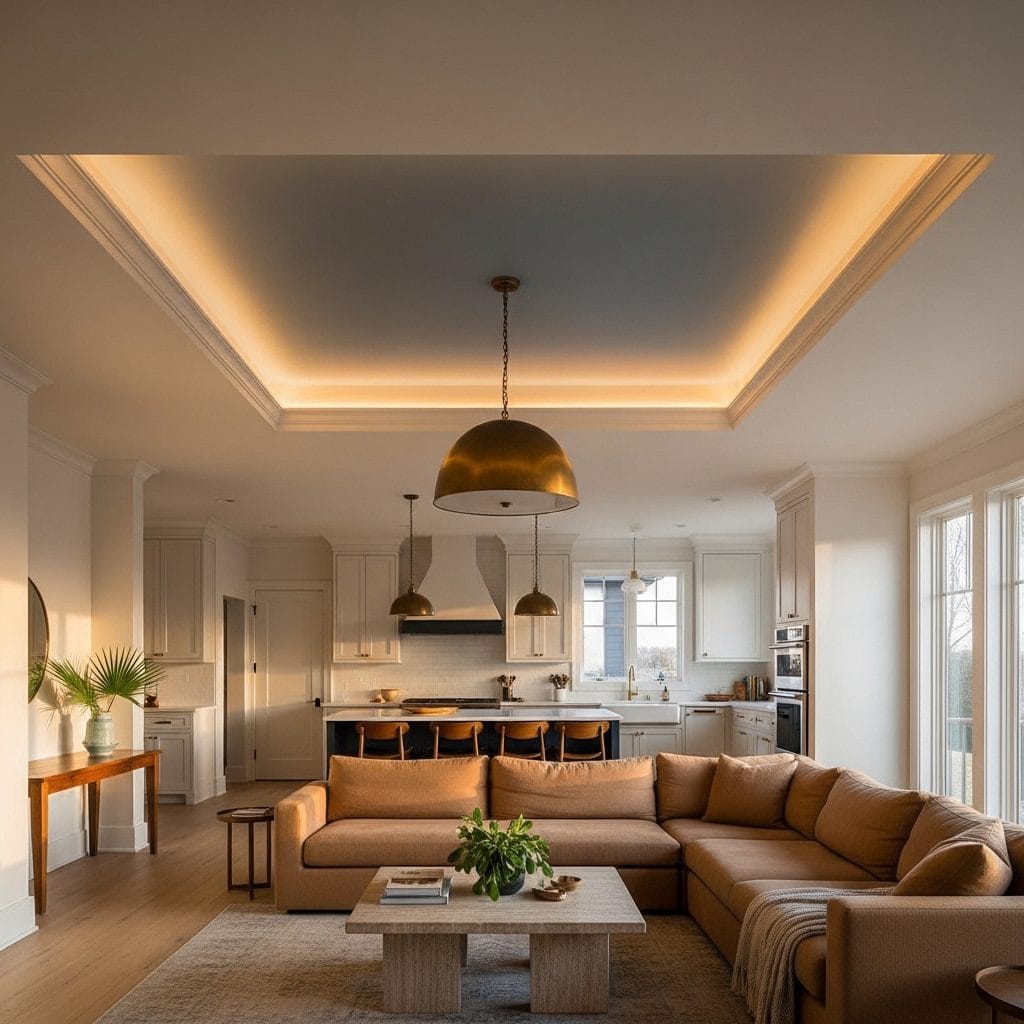
The single-zone tray ceiling is the most spatially intelligent of all false ceiling designs — specifically because it solves a problem that no floor-level intervention can fully address: the definition of distinct zones within an open-plan space. When a living area flows into a dining area, a kitchen, a hallway, the boundaries between zones are often established only by rugs and furniture arrangement, both of which define the zone’s footprint without saying anything about its vertical space. A tray ceiling that rises above the seating area — and only the seating area — creates a room within a room, a canopy above the primary living space that establishes it as a destination rather than a throughway. The effect is specific and deeply satisfying: you step under the tray and the space immediately feels more enclosed, more intentional, more like somewhere worth sitting down.
The specific proportional decision that makes or breaks this design is the relationship between the tray’s raised field and the surrounding ceiling height. The raised centre must be genuinely elevated — not a token inch or two but a meaningful step of six to ten inches — otherwise the tray reads as a depression rather than an elevation, which produces the opposite effect from what’s intended. The tray ceiling works by creating a higher zone that the eye reads as the primary ceiling; if the step is insufficient, the eye reads the outer ring as the primary ceiling and the centre as a recessed panel, which feels lower and more confining. Ten inches of elevation is the minimum to achieve the floating canopy effect; eight inches of elevation with the addition of warm cove lighting within the tray step achieves comparable results through light rather than solely through geometry.
4. The Wooden Beam False Ceiling — The Design That Makes Warmth Structural
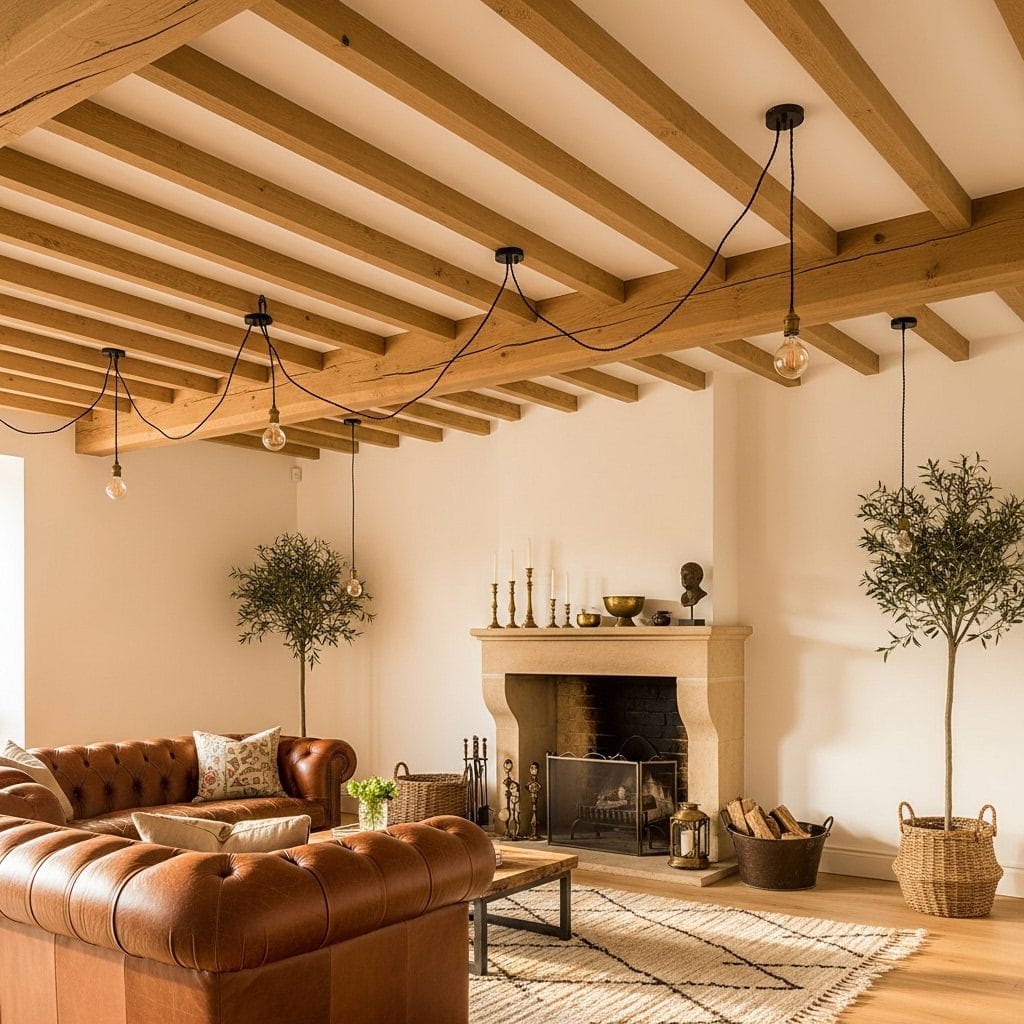
The wooden beam false ceiling is the design that most directly imports a quality from vernacular and historical architecture — the exposed structural timber of farmhouses, manor houses, hunting lodges, and Mediterranean cortijos — and makes it available to contemporary rooms that were built without it. False beams, when well-executed, do not read as false at all; they read as the room’s most honest material, as something that has been there since the building was constructed and simply uncovered. This sense of discovered authenticity is the specific quality that wooden beam ceilings deliver to living rooms that no painted or plastered ceiling treatment can replicate, and it is why they remain among the most sought-after ceiling features in every style of home from rustic farmhouse to contemporary loft.
The specific material decision that separates a beam ceiling that reads as genuinely architectural from one that reads as a home improvement project is the beam’s profile and actual weight. Hollow polyurethane beams — widely sold as the budget alternative — have a specific visual lightness and surface regularity that trained eyes identify immediately as artificial: the grain is too consistent, the edges too sharp, the corners too even. Solid timber beams, or at minimum solid timber box beams constructed from three boards mitred at the corners and glued over a structural carrier, have the slight imperfections, weight, and shadow that make a beam ceiling read as real. Quarter-sawn white oak, which shows ray fleck grain in strong light, is the most decoratively interesting species for this application; Douglas fir has a warmer reddish tone; reclaimed pitch pine carries the patina of genuine age.
5. The Backlit Stretch Fabric Ceiling — The Design That Turns the Ceiling Into Light Itself
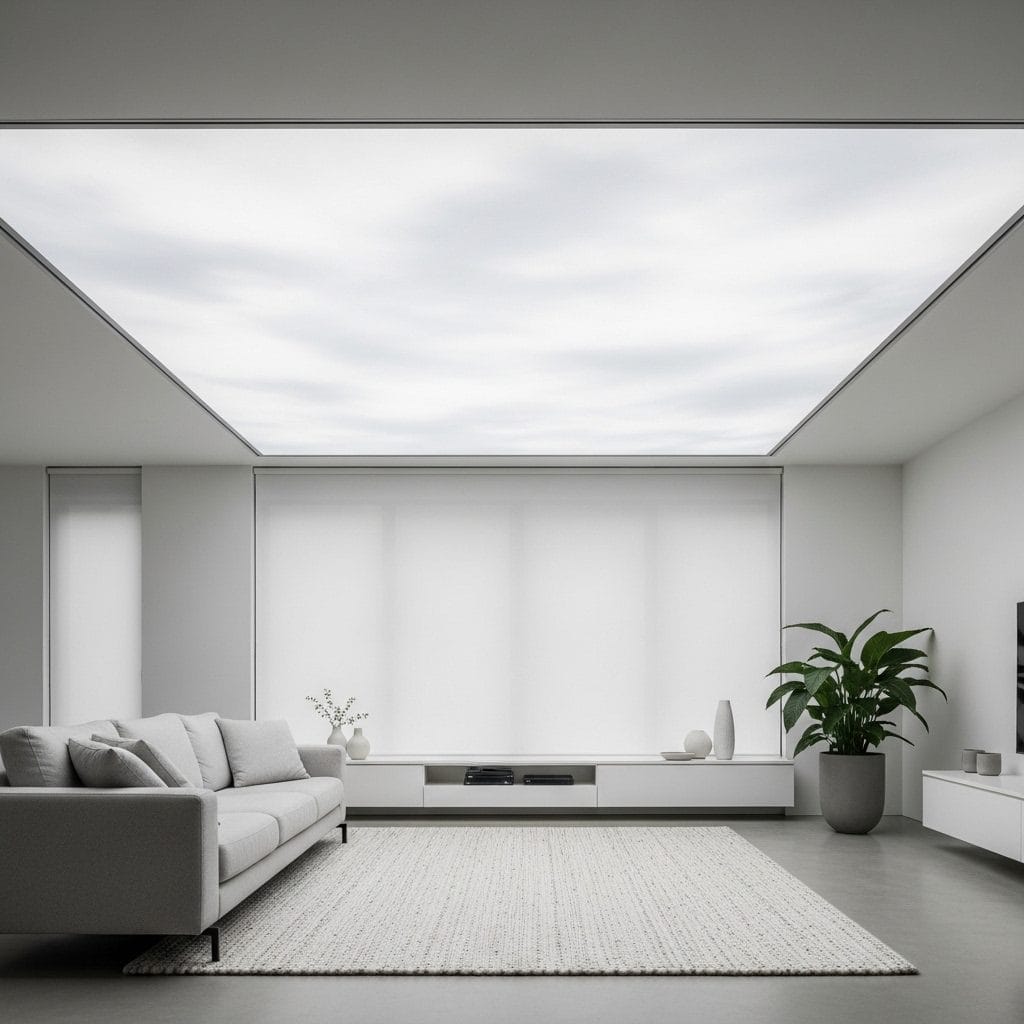
The backlit stretch fabric ceiling is the most radical departure from conventional ceiling design on this list — specifically because it doesn’t just treat the ceiling surface but replaces it entirely with a light-emitting plane, turning the ceiling from a passive reflector of light into its primary source. The effect in a living room is unlike anything achievable with conventional lighting design: the entire overhead plane glows evenly, without hotspots or shadow, producing the specific quality of light you associate with overcast Northern European days — clear, even, directionless, and strangely energising. For living rooms used heavily for work, reading, or creative activities during the day, this even diffused illumination is functionally superior to any combination of directional recessed lights or pendant fixtures.
The specific technical consideration in a stretch fabric ceiling is the colour temperature of the LED source panels behind the membrane. Standard commercial installations often use cooler LED temperatures — 4000K or 5000K — which read as clinical and flat in a domestic setting, more like an office than a home. The version for a living room should use 2700K panels, which produce warm, amber-adjacent light that the white fabric diffuses into something genuinely golden rather than merely white. The fabric membrane itself should be specified in warm white rather than cool white — there are meaningful differences in the undertone of stretch ceiling fabrics, and a fabric with a slightly warm, ivory cast produces fundamentally warmer light than a pure cool-white membrane. These are decisions that must be made at the specification stage; they cannot be adjusted after installation.
6. The Geometric Panel Ceiling — The Design That Treats Geometry as Decoration
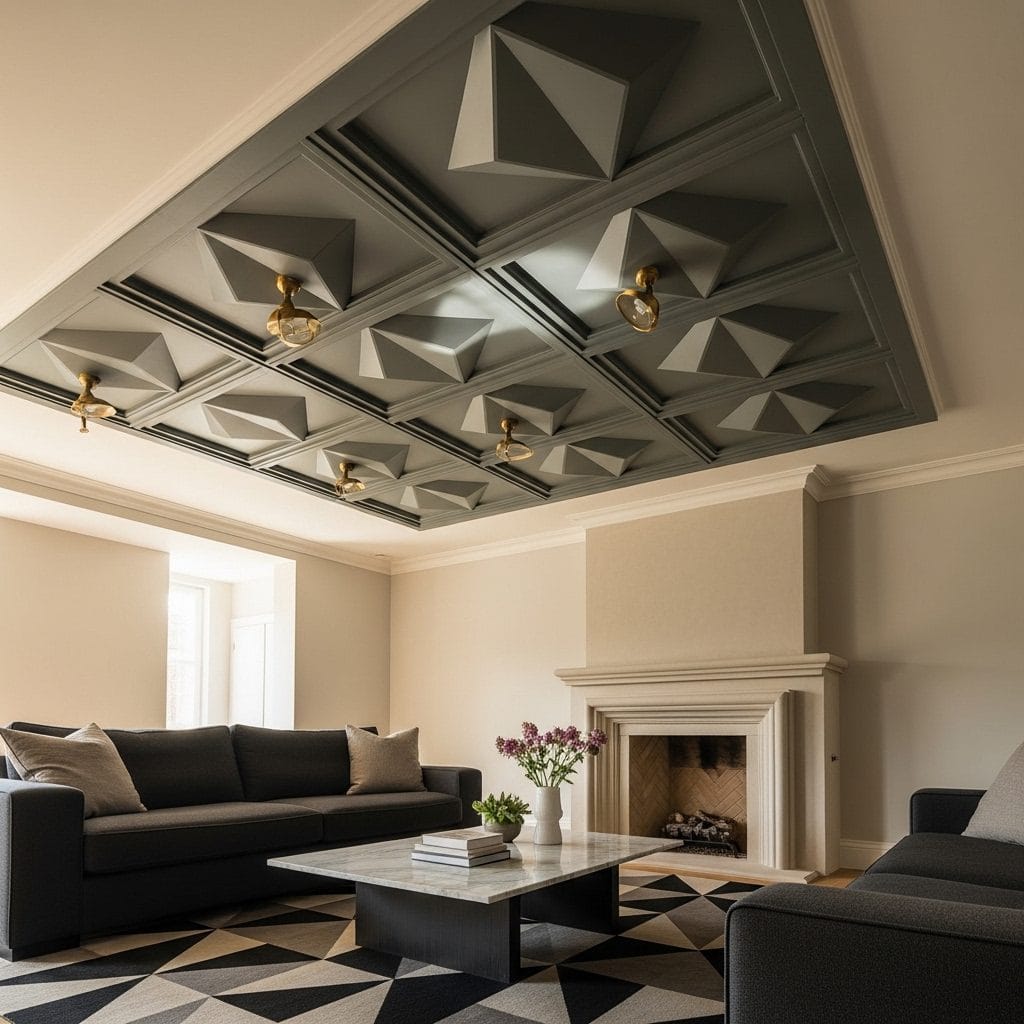
The geometric panel ceiling is the false ceiling design that most directly uses pattern as a three-dimensional phenomenon rather than a two-dimensional one — which is the specific quality that elevates it above wallpaper or painted surface treatments. When geometric forms are built into a ceiling in relief, they engage light dynamically: the shadows within each panel change as the light source moves through the day, meaning that a geometric panel ceiling at noon looks fundamentally different from the same ceiling at dusk, and different again by lamplight. This temporal quality — the ceiling as a changing surface rather than a fixed one — is what distinguishes genuine three-dimensional ceiling design from its flat approximations, and it rewards sustained living-with rather than immediate impact.
The specific decision that most affects this design’s success is the depth of the panel relief relative to the panel size. Very shallow relief — less than half an inch — produces shadows too thin to read clearly except in raking directional light, which means the ceiling looks flat in most conditions. Very deep relief — more than two inches — in panels smaller than twelve inches creates a surface that reads as busy and restless rather than geometric and considered. The register that works for most living rooms is panels of eighteen to twenty-four inches across with one to one-and-a-half inches of relief depth: enough shadow at all light conditions to make the geometry visible, not so much that the ceiling becomes the loudest thing in the room.
7. The Double-Height Cove with Dramatic Pendant — The Design for Rooms That Can Take Grandeur
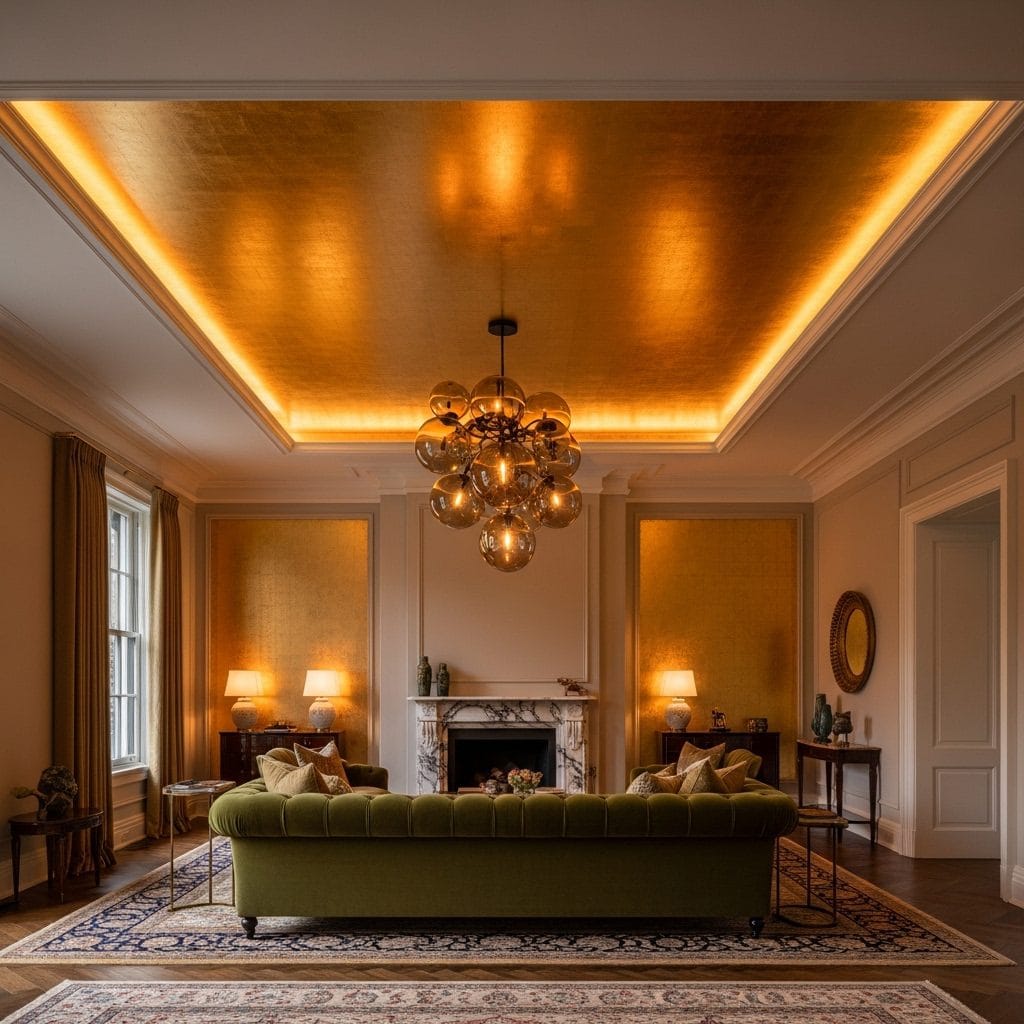
The double-height cove with dramatic pendant is the ceiling design that requires the most from the room it inhabits — specifically a ceiling height of at least ten feet, preferably eleven or twelve — and delivers the most in return, because it is the only treatment on this list that converts genuine architectural height into genuine architectural grandeur rather than merely acknowledging it. Most living rooms with high ceilings make one of two mistakes: they leave the ceiling completely untouched, which means the height reads as emptiness rather than space, or they fill it with oversized recessed lighting that diminishes rather than dramatises the vertical dimension. The deep cove with pendant does something different: it frames the height, establishing the ceiling’s upper zone as distinct and special, and then punctuates it with a single hanging element that scales the space and gives the eye a destination.
The specific element that separates this design from mere decoration is the quality of the cove’s interior treatment. A cove painted in standard white paint is a cove; a cove lined in dull gold leaf, or in deeply coloured lacquer, or in hand-applied Venetian plaster, is an architectural event. The cove interior is seen from below at an angle — it’s partially visible, glimpsed rather than directly viewed — and this oblique visibility means it rewards close-up richness of material in a way that a fully frontal surface does not. Gilded surfaces seen from below in warm light produce exactly the quality of luminous depth that this design needs; mirror-polished surfaces would be too harsh; flat paint too ordinary. The material choice in the cove is the decision that makes the design feel inevitable rather than merely expensive.
8. The Stepped Multi-Level Ceiling — The Design That Organises Space From Above
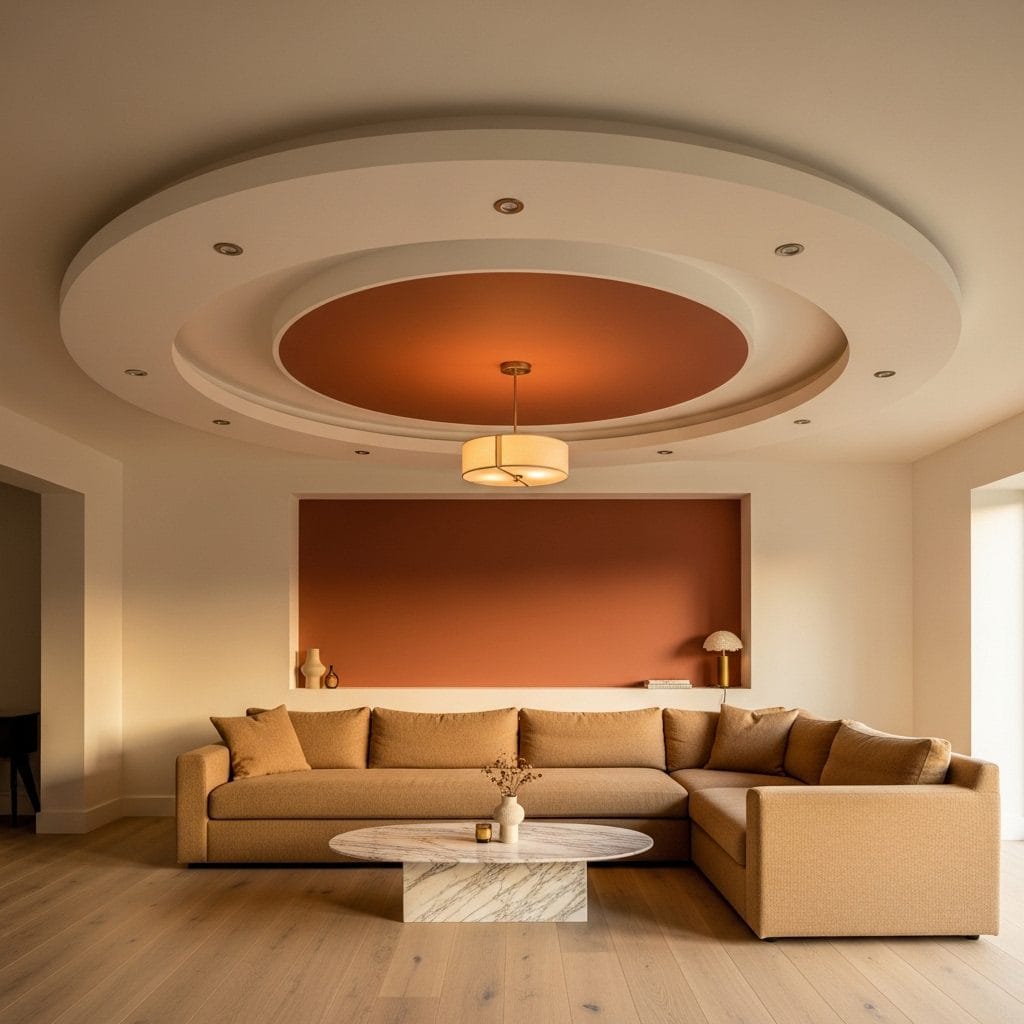
The stepped multi-level ceiling is the most spatially complex false ceiling design and the one that most directly borrows from the language of architectural section drawing — where buildings are understood through the relationship between volumes at different heights. In a living room, this complexity serves a specific function: it creates a vertical hierarchy that mirrors and reinforces the spatial hierarchy established at floor level by furniture and rugs. The seating zone sits beneath the lowest, most intimate ceiling plane; the circulation areas sit beneath higher planes; the transition between them reads as a spatial threshold, a moment of compression and release that makes moving through the room a more physically conscious experience. This is not ceiling design as decoration but ceiling design as spatial organisation.
The specific technical challenge in a stepped ceiling is the quality of the transitions between planes. If the steps are expressed only as flat paint transitions — a line where one ceiling height ends and another begins — the design reads as flat and indistinct, as though the room simply has an irregular ceiling rather than a deliberately stepped one. The version that works uses a small, clean return — a narrow vertical face of three to four inches — at each step, painted in a tone slightly deeper than the ceiling planes on either side. This creates a shadow line that articulates each step as a genuine three-dimensional transition, making the ceiling read as layered rather than merely varied. The detail is small; the difference it makes is enormous.
9. The Linear Plaster Batten Ceiling — The Design That Makes Minimalism Feel Warm
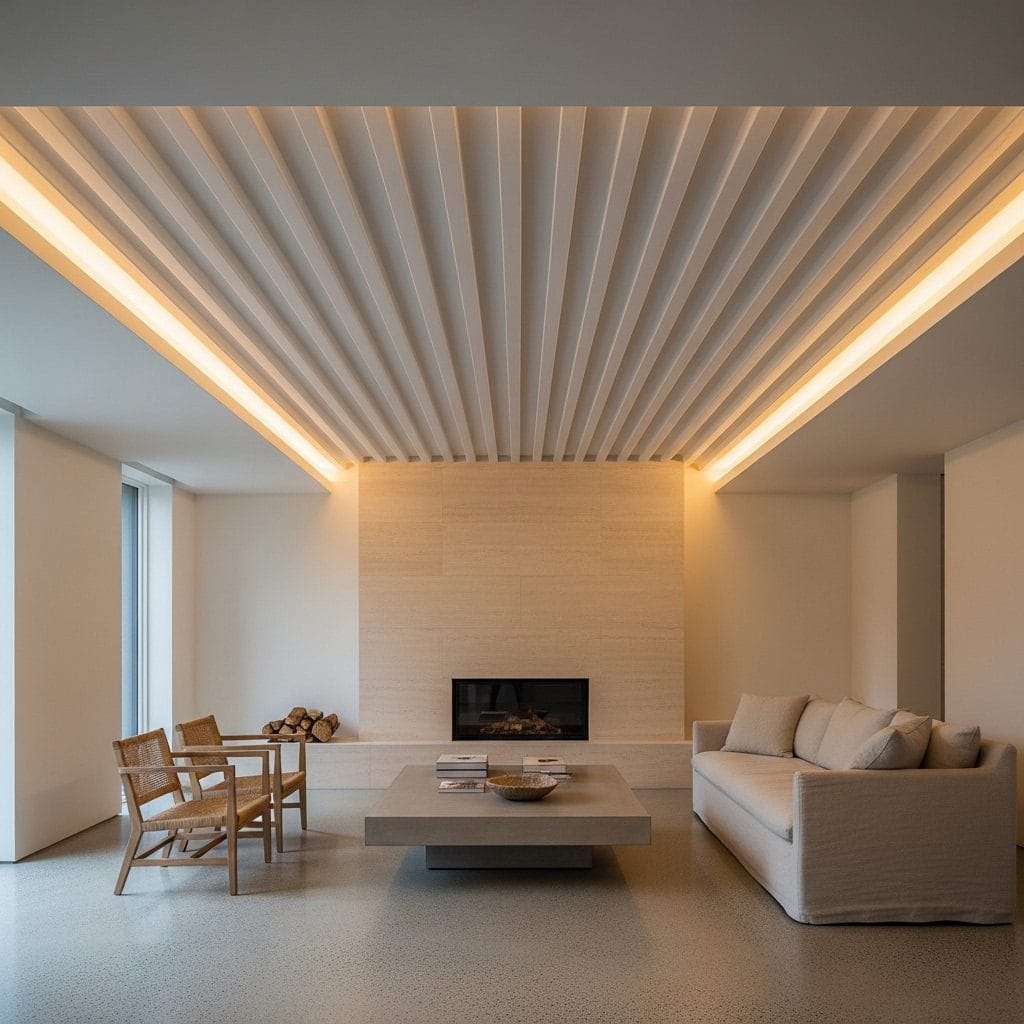
The linear plaster batten ceiling is minimalism’s answer to the coffered ceiling — delivering comparable spatial richness through a single repeated element rather than a complex grid — and the specific quality it achieves is warmth within restraint, texture that reads as almost tactile from below without making a statement about itself. The battens, when painted identically to the ceiling behind them, function as light-catching elements rather than colour elements: they catch the angle of daylight, they create consistent shadow lines that give the ceiling visual depth, and they channel the LED strip lighting concealed within them into a warm, directional wash that illuminates the ceiling plane without revealing its source. The result is a ceiling that rewards sustained attention without demanding it.
The specific proportional decision in a batten ceiling is the ratio of batten projection to batten spacing. Battens that project too little — less than two inches — cast shadows too thin to read as genuine texture at normal ceiling heights. Battens spaced too far apart — more than sixteen inches — begin to read as discrete elements rather than as a continuous surface rhythm. The register that works for a standard nine-foot ceiling is battens of three to four inches projection spaced eight to twelve inches apart, which produces a ceiling texture that reads as continuous from across the room while revealing its individual character when seen from directly below. The lighting channel concealed within every second or third batten spacing should always be positioned centrally within the gap between battens, so that the light washes both adjacent batten faces equally and the illumination reads as even rather than directional.
10. The Lacquered Tray Ceiling in a Deep Colour — The Design That Makes Darkness Into Luxury
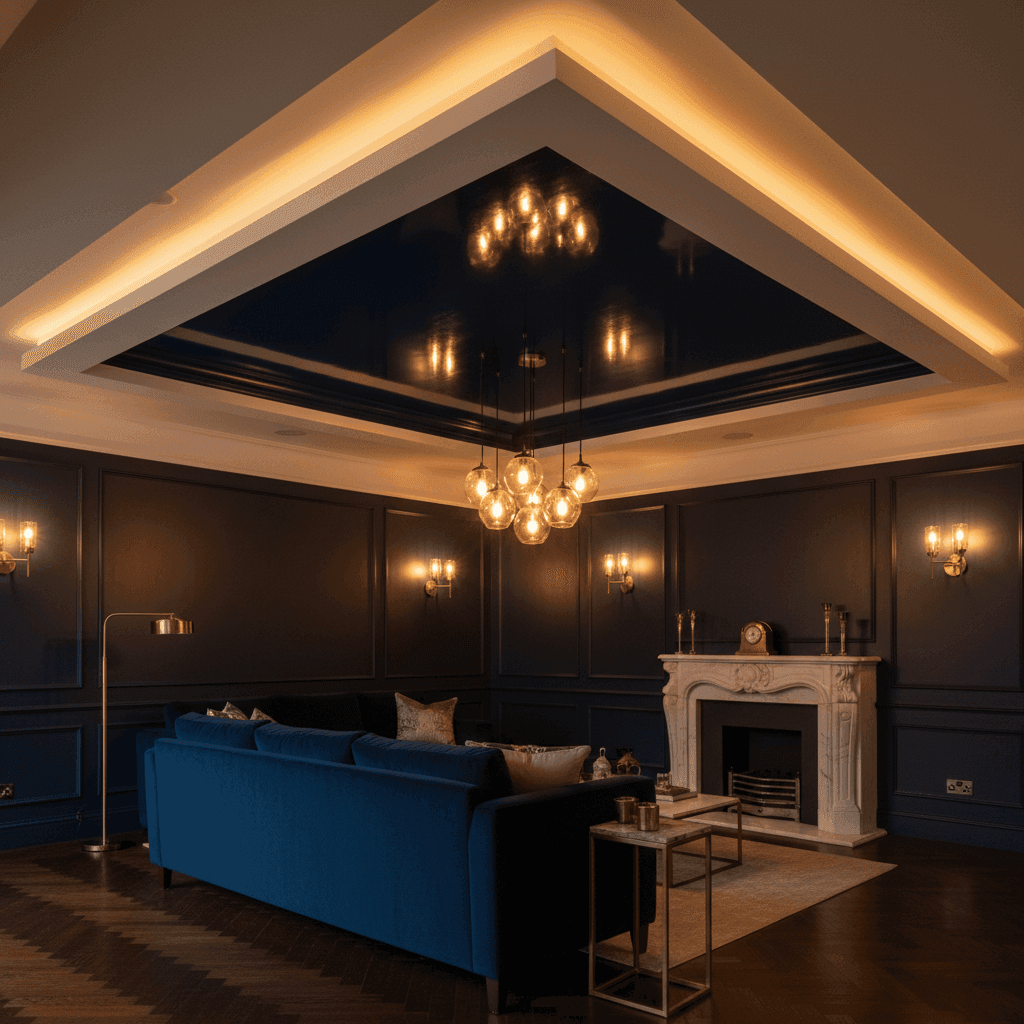
The lacquered tray ceiling in a deep colour is the ceiling treatment that most divides opinion — it requires a specific conviction that darkness applied overhead, correctly, creates luxury rather than weight — and it is precisely this specificity that makes it so effective when executed well. The mechanism is the gloss finish: a flat dark ceiling, however richly coloured, absorbs all the light that reaches it and reads as a hole in the room’s atmosphere. A lacquered dark ceiling reflects that light back, transformed: pendant light becomes a golden constellation on the lacquered surface; candlelight becomes multiple dancing points of warmth; wall sconces create pools of reflection that make the ceiling appear to recede and shimmer simultaneously. The lacquer turns darkness into depth, and depth into luxury.
The specific paint system required for a genuinely successful lacquered ceiling is critical and cannot be improvised. A standard high-gloss paint applied to a ceiling will reveal every imperfection in the plaster — every tool mark, every joint, every slight unevenness — because gloss sheen is directional and highlights surface variation in exactly the way that matte finishes absorb and hide it. The ceiling must be skimmed to an absolutely flat, perfect surface — a process that may require multiple skim coats and very fine sanding — before the lacquer is applied. Professional spray application rather than roller application produces the specific depth and evenness of finish that makes lacquered surfaces genuinely beautiful; roller-applied gloss, however carefully executed, will show texture and lap marks in raking light that undermine the effect entirely. The preparation and application quality is the cost of this design; the visual result is its reward.
11. The Integrated Skylight False Ceiling — The Design That Brings Light Down From Above
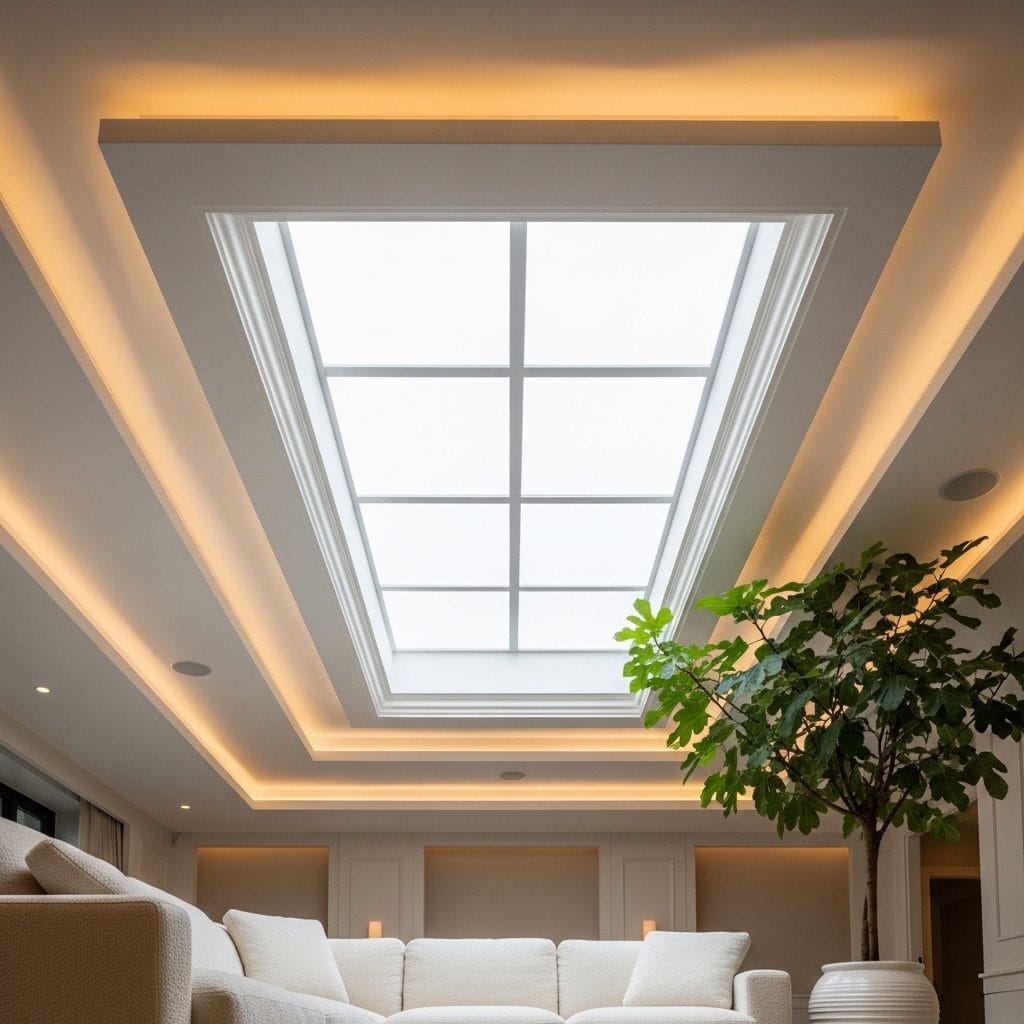
The integrated skylight false ceiling is the design that addresses the specific problem that afflicts many urban and suburban living rooms: the shortage of natural light from the sides, in rooms where the windows are limited by neighbouring buildings, narrow plots, or unfavourable orientation. A skylight, real or simulated with LED backlighting behind translucent glazed panels, brings light from the most reliable direction — directly above — and the false ceiling that frames it converts this structural intervention into a considered design feature. The perimeter drop that frames the skylight is not decorative trim but functional architecture: it creates a visual threshold between the lit zone and the ambient space, preventing the skylight from reading as a simple hole in the ceiling and instead framing it as a deliberate event.
The specific decision between a real skylight and a simulated one — LED panels behind back-lit glazing or stretched fabric — involves trade-offs that are worth understanding clearly. A real skylight brings genuine daylight, which varies in quality and direction across the day in ways that animated and alive artificial light simply cannot replicate; it also requires structural intervention, weatherproofing, and ongoing maintenance. A simulated skylight brings consistent, controllable light at any hour of the day or night, can be tuned for colour temperature, and involves no structural work beyond the false ceiling itself. In basement or interior rooms, the simulated version is the only option; in top-floor rooms, the real version repays its greater investment with a quality of light that remains superior to any artificial approximation, however sophisticated.
12. The Plank-Effect Timber False Ceiling — The Design That Turns the Ceiling Into a Floor You Look Up At
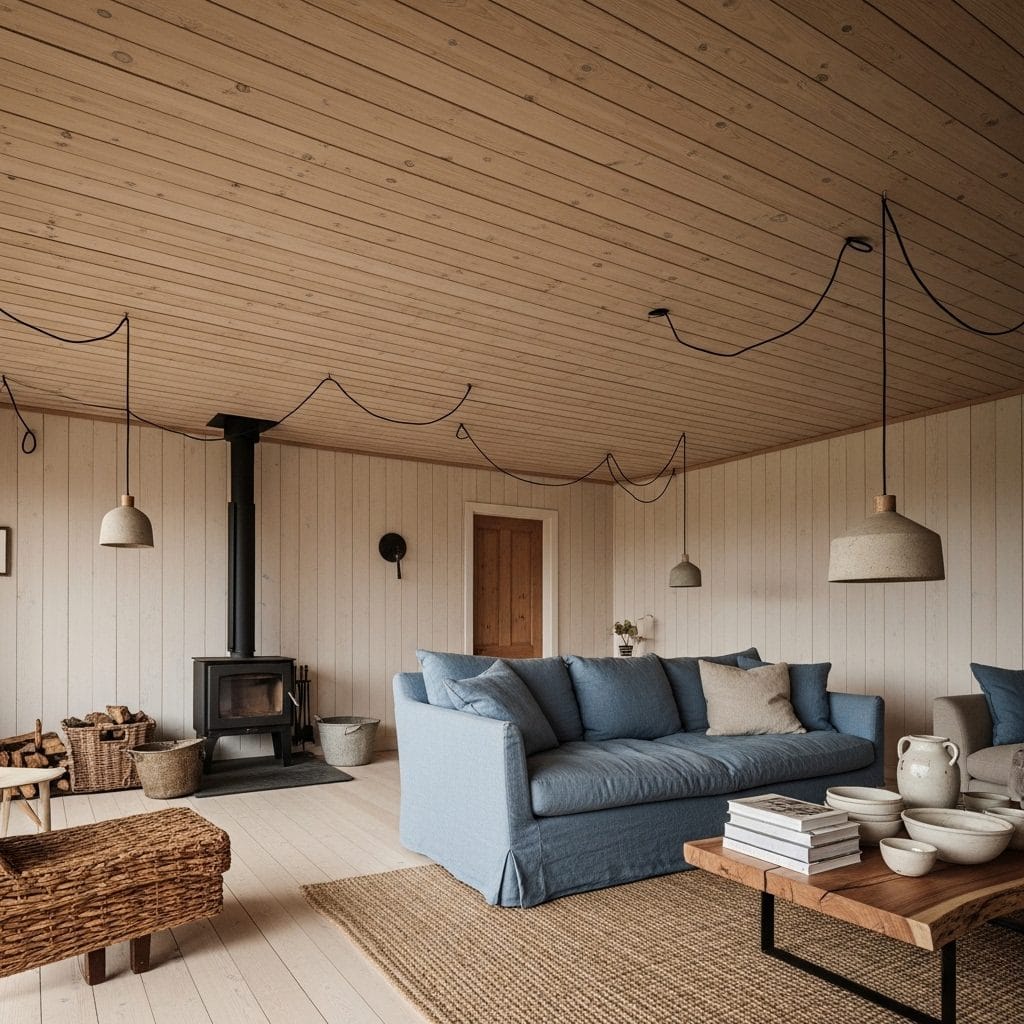
The plank-effect timber false ceiling is the ceiling design that most directly evokes the specific vernacular architecture of Scandinavian and North American timber buildings — where the ceiling is simply the underside of the floor above, expressed in its most honest and direct material form. In a contemporary living room, this honesty of expression is the quality that makes it so affecting: a plank ceiling doesn’t announce design intent so much as it announces material conviction, a willingness to let wood do its work without apology or qualification. The grain, the knots, the slight variation between boards — all of this is the point rather than something to be managed, and the ceiling rewards the room with a warmth that painted or plastered surfaces simply cannot achieve.
The specific technical decision in a plank ceiling is the direction of the planks relative to the room’s longer dimension. Running the planks parallel to the room’s length — along the longer axis — emphasises depth and draws the eye toward the end wall, making the room feel longer and more directional. Running them across the shorter dimension creates a sense of compression and coziness, making the room feel broader and more contained. Neither direction is inherently superior; the choice depends on whether the room’s primary quality to be enhanced is its depth or its width. In a room that already feels long and narrow, cross-direction planks will make it feel broader; in a room that needs to be drawn inward and made cozier, longitudinal planks will emphasise the journey from one end to the other.
13. The Floating Panel Ceiling With Hidden Lighting — The Design That Architectural Magazines Reach For
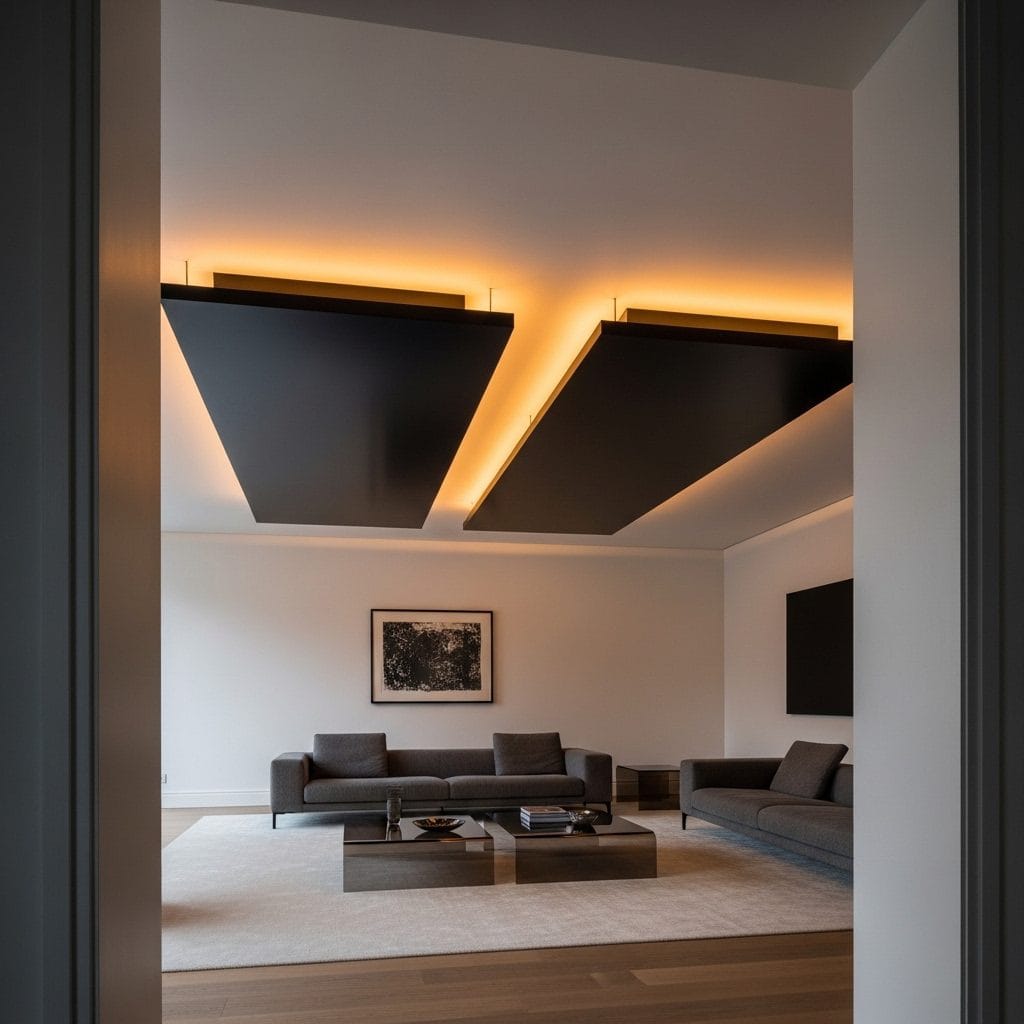
The floating panel ceiling is the ceiling design that most fully belongs to the contemporary architectural moment — appearing in the living rooms, hotel lobbies, and gallery spaces that define 2026’s most considered interiors — and its specific power is that it treats the ceiling as sculpture rather than as surface. By suspending large panels below the original ceiling plane and lighting the gap between them with concealed warm LEDs, it creates a ceiling that has genuine three-dimensional depth, that plays with mass and lightness simultaneously — the panel is visually heavy but physically floating — and that makes the room’s lighting appear to originate from the ceiling itself rather than from identifiable fixtures. This is the ceiling design that reads as effortless while actually requiring the most precise engineering and installation of any treatment on this list.
The specific material for the floating panels determines the entire character of the design. Matte black panels create drama and authority, making the ceiling the boldest element in an otherwise restrained room. Warm timber panels — solid oak or walnut, bookmatched for symmetry — create the same floating effect with organic warmth. Back-painted glass in a deep colour creates a reflective surface that picks up and amplifies the LED lighting concealed at its edges, producing a ceiling that literally glows. Concrete-effect panels in fibreglass or architectural precast deliver the raw material quality of exposed structure with the lightness required for suspension. The panel material should be chosen not in isolation but in direct relationship to the surfaces below it — a warm timber panel over a stone floor, a black panel over pale furniture — so that the ceiling becomes the element that resolves the room’s material palette rather than competing with it.
14. The Plaster Medallion and Cornice Ceiling — The Design That Restores Architectural Character
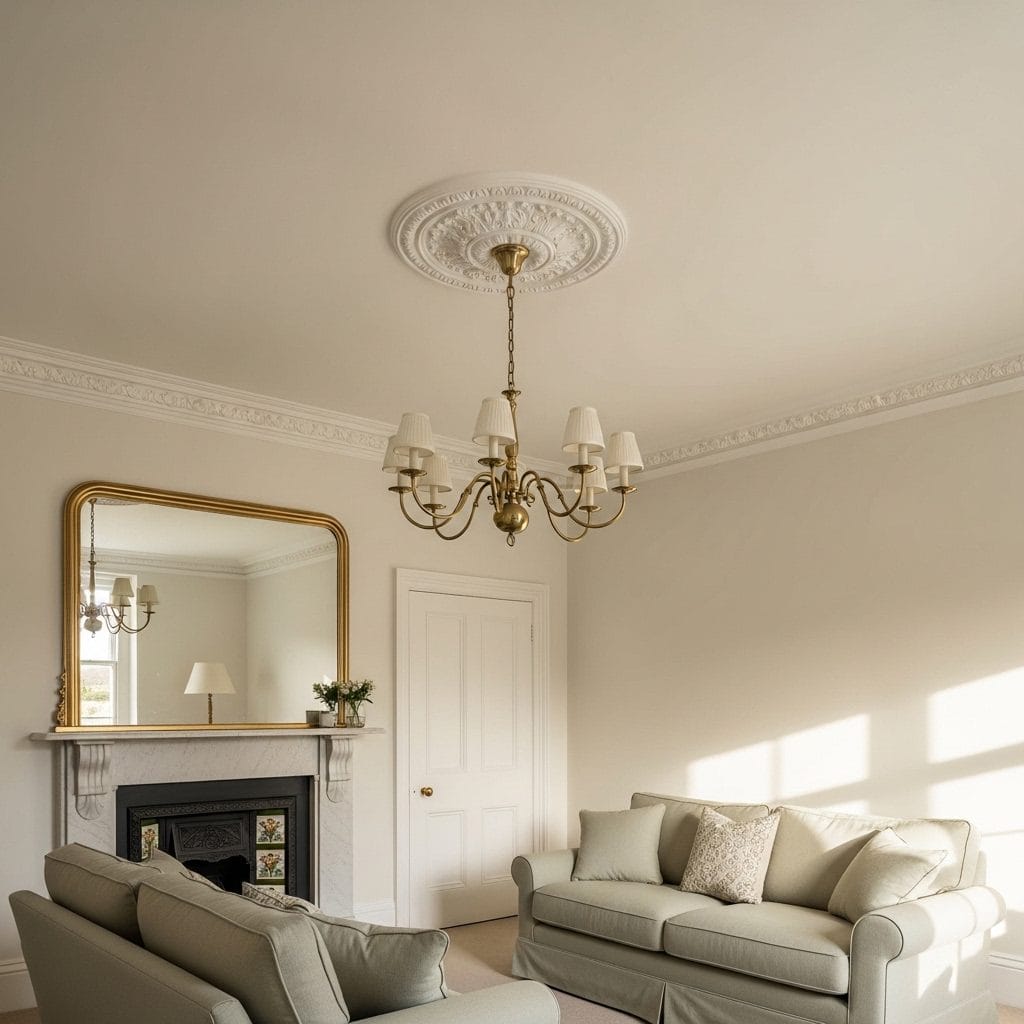
The plaster medallion and cornice ceiling is not, strictly, a false ceiling — but it is, in many older homes and period apartments, a false ceiling restoration: the recreation of plasterwork that has been lost, damaged, covered, or painted over in decades of insensitive renovation. Its inclusion here is specifically because restoring or installing period plasterwork constitutes a ceiling design decision of the greatest consequence, one that can transform a living room from a pleasant contemporary space into a room with genuine architectural character. The cornice is the element that defines the transition between wall and ceiling — it is the frame within which the ceiling exists — and its absence in a period room is precisely as noticeable as the absence of a frame around a painting.
The specific quality consideration in period plasterwork, whether original or reproduction, is the crispness of the profile relative to the softness of the paint treatment. Very sharp, crisp plaster profiles — particularly egg-and-dart, dentil, or acanthus-leaf cornices — should be painted in a finish that is neither fully flat (which makes them read as dusty) nor overly glossy (which makes them look synthetic). A soft eggshell — two to five percent sheen — in a warm white with cream undertone reads the profiles correctly, catching light on their projecting faces and casting real shadow in their recesses. The common mistake of painting cornice and ceiling the same pure white in the same finish flattens the profiles into near-invisibility; toning the cornice very slightly darker than the ceiling — even one shade — is enough to make it read as a genuinely three-dimensional element rather than a white stripe at the room’s perimeter.
15. The Curved Soffit False Ceiling — The Design That Introduces Architecture Where There Was Only Geometry
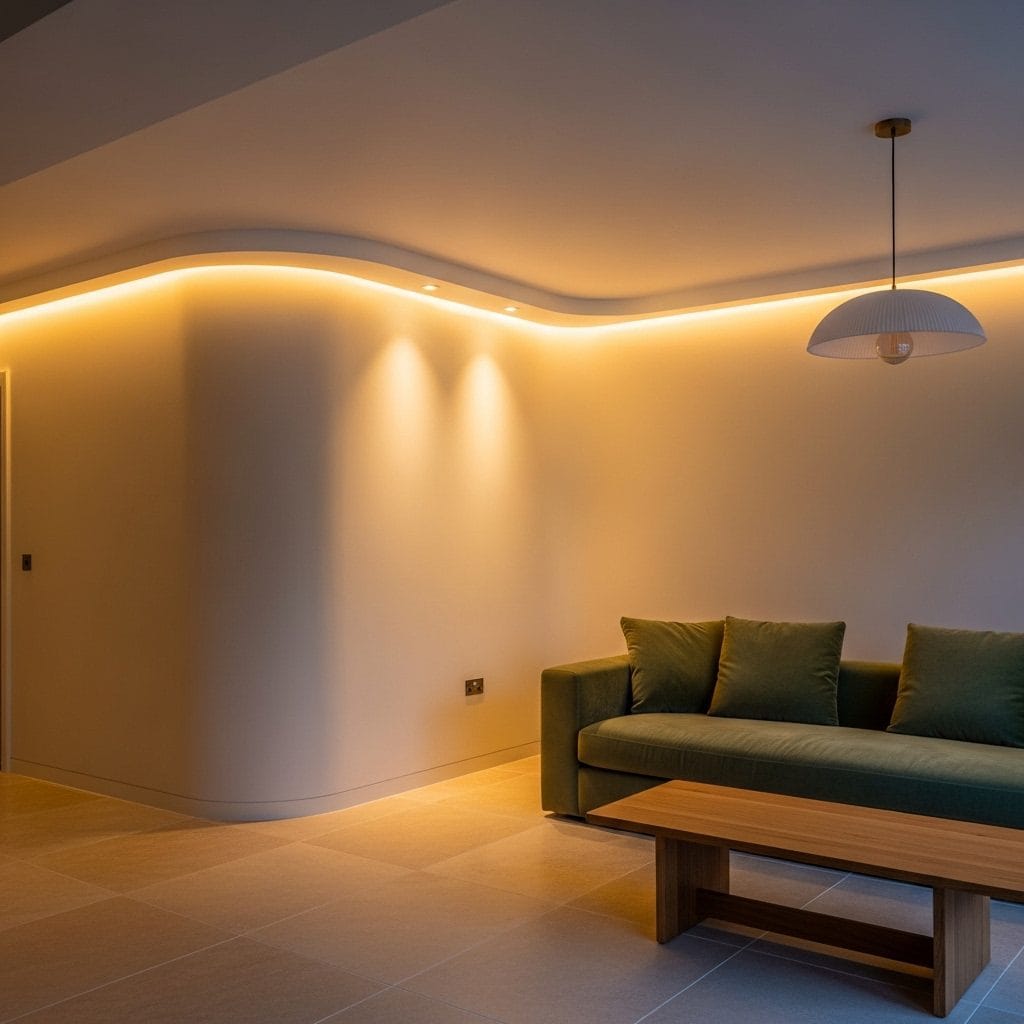
The curved soffit false ceiling is the design that introduces the architectural vocabulary of organic form into a room otherwise defined by right angles — and the specific quality of this intervention is its effect on the room’s atmosphere rather than just its appearance. Right-angle transitions between ceiling and wall have a particular visual hardness: the eye reads them as boundaries, as the edge where one surface ends and another begins. A curved soffit, by contrast, turns the transition into a continuation: the ceiling flows down toward the wall, the wall rises up toward the ceiling, and the two surfaces read as parts of the same continuous form. In a room where this curve is additionally lit — warm LED strip concealed at the curve’s apex washing both the ceiling above and the wall below — the effect is of a room that breathes, that has been shaped by hand rather than assembled from flat planes.
The specific structural consideration in a curved soffit is the minimum radius required to read as genuinely curved rather than merely angled. Very tight curves — less than ten inches of radius — read as chamfers rather than curves, losing the specific flowing quality that is the design’s entire point. Very generous curves — more than thirty inches of radius — can begin to feel womb-like or uncomfortably organic in a room with conventional furniture. The register that works for most living rooms is a curve of fourteen to twenty-two inches radius, which is large enough to read as genuinely architectural at normal viewing distances while remaining in scale with standard ceiling heights. The curve must be executed in wet plaster or fibreglass-reinforced plaster rather than in plasterboard, which cannot form a genuinely smooth curve without visible faceting between board sections — the difference between the two is immediately apparent and permanently consequential.